Apple CEO Tim Cook's 15-Year Consistent Storytelling: “Enriching Lives”
IT DAILY ·
✦ AI Summary
Tim Cook took over as CEO in 2011 as Steve Jobs' successor and led Apple for about 15 years.
Under his leadership, Apple became the first publicly listed company to surpass a market capitalization of USD 1 trillion and established itself as one of the world's most influential brands.
Even in his final WWDC keynote, Cook emphasized that Apple's goal is to make the world's best products that enrich people's lives, and that principle continued to guide the company as a whole.
Apple CEO Tim Cook is stepping down, bringing his roughly 15-year run leading Apple to a close. He became CEO in 2011 as Steve Jobs' successor.
At the time, some in the market predicted that Apple's heyday was over, but Apple has since grown under Tim Cook's leadership. Apple became the first publicly listed company to surpass a market capitalization of USD 1 trillion and established itself as one of the world's most influential brands.
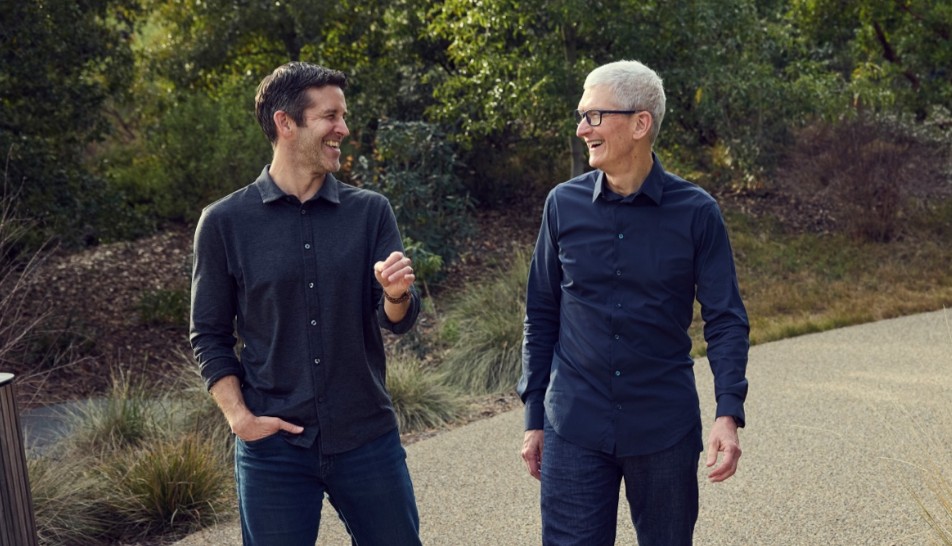
Forbes said Tim Cook's success cannot be explained by market capitalization and revenue figures alone. Forbes viewed Steve Jobs as a business storyteller who defined an era and Tim Cook as the most consistent storyteller in Apple's history. The core of Tim Cook's consistent message was presented as being customer-centric. The photo was described as showing Tim Cook talking with John Ternus.
Tim Cook also delivered a consistent management message in his final WWDC keynote. Apple's executives introduced new services, software, and Siri's AI features, and Cook emphasized the unchanging goal in his closing remarks at the keynote on day one. The essence of his remarks was that Apple exists to make the world's best products that enrich people's lives.
That goal at Apple has continued for 15 years. The phrase "enriching lives" is known to have begun being used inside Apple around March 1998.
Cook's title at the time was Senior Vice President of Worldwide Operations, and he joined Apple around March 1998. Around that time, Steve Jobs and Ron Johnson were preparing to open the first Apple Store.
At the time, Ron Johnson was in charge of Apple's retail operations, and the thrust of his interview comments was that the purpose of the Apple Store was to enrich people's lives. The expression went on to serve as the purpose not only for products but also for the retail strategy.
The expression later became established as Tim Cook's management philosophy. After becoming CEO, Tim Cook gave an interview to the Los Angeles Times, where he explained Apple's philosophy and his own decision-making criteria. He said Apple's way of thinking is simple: focus on making the world's best products and on enriching people's lives.
Many companies present mission statements only for them to later degrade into formulaic slogans. Apple, however, used the phrase "enriching people's lives" as a standard for product development, as well as for entering new businesses and making management decisions, during Tim Cook's tenure.
This philosophical foundation became the background for the creation of Apple's ecosystem with its deeply loyal customer base. Its expansion into health care was also presented not as a change in direction but as an extension of its existing goal.
As Apple expanded its business areas, it continued repeating a similar message. In 2019, some investors and analysts viewed Apple as a hardware company with limited room for growth, but Tim Cook has proved that those evaluations, analyses, and perceptions were biased and shortsighted. The direction Cook has set for Apple is focused on health care for people, including Apple customers in a narrow sense and potential customers in a broader sense.
Cook and Apple have explained that entering the health and wellness field was not a pivot from the existing business strategy but an expansion of Apple's fundamental purpose. In an interview with CNBC's Jim Cramer, Cook said, in discussing Apple's expansion into health care centered on Apple Watch, that Apple's greatest contribution to humanity in the future would likely be its health-related achievements, and he added that the consistent purpose of Apple's business is to enrich people's lives.
Notable is the way Apple has explained the meaning of business expansion around its existing core goal rather than establishing a separate management logic each time a new product or service appears. This aligns with the view that Cook's leadership has gone beyond product-centered management to build a consistent corporate story. It also points to the need to continue telling a coherent story about why the organization exists.
In this process, the "unchanging goal toward people's lives" has functioned as a decision-making standard across the organization, from product development to talent recruitment. Cook has consistently upheld the same core goal. He has said that Apple should concentrate its capabilities on making the world's best products that enrich people's lives, and that business results are possible when it maintains that focus and makes decisions based on it.
Cook's consistency in goals is seen as having contributed to building trust between the organization and its stakeholders. The goal was maintained even amid management crises such as patent lawsuits, temporary growth slowdowns, legal disputes with regulators, supply-chain problems, and global environmental changes.
Cook also sent the message to the next management team that this principle should be used as a decision-making criterion. His successor CEO, John Ternus, will take over Cook's position next month. Cook urged John Ternus to always keep the organization's unchanging goal in mind.
During his 15 years as Apple CEO, Tim Cook set out the conditions for the sustainability of a corporate story, defining it not as a mere promotional phrase but as a philosophy that keeps an organization moving. He saw the key to sustainability as a philosophy that stays in the heart, and believed that such a philosophy must remain after a leader is absent or replaced, continue to exist as a story, and influence organizational decisions while leaving an imprint on employees, customers, and investors.
Source: IT DAILY · Jo Min-su
Original: https://www.itdaily.kr/news/articleView.html?idxno=241273
References
This article was produced with the help of an automated content generation algorithm.
Source: IT DAILY
View originalThis article was summarized and organized by BizCrush based on the original article from IT DAILY. For exact quotations and full details, please refer to the original article.