“I Want to Call It ‘AI-PMO’”
IT DAILY ·
✦ AI Summary
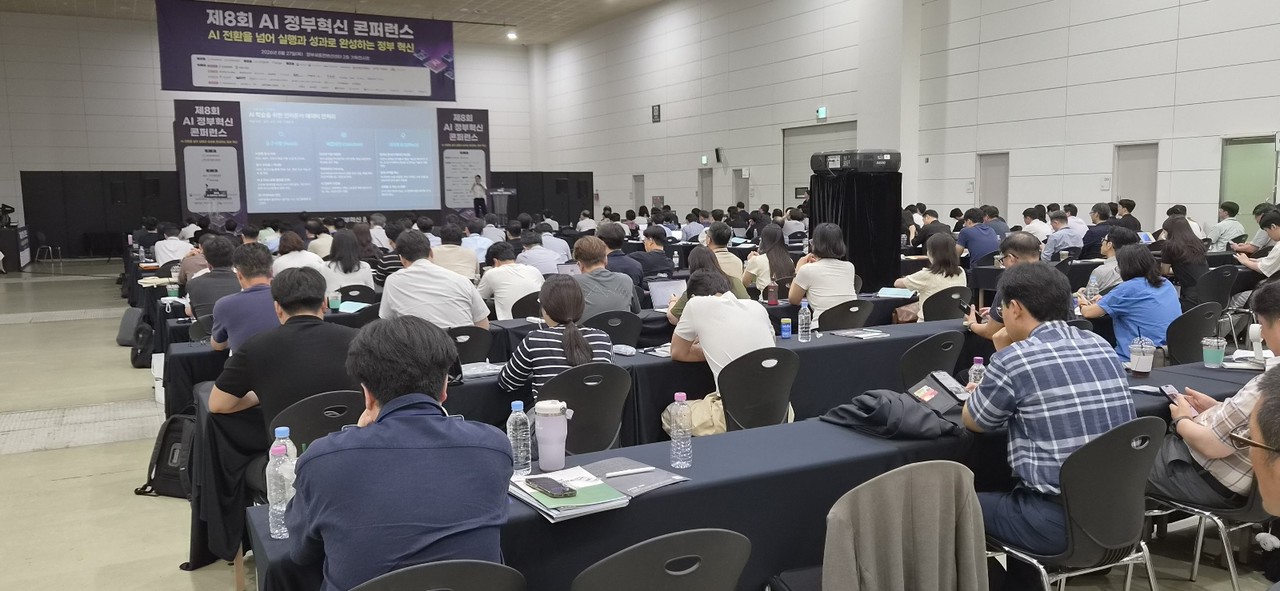
The Korea PMO Association held the 8th Digital AI Government Innovation Conference at the Government Sejong Convention Center on the 27th.
The event was organized around 3 areas: Ax (AI transformation), Agentic AI, and sovereign AI semiconductors, and was conducted in a case-study format.
The Ministry of the Interior and Safety presented a transition to an 'AI democratic government' and a direction for integrated AI services through a single window starting in 2027.
Shin Yong-tae, president of the Korea PMO Association, held the 8th Digital AI Government Innovation Conference at the Government Sejong Convention Center on the 27th. The event’s theme was government innovation completed through execution and results, beyond AI transformation.
The Korea PMO Association said the stage of government innovation is progressing from adoption to execution and result creation. The conference was organized in line with that trend.
The conference was divided into 3 areas: Ax (AI transformation), Agentic AI, and sovereign AI semiconductors. It was conducted in a case-study format.
The event linked technology advancement, including generative AI, data integration, cloud native systems, and ultra-large AI-based administrative services, with concrete results such as greater efficiency, transparency, and improved citizen-facing services required in the public sector. Photo caption: Conference venue, photo by Kim Yong-seok.
It was presented that practical challenges continue to exist in the process of advancing AI government, including budget constraints, security and regulatory issues, changes in organizational culture, limits to interagency cooperation, and securing AI ethics and accountability. Accordingly, the importance of execution methods and result creation, rather than the technology introduction itself, was emphasized.
The 8th Digital AI Government Innovation Conference focused on presenting solutions suited to addressing these concerns. Exhibition booths at the venue demonstrated solutions from companies related to AI, data, cloud, security, and GovTech, and the number of participating companies rose by 6 from 28 last year to 34.
The event began with opening remarks by Shin Yong-tae, president of the Korea PMO Association, followed by welcoming remarks from Sohn Kyung-ja, president of the Public Procurement Association, and Baek Il-kwon, director of the AI-Based Administration Bureau at the Ministry of the Interior and Safety's AI Government Division. Sohn is serving as director of information and digitization at the Ministry of Agriculture, Food and Rural Affairs.
Shin said that as a result of Korea's digital government achievements, Korea ranked No. 1 overall in the OECD Digital Government Review in 2023 and recorded No. 1 overall for 2 consecutive times in the OECD review. He also said Korea ranked No. 4 worldwide among 193 member states in the 2024 UN e-government survey and placed No. 1 globally in the online services category of the 2024 UN e-government survey. Based on this, he said Korea has grown into a globally recognized leading e-government country.
Shin stressed that these achievements were not the result of the efforts of a single institution or individual. He said the government, public institutions, companies, academia, information technology experts, and Project Managers have all worked together to create these results, and that the related achievements are valuable assets created collectively.
He then introduced 2 key questions under a subheading suggesting that, when it comes to AI, the time for debating whether to adopt it has already passed. The questions Shin posed were how to build a government for the AI era and who will succeed in driving AI government innovation on the ground.
As the answer to the first question, he proposed a government that proactively provides services needed before citizens request them. He also proposed faster and more accurate policy decisions based on data and AI, and suggested a direction in which AI supports repetitive work while public servants focus on more creative and valuable tasks.
In his opening remarks and greetings, Shin Yong-tae presented PMO-centric thinking as the answer to the second question. While noting that PMOs in the e-government era were responsible for schedule, budget, quality, and risk management, as well as supporting the success of large-scale information projects, he explained that such management-centered functions are insufficient in the AI era. He then defined the role of the PMO in the AI era as understanding AI technology, connecting policy and technology, connecting data and services, connecting the public and private sectors, bringing together diverse stakeholders, and driving a single innovation goal.
He went on to say that the status of the future PMO must go beyond a simple Project Manager, and defined the future PMO's role as a Transformation Orchestrator. He also presented AI innovation design, coordination, and execution as the functions of the future PMO, saying that the future PMO must be the conductor of change. He said he would call this "AI-PMO," and expressed hope that "AI-PMO" would become the starting point for connecting AI from technology to value, connecting ideas to projects, and connecting projects to citizen-facing innovation.
Sohn Kyung-ja said AI is now becoming part of everyday life, with chatbot-based civil complaint handling, AI organizing vast administrative data, and cloud-based creation of new public services already taking shape. She said the stage of reviewing whether to introduce AI is over, and that the task now is to create results that citizens can feel through the use of AI.
Baek Il-kwon said AI is not merely changing work methods but fundamentally reshaping the overall paradigm of industry and society. In response, the Ministry of the Interior and Safety is promoting a transition to an 'AI democratic government,' and the purpose of the 'AI democratic government' is to enhance citizens' rights and realize democratic values.
He laid out 3 action plans for this effort. First, he said the ministry will build a government-wide common AI foundation, create a secure environment for central and local governments, and support the use of the latest private-sector AI technologies across work operations. Second, he said the ministry will open public data (Top 100) and strengthen AI capabilities in parallel, push key projects for public service innovation, and speed up key projects to improve government efficiency.
Third, he said the ministry will secure a stable operational base for information resources and advance infrastructure. In addition, he outlined a direction, in line with a news subheadline, to provide integrated AI services through a single window starting in 2027.
Baek said the ministry plans to establish an AI-facing consultation system in 5 priority areas: welfare, taxes, safety, agriculture, and food and drug services, and to provide 24-hour uninterrupted consultation services. He also said the government plans to link Government24, the National Secretary, and Benefit Alert to provide integrated, personalized AI services through a single window starting in 2027. He added that it will promote standardization and modularization of public services and aims to make use of private platforms such as Kakao and Naver and 'Everyone's AI.'
The Digital AI Government Innovation Conference featured presentations in major company sessions and operation of exhibition booths. Participants generally said the conference offered an opportunity to review new solutions incorporating AI technology and to verify actual performance. The Korea PMO Association holds the conference every year, and the opportunity to inspect solutions and verify performance was cited as the reason this annual event draws attention.
Along with the conference, the Korea PMO Association honored contributors to PMO projects over the past year. The association selected 3 winners for this year's awards.
The winners were Kim In-hyun of Toi Consulting, who received the Minister of the Interior and Safety Award; Yoo Jae-ryeon, executive vice president of Korea Information Technology, who received the Best PMO Award; and Park Hwal, team leader at the Korea Securities Depository, who received the Best Project Management PM Award. The people in the photo are Baek Il-kwon, director at the Ministry of the Interior and Safety; Kim In-hyun, CEO of Toi Consulting; Yoo Jae-ryeon, executive vice president of Korea Information Technology; Park Hwal, team leader at the Korea Securities Depository; and Shin Yong-tae, president of the Korea PMO Association.
Kim In-hyun, who received the Minister of the Interior and Safety Award, has continued working in the related field since founding Toi Consulting in 1996. Over about 30 years, Toi Consulting grew and developed into a Korean IT consulting company focused on IT consulting business and received top-level evaluations.
Kim led the domestic introduction of electronic government project management (PMO). He also led the establishment of the electronic government project management (PMO) system and the training of specialized personnel, contributing to improved quality in informatization projects.
Kim served as president of the Korea PMO Association from 2017 to 2025. During this period, he contributed to laying the foundation for the association's development.
In addition, Kim contributed to the spread of the electronic government project management outsourcing (PMO) system. Based on these contributions, the Korea PMO Association selected Kim as a recipient of the Minister of the Interior and Safety Award.
CEO Kim In-hyun said in his acceptance remarks that he wanted to emphasize the importance of project management. He said he felt honored and proud to be recognized for his activities by the association he had worked with alongside people he respects. He then said that we have entered an era of change, and that both the scope and speed of change are increasing.
Kim said organizations' attempts to respond to change take the form of projects. He also said project management cannot be limited to the success of individual projects that meet schedule and budget targets, and that change must be executed through projects. He stressed that pursuing organizational vision through these changes is the true value of project management.
Executive Vice President Yoo Jae-ryeon carried out PMO services for building the National e-Procurement System (KONEPS), handling PMO work across the planning, execution, and post-management stages. He developed project integration management measures such as communication management and decision-making support, and thoroughly carried out performance management, including setting business goals and detailed performance indicators. These efforts earned Yoo high marks.
In his acceptance remarks, Yoo said the biggest difficulty in PMO projects was the gap between the implementing company and the sponsoring institution, rather than the project itself. He explained that there was also a significant disconnect between the project promotion team and the department actually operating the work, and said he carried out the PMO role by deriving mutually necessary and sufficient conditions and presenting valid opinions.
Park Hwal, team leader at the Korea Securities Depository, worked on the next-generation system build project from April last year to August this year. The project was reportedly carried out in 2 phases to minimize development risks and verify new technologies in advance. In Phase 1, to secure business independence for the core systems, foreign currency securities and securities agency services were separated from the existing system to enhance operational independence, and a digital work environment was created through improvements to the management support system to maximize business support and efficiency. The project was highly rated because Park led the successful establishment of an innovative financial platform for the core systems (foreign currency securities and securities agency services) and successfully completed a digital management innovation project.
Park said the project drew strong attention from employees because it was a large-scale next-generation IT project for the first time in 14 years since 2011. He added that during the 16-month project period, the client, the vendor, the PMO, and the IT supervision team each carried out their own roles and responsibilities, and that dedication, consideration, and sacrifice led to a successful launch. He also said the Phase 2 project, which begins next year, will require a large budget and a long period of time, but that if everyone pulls together, Phase 2 can also succeed.
Source: IT DAILY · Kim Yong-seok
Original: https://www.itdaily.kr/news/articleView.html?idxno=241260
References
This article was produced with the help of an automated content generation algorithm.
Source: IT DAILY
View originalThis article was summarized and organized by BizCrush based on the original article from IT DAILY. For exact quotations and full details, please refer to the original article.