Government, Mobile Carriers Launch Public-Private Forum to Spur Network Investment
IT DAILY ·
✦ AI Summary
The Ministry of Science and ICT, together with SK Telecom, KT, and LG Uplus, has launched the "Public-Private Consultative Body for Promoting Network Investment in the AI Era." The body consists of the government and the three mobile carriers, and it discusses investment in next-generation networks, regulatory improvements, and tax improvements. At the meeting, participants reviewed network investment measures, regulatory rationalization, and the status of efforts to commercialize 5G standalone mode (SA).
The Ministry of Science and ICT, together with SK Telecom, KT, and LG Uplus, has launched the "Public-Private Consultative Body for Promoting Network Investment in the AI Era." The body consists of the government and the three mobile carriers, and its purpose is to improve investment in next-generation networks, regulations, and taxes.
The Ministry of Science and ICT held the inaugural meeting on the 27th. The forum is a follow-up measure set up after a meeting in July between the ministry's deputy prime minister and the CEOs of the three mobile carriers.
At the meeting, participants discussed measures to invest in next-generation networks, ways to rationalize regulations on network investment, and the status of efforts to commercialize 5G standalone mode (SA).
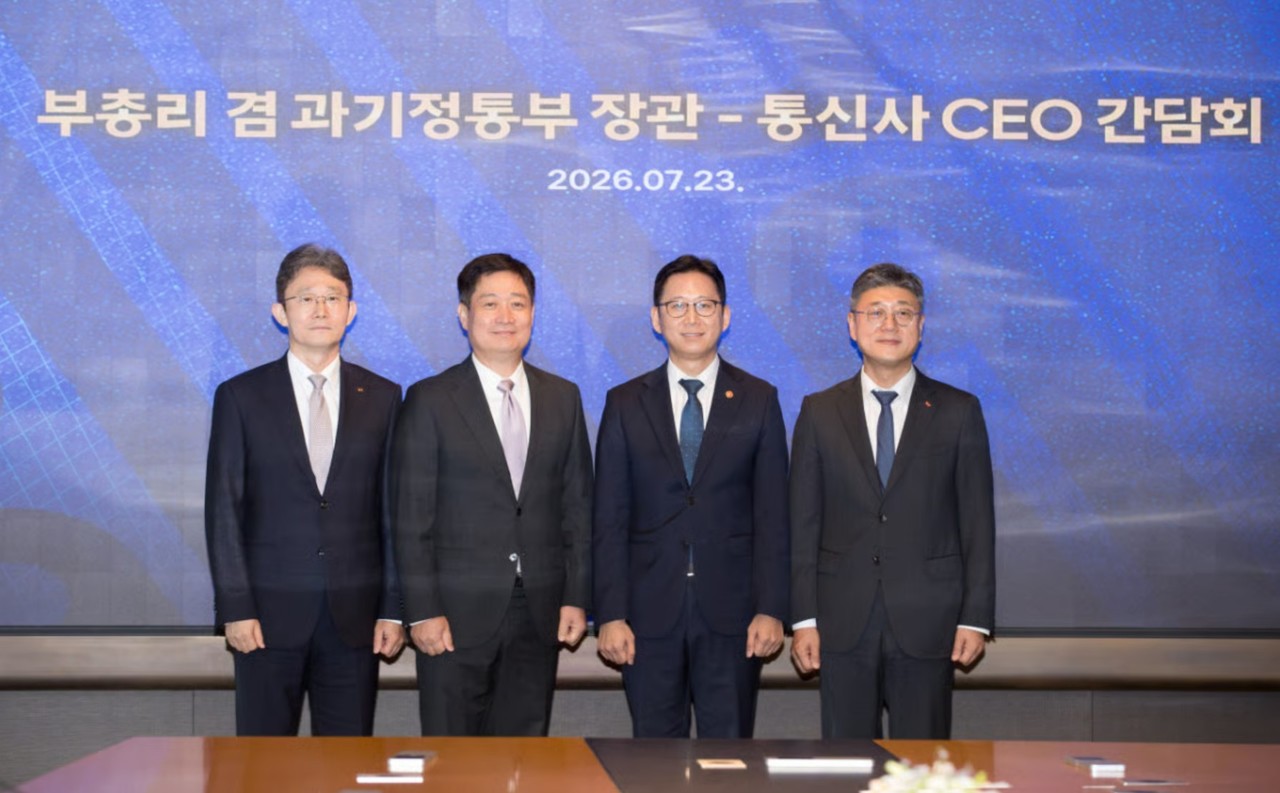
A photo provided by the Ministry of Science and ICT shows a commemorative group shot from the July 23 meeting between the deputy prime minister and telecom CEOs, featuring KT CEO Park Yun-young, LG Uplus CEO Hong Bum-sik, Deputy Prime Minister and Minister of Science and ICT Bae Kyung-hoon, and SK Telecom CEO Chung Jae-heon.
After the initial period of heavy 5G investment by the three mobile carriers ended, telecom CAPEX has been on a downward trend. CAPEX fell from KRW 9,000,060,000,000 in 2019 to KRW 6,000,002,000,000 in 2025, and the three carriers shared this situation with the Ministry of Science and ICT.
Afterward, the three carriers and the ministry discussed ways to stimulate investment through the advancement of wired and wireless networks and the construction of next-generation networks. They also addressed the growing need to respond to network upgrades as data traffic increases with the spread of AI services.
During the discussions, participants exchanged views on the introduction of next-generation technologies such as AI-based radio access networks (AI-RAN) and 6G, and also discussed related investment directions. They also discussed policy support measures to revitalize network investment. Until now, the three carriers have held two meetings with Deputy Prime Minister Bae Kyung-hoon and have proposed institutional improvements to expand network investment.
On the day, discussions also included rationalizing regulations for network innovation, government budget projects and tax support measures, and the gradual transition of 3G networks. Based on these discussions, the government plans to announce a comprehensive policy package on next-generation network investment and regulatory improvements within this year.
At the meeting, participants reviewed progress in promoting the commercialization of 5G SA, which is scheduled for the end of this year.
The three carriers are expanding their 5G core networks to build a stable 5G environment, and they are also conducting device interoperability testing.
In line with the commercialization of 5G SA, each company has proposed different use cases as well as new services. SK Telecom plans to provide tailored services for specific regions and user groups.
KT applied network slicing technology to a World Cup street cheering event. Network slicing is a technology that divides a telecom network into multiple independent virtual networks for different service purposes and uses them accordingly.
LG Uplus is pushing ahead with new services by applying physical AI to areas such as live event broadcasting, delivery, and patrol operations.
In addition, the three carriers are supporting the "emergency rescue priority transmission service," which gives priority to calls between firefighters and reporting callers in the event of a disaster.
The Ministry of Science and ICT is moving to supplement its network neutrality guidelines in order to support the spread of services using new technologies such as network slicing in the AI era. To this end, it plans to revise the guidelines by comprehensively considering examples from major countries, focusing on priority transmission standards such as emergency rescue communications and criteria for applying special services. The ministry plans to release a draft revision in the fourth quarter of this year and incorporate the opinions it receives.
Separately, the ministry plans to reflect the characteristics of 5G SA in its telecom quality assessment methods. The measurement and announcement items will include upload speed, transmission latency, network slicing quality, and user-perceived quality (QoE), and the evaluation method will comprehensively reflect these items.
Source: IT DAILY · Seong Won-young
Original: https://www.itdaily.kr/news/articleView.html?idxno=241249
References
This article was produced with the help of an automated content generation algorithm.
Source: IT DAILY
View originalThis article was summarized and organized by BizCrush based on the original article from IT DAILY. For exact quotations and full details, please refer to the original article.