LG Electronics to Recover Rare-Earth Permanent Magnets From E-Waste, Targeting 1.6 Tons a Year
IT DAILY ·
✦ AI Summary
LG Electronics signed an MOU on the 27th with the Ministry of Climate, Energy and Environment and E-Cycle Governance for the "Pilot Project to Recover Discarded Permanent Magnets From Refrigerant Compressors in Discarded Home Appliances."
The project aims to separate rare-earth-containing permanent magnets from compressors in discarded home appliances and recycle them as resources.
LG Electronics is targeting recovery of about 1.6 tons of rare-earth-containing permanent magnets from about 40,000 units a year.
LG Electronics has launched a pilot project to add rare-earth-containing permanent magnets to the list of metal resources it mainly recovers from discarded home appliances. The company has expanded the scope of materials recovered from e-waste beyond iron, copper and aluminum to rare-earth-containing permanent magnets.
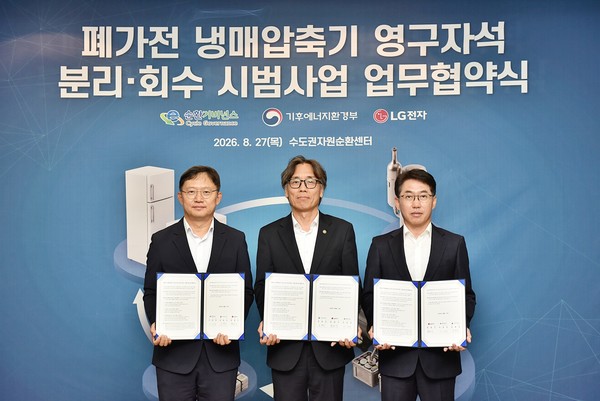
On the 27th, LG Electronics signed an MOU for the "Pilot Project to Recover Discarded Permanent Magnets From Refrigerant Compressors in Discarded Home Appliances" with the Ministry of Climate, Energy and Environment and E-Cycle Governance at the Capital Area Resource Circulation Center in Yongin, Gyeonggi Province. The three parties to the agreement signed the business pact on the 27th.
The core of the project is to separate rare-earth-containing permanent magnets from compressors in discarded home appliances and then recycle them as resources. Compressors are key components that compress and circulate refrigerants in refrigerators, air conditioners and other appliances.
Those pictured at the event, from left, are Lee Sang-jin, chairman of E-Cycle Governance; Geum Han-seung, first vice minister of the Ministry of Climate, Energy and Environment; and Yang Hee-gu, head of the Production Innovation Center at LG Electronics Production Technology Institute. Through this pilot application, LG Electronics has applied technology to separate and recycle rare-earth-containing permanent magnets from compressors in discarded home appliances.
In recycling discarded compressors, metals such as copper have mainly been recovered, while the permanent magnets inside discarded compressors were difficult to separate because of their strong magnetic force. As a result, under existing processing methods, many of the permanent magnets were recycled together with scrap metal.
LG Electronics has developed a demagnetization technology that uses magnetic fields. The method removes the magnetism from permanent magnets and then separates them from compressors. Unlike the conventional method of removing magnetism through high-temperature heat treatment, it does not use heat.
This new technology can reduce energy use and also minimize changes in the physical properties of the magnets. In addition, the separation process uses vision AI-based image analysis technology to recognize the size and shape of discarded compressors and analyze the location of the internal permanent magnets, allowing a suitable separation process to be applied to each product.
Through the pilot project, LG Electronics aims to recover about 1.6 tons of rare-earth-containing permanent magnets annually from about 40,000 discarded home appliances. The recovered permanent magnets are expected to be used in developing technologies to turn them into raw materials for new magnet production.
Rare earths such as neodymium are used in permanent magnets, and demand for permanent magnets is growing as the use of high-efficiency motors in home appliances and electric vehicles increases.
At the same time, the importance of technologies for recovering and recycling materials from end-of-use products is increasing as the production and refining supply chains for rare earths are concentrated in specific countries. Yang Hee-gu, head of the Production Innovation Center at LG Electronics Production Technology Institute, said the company would continue strengthening its resource circulation technology capabilities for recovering and recycling core materials from end-of-use products.
Source: IT DAILY · Kim Byung-joo
Original: https://www.itdaily.kr/news/articleView.html?idxno=241252
References
This article was produced with the help of an automated content generation algorithm.
Source: IT DAILY
View originalThis article was summarized and organized by BizCrush based on the original article from IT DAILY. For exact quotations and full details, please refer to the original article.