AWS Targets Financial Sector’s Shift to Production AI, Citing Trust and Choice as Sources of Value
IT DAILY ·
✦ AI Summary
AWS held the "AWS Financial Services Forum Seoul 2026" on the 27th and shared ways and cases for expanding the use of generative AI and AI agents in the financial sector.
Roh Kyung-hoon, AWS Korea leader, said financial-sector AI is moving from training and simple PoCs to core-business adoption, enterprise-wide scaling, and production transition.
Hyundai Capital introduced its enterprise-wide AI transformation strategy and results, while Anthropic said it plans to officially make Opus 5 and Sonnet 5 available soon in the AWS Amazon Bedrock Seoul Region.
AWS held the "AWS Financial Services Forum Seoul 2026" on the 27th. About 1,000 people from more than 140 financial firms attended the event. AWS shared infrastructure strategies and financial innovation cases for expanding generative AI and AI agents into production-level use for frontline operations and customer-facing services.
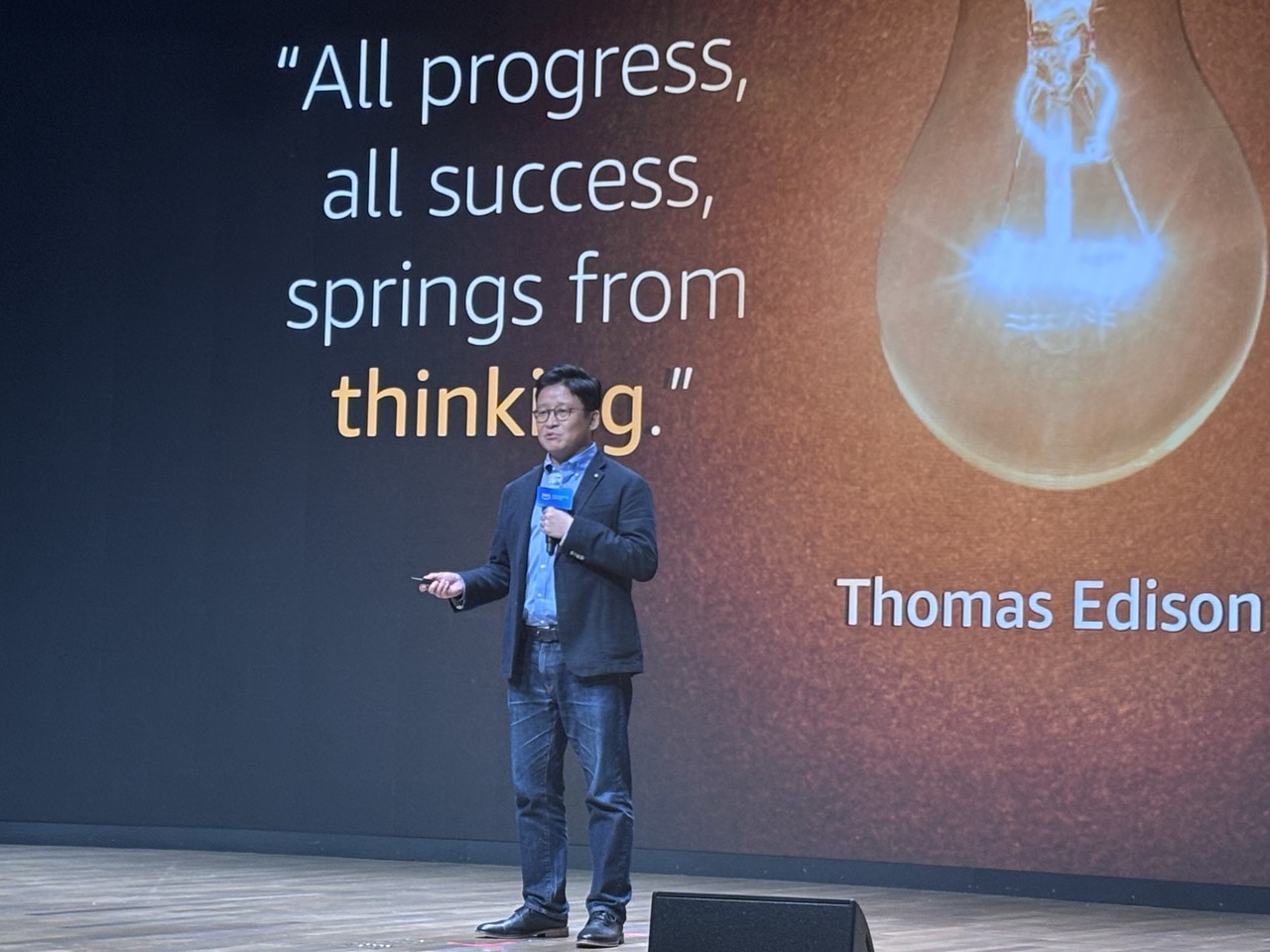
In his presentation, Roh Kyung-hoon, AWS Korea leader for the financial services and public sector, said the financial industry’s AI push over the past 2 to 3 years had centered on training and simple PoCs. He added that the current trend is moving toward introducing AI agents into core businesses, scaling them across the enterprise, and fully transitioning to production.
To match that trend, AWS outlined three pillars for supporting financial institutions’ AI transformation. The first pillar, "Freedom to invent," covers the ability to freely choose foundation models and tools, as well as support for migration.
"Freedom to invent" also includes building an Agent-to-Agent collaboration environment. The second pillar, "AI you can trust," was described as being based on a no-training-use principle, with encryption across all stages and guardrails applied.
The third pillar is "Maximizing value," which includes cost optimization and linkage with business workshops. At the event, AWS introduced ways and examples of expanding financial firms’ use of generative AI and AI agents into production for practical work and customer service.
After the Financial Services Commission announced a one-year network-separation exemption for AI used for security purposes and selected 10 financial firms in the first round, AWS stepped in to support the sector by using Amazon Bedrock and AWS Security Agent in response to the measure.
Through this support, AWS is helping financial institutions meet regulatory requirements while also supporting the building of a safe operating framework at a level that effectively redesigns existing security systems for AI environments.
Roh Kyung-hoon, AWS Korea leader for the financial services and public sector, emphasized that the challenge for the financial industry is to move beyond the AI-curiosity stage and establish strategies for rapid scaling and tangible business results. He also said AWS would support end-to-end business value creation regardless of a financial customer’s environment or stage of adoption.
Choi Ki-young, CEO of Anthropic Korea, appeared as a speaker at the event and explained the AI safety and frontier model roadmap required in enterprise environments. Anthropic is supplying its latest models in the Seoul Region.
Choi then introduced "Claude Security," a security solution linked to GitHub repositories. He used it as an example to explain how it can be applied in enterprise environments.
"Claude Security" provides GitHub repository integration. It also supports rapid scanning of codebase security vulnerabilities and patch linkage.
Choi highlighted its capability to support enterprise-level security through "Claude Security." His presentation went on to introduce how it can be used in corporate environments, with a focus on security functions.
Based on that, Anthropic is focusing on providing the accuracy and consistency essential to the financial sector. It also highlighted interpretability, which explains the basis for responses, and audit-trail functionality as key priorities.
The company also introduced a case in which Allianz deployed Claude to its 150,000 employees worldwide. Allianz is using it to improve work productivity and connect it to the new product development process.
Anthropic said it plans to officially make the latest frontier models, including Opus 5 and Sonnet 5, available soon in the AWS Amazon Bedrock Seoul Region to meet the AI and data sovereignty requirements of the domestic financial sector.
Choi said the company is committed to supporting the safe use of top-tier frontier intelligence, on the premise that domestic financial customers comply with data regulations and compliance requirements. He also said Anthropic plans to continue close cooperation with AWS Korea.
At the event, Kim Woo-young, managing director at Hyundai Capital, took the stage as the final keynote speaker. The photo credit was given to reporter Kwon Young-seok.
Hyundai Capital disclosed its enterprise-wide AI transformation (AX) strategy and success story. The company said it has pursued a phased AI transformation based on an in-house development team of about 50 people.
Hyundai Capital said it has prioritized AI in core decision-making areas rather than simple task automation. The areas first targeted were financial review, marketing, debt collection, and vehicle valuation, all of which were mission-critical.
The company said this effort has demonstrated quantitative results such as transaction volume and maturity rate.
The subheadline is auditable AI. The keywords are choice and ROI. The organization holds an "AI Focus Meeting" every month and maintains strong top-down sponsorship through the meeting with business heads participating. Roh Kyung-hoon, AWS Korea leader, and Choi Ki-young, CEO of Anthropic Korea, explained the related details at a press briefing. The photo credit was given to reporter Kwon Young-seok.
It also held an AWS-partnered "vibe coding hackathon," led by non-developer general employees. Alongside efforts to expand bottom-up AI literacy, all 12 finalist team projects were reflected in next year’s business plan.
Kim Woo-young said enterprise-wide AI transformation is impossible through the efforts of a single department alone. He also said that an all-hands culture and clear priority setting are key. In this way, the organization is pursuing both top-down sponsorship and bottom-up learning expansion.
Kim said the company plans to continue expanding its practical, production-level AI ecosystem based on AWS’s Amazon Bedrock environment and cloud architecture collaboration foundation.
At the press briefing held right after the keynote, participants discussed the structural changes in AI security facing the financial sector and ways to optimize infrastructure costs. Roh Kyung-hoon, AWS Korea leader, and Choi Ki-young, CEO of Anthropic Korea, attended the briefing and shared related topics.
At the briefing, Roh Kyung-hoon emphasized the changing AI security paradigm in the financial sector. He said that while financial security in the past was heavily centered on data protection and blocking, the direction of change is moving away from simple blocking and toward observability and auditability of decision paths. He added that in the AI era, visibility and observability across the entire process are required, including how AI uses data and how it reaches results.
Roh said it is difficult to perfectly meet detailed regulatory requirements set by financial authorities in advance. Accordingly, he explained that agent platforms must be built in a form that can be audited at any time, and that such auditable platforms are intended to provide stability when responding to supervisory agencies’ requests for explanation and to regulatory issues.
As AI infrastructure costs emerged as one of the major concerns for companies, the discussion raised the point that simple comparisons of token prices are not enough. In response, participants argued that what is needed is not unconditional reductions in token prices, but an approach centered on tangible business outcomes and ROI.
Choi said there is no single correct answer when it comes to token costs, and that the key lies in the problem to be solved and the result achieved. He explained that using low-cost lightweight models often leads to repeated work and trial and error on complex problems, which in turn prolongs the time needed to produce results and, in many cases, increases token usage overall.
By contrast, Choi said top-tier frontier models such as Opus 5 can quickly solve highly difficult problems. He added that using top-tier frontier models can speed up time to market and help secure business opportunities early, stressing that the key is reasonable management of token costs and the rapid, certain recovery of ROI.
Roh noted the importance of branching models by type of work and the importance of prompt optimization. He said top-tier models are unnecessary for simple email replies and basic document drafting, and explained the need for prompt optimization based on workload complexity and characteristics, as well as a system for selecting the right model for the workload. He added that the purpose of building such a system is to ease the cost burden on financial customers.
Roh said there is concern that locking into a single model could undermine cost control. He said that within the Amazon Bedrock environment, it is possible to flexibly switch among various model versions and types, and explained that the environment enables optimal selection. He also said AWS aims to provide broad choice to financial customers, and that AWS’s goal is to support the delivery of maximum business results at the lowest possible cost.
Source: IT DAILY · Kwon Young-seok
Original: https://www.itdaily.kr/news/articleView.html?idxno=241246
References
This article was produced with the help of an automated content generation algorithm.
Source: IT DAILY
View originalThis article was summarized and organized by BizCrush based on the original article from IT DAILY. For exact quotations and full details, please refer to the original article.