“No AI Without a Data Strategy”: Snowflake’s Conditions for an “Agentic Enterprise”
IT DAILY ·
✦ AI Summary
Snowflake outlined its strategy for building an “agentic enterprise,” saying that applying AI agents to real business operations requires improving data, systems and operations together.
It cited reliable integration of a trusted data foundation, links between AI models and existing business systems, and a structure for managing agent behavior under a single framework as key conditions.
It also said it provides Horizon Catalog, Trust Center, AI Budget Control, zero-copy integration, Cortex AI Gateway and an agentic control plane.
Snowflake outlined its strategy for building an “agentic enterprise.” The goal is to enable the stable use of AI agents in real business operations. Snowflake said that applying AI agents to enterprise work requires improving data, systems and agent operations together.
To that end, it identified the reliable integration of fragmented in-house data as a core requirement. It also cited connecting a range of AI models with legacy business systems, as well as managing agent behavior under a single framework, as key conditions. In other words, it presented a structure centered on integrating distributed data into a foundation, linking AI models with existing systems and managing agent behavior within one system.
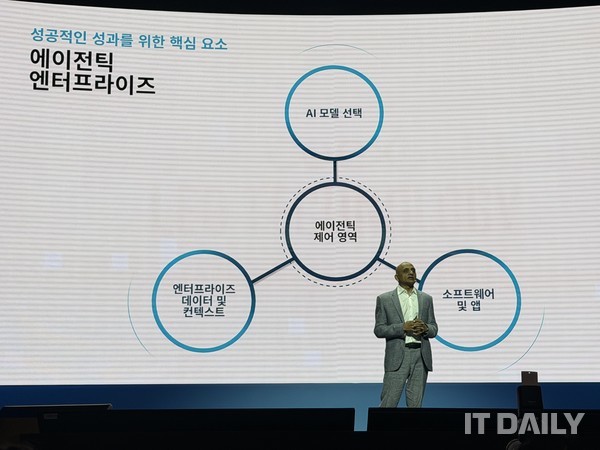
Bala Kasiviswanathan, Snowflake vice president of product management, shared the details at the company’s annual conference, Snowflake World Tour Seoul, held on the 27th at COEX in Samseong-dong, Seoul. The photo shows Bala Kasiviswanathan speaking at Snowflake World Tour Seoul on the 27th, and the photo credit is Yang Seung-gab.
The starting point for an AI strategy is trustworthy data.
That day, Vice President Kasiviswanathan pointed to the challenges companies face in adopting AI. He noted the high fragmentation of today’s enterprise environment and said that different data types, data formats and databases coexist.
In such an environment, he said, the challenge becomes ensuring trustworthy AI operation across the entire environment. He added that security and privacy complexities increase when AI agents interact with systems.
Kasiviswanathan analyzed four capabilities needed to build an agentic enterprise. He identified trustworthy enterprise data and context, flexible AI model selection, seamless connectivity with enterprise applications and an integrated agentic control plane as necessary capabilities.
His view is that trustworthy data infrastructure is a prerequisite for AI to reason and act correctly. Simply aggregating data is not enough; AI must understand internal business terms and definitions to produce accurate and consistent results.
In that context, he said a governed data platform is needed as a condition for reliable AI agent operation. He also stressed that without a data strategy, there can be no AI strategy.
Snowflake offers Horizon Catalog as a way to implement this. Horizon Catalog provides a single governance layer for data, metadata, security and AI workloads, extending governance from data to the full operation of AI agents.
Snowflake also offers Trust Center and AI Budget Control. Trust Center handles agent identity, AI guardrails and security related to data leakage, while AI Budget Control provides usage and cost management by model, team and workload.
He pointed out that one of the concerns customers have when companies deploy AI at scale is the cost of large-scale deployment and how to control it. He also said the range of available AI models has expanded.
He then said that choosing the right model for the task is important. Frontier models are strong at complex reasoning, but not every enterprise task requires top-tier reasoning performance, he explained.
He emphasized avoiding lock-in to a specific model or provider. Snowflake said it supports selecting models with the right size and performance for each task.
He also said Snowflake’s stance is to prioritize customer choice. He added that enterprise tasks, work and agents change over time, and that given the pace of AI advancement, avoiding lock-in in model selection is necessary.
Even if data and models are ready, AI cannot easily deliver business outcomes if it is not connected to the actual enterprise work environment. In particular, it was emphasized that AI struggles to create business value when enterprise systems are not connected.
To address this, Snowflake said it provides AI agents with secure access to enterprise data and legacy business systems, as well as interaction capabilities. Its “zero-copy integration” support enables the use of data from existing databases and core systems without copying it separately.
Snowflake also said that through Cortex AI Gateway, it can manage and observe an integrated layer of agent behavior connecting models, MCP servers and enterprise systems. It presented a structure in which agent actions across multiple connection points can be managed in one place.
Based on this structure, Kasiviswanathan said consistent application of security, access control and request limits is possible when connecting business systems such as SAP, Salesforce, Workday and Slack. In other words, the same security and control standards can be applied even when integrating diverse business systems.
He identified the degree to which agents are integrated with existing and adjacent systems as a key factor determining how effective AI agents will be. He also highlighted implementation without additional security risks as an important point.
He said Snowflake provides zero-copy integration based on Horizon Catalog for major business systems such as SAP, Workday and Salesforce. He emphasized not the importance of data replication, but the importance of not replicating data.
Along the same lines, Kasiviswanathan stressed that a consistent management framework is necessary for operating enterprise AI agents at scale. Snowflake presented an agentic control plane as its answer to that need.
Snowflake’s vision is for business users and developers alike to use AI agents tailored to their work. The personal agent for business users is Coweork, while the coding agent for developers is Cocco. The system is focused on supporting consistent work under the same data and security policies.
Kasiviswanathan said this functionality increases data accessibility across the organization by enabling anyone in the company to obtain correct, data-backed answers in natural language. He added that by integrating with other enterprise applications and workflows, it can go beyond data lookups and perform actual actions.
Source: IT DAILY · Yang Seung-gab
Original: https://www.itdaily.kr/news/articleView.html?idxno=241244
References
This article was produced with the help of an automated content generation algorithm.
Source: IT DAILY
View originalThis article was summarized and organized by BizCrush based on the original article from IT DAILY. For exact quotations and full details, please refer to the original article.