Snowflake Keeps Up Growth in South Korea, Says AI Must Deliver Business Results Beyond PoC
IT DAILY ·
✦ AI Summary
Snowflake held "Snowflake World Tour Seoul" at COEX in Samseong-dong, Seoul, on the 27th and introduced its priorities for its South Korea business.
Lee Yong-seok, head of the South Korea office, said total revenue in 2025 had grown by about 18 times and customer numbers had increased by more than about 10 times.
The company said it will work to keep AI from remaining at the PoC stage and move it into real operations, while strengthening its partner ecosystem, training, and security and governance capabilities.
Snowflake held its annual conference, "Snowflake World Tour Seoul," on the 27th at COEX in Samseong-dong, Seoul. Lee Yong-seok, who was appointed head of the South Korea office on the 18th, introduced the company’s key business priorities in Korea at the event.
At the venue, Lee cited Snowflake’s growth in South Korea, saying that four years after the company began its business in the country, total revenue in 2025 had grown by about 18 times and the number of customers in 2025 had increased by more than about 10 times.
Lee also outlined a strategy to connect AI to actual business results, saying it should not be left at the PoC stage. He said a key priority for the South Korea business is to help AI move quickly into real operations.
Lee Yong-seok, head of Snowflake’s South Korea office, said at "Snowflake World Tour Seoul" at COEX in Samseong-dong, Seoul, on the 27th that the significance of Snowflake’s growth in the country goes beyond simple revenue expansion. He viewed it as evidence of local customers’ confidence in expanding real production workloads on Snowflake.
In South Korea, Snowflake counts Samsung, SK, LG, Shinsegae, Nexon, and Kakao among its customers.
Lee said that across industries and company sizes, including large conglomerates, startups, and technology companies, customers are moving beyond the pilot PoC stage and operating real business workloads in production while generating results.
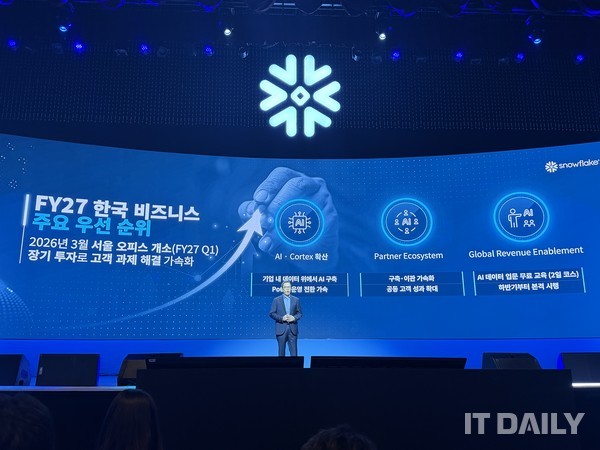
Based on this trend, Snowflake plans to focus on three areas in the South Korean market going forward: expanding AI and Cortex adoption, strengthening its partner ecosystem, and building market capabilities.
The company said it will work to move enterprise AI adoption into real operations through broader AI and Cortex adoption. Lee said many companies’ AI efforts are largely stuck at the project stage, and outlined a direction for moving them from the experimental or project level into actual operational use.
To that end, the company plans to support AI development on site without moving internal data outside the company, while preventing it from staying at the PoC stage and helping it move quickly into production. Lee said the company’s commitment is to turn AI into a current revenue-generating workload, not a future task.
The company also announced plans to strengthen its partner ecosystem. It said that legacy system migration, implementation, and industry-specific expertise are all critical in the data and AI transformation process, and it also outlined plans to expand collaboration with partners.
Lee said shortages of resources, migration from legacy environments, and the need for industry-specific expertise are inevitable. Accordingly, the company plans to accelerate implementation and migration with partners and continue expanding in the direction of creating joint results with them, he said.
The company is also moving to strengthen practical AI deployment capabilities in the market. It said that rapid advances in technology and AI alone are not enough to drive adoption, and that broader expansion would be difficult if market acceptance and utilization capabilities are lacking. To support real-world use, it plans to offer related training in the second half of this year to build adoption and utilization capabilities.
At the same time, the company plans to strengthen security capabilities in response to the spread of AI agents and to bolster governance capabilities as well. It also continues to centralize management and control across connected systems, based on its acquisition in May of "Natoma," a company with MCP-related technology.
Snowflake is also working to enhance integrated management features for AI agents through the "Cortex AI Gateway." The Cortex AI Gateway supports integrated layer management and observability for model, MCP server, and enterprise system connection agent behavior, and also helps control costs. When connecting external systems such as SAP, Salesforce, Workday, and Slack, a central gateway is applied, enabling consistent enforcement of security, access control, and request limits.
Coco Desktop is a tool introduced in July to improve developer productivity. The tool integrates an editor, an integrated terminal, an agentic notebook, and a browser into a single environment, enabling developers to perform end-to-end natural language-based data pipeline building, analysis, machine learning, and AI agent development.
Lee said the core of Coco lies in governance compliance, adding that it enables safe development, exploration, and operation within a managed environment while preserving existing roles and access controls. He said Coco Desktop can help improve developer productivity and, further, could be a steppingstone for changing how employees work with data and for broader organizational culture innovation.
Source: IT DAILY · Yang Seung-gap
Original: https://www.itdaily.kr/news/articleView.html?idxno=241241
References
This article was produced with the help of an automated content generation algorithm.
Source: IT DAILY
View originalThis article was summarized and organized by BizCrush based on the original article from IT DAILY. For exact quotations and full details, please refer to the original article.