[Report] “In the Age of Low-Earth Orbit Satellites, the Key Is Operational Capability” — A Visit to KT sat’s Yongin Control Center
IT DAILY ·
✦ AI Summary
KT sat’s Yongin Satellite Control Center is a facility that monitors and operates geostationary satellites 24 hours a day, 365 days a year, and it said the importance of control and operations capabilities is growing in a Multi-Orbit environment.
Since opening in 1995, the center has continued the launch and operation of a total of 9 satellites, and it currently directly operates 5 satellites: Mugunghwa K5, K6, K7, K5A, and K6A.
Based on the localization of satellite control systems and the reuse of Mugunghwa Satellite 6, KT sat plans to expand its control capabilities into low-Earth orbit and Multi-Orbit environments.
Above our heads are geostationary satellites that play one of the main roles in communications. Geostationary satellites operate at an altitude of about 36,000 km. KT sat’s Yongin Satellite Control Center is a facility that monitors and operates these geostationary satellites 24 hours a day, 365 days a year.
Recently, as low-Earth orbit satellite communications services that operate at relatively low altitudes and consist of hundreds to several thousand satellites have spread, a Multi-Orbit environment that uses both existing geostationary and low-Earth orbit satellites in parallel has emerged. As this Multi-Orbit trend gains ground, the importance of control and operations capabilities is also rising, and KT sat’s Yongin Satellite Control Center was selected as the site for this article’s field visit based on more than 30 years of satellite control and operations experience.
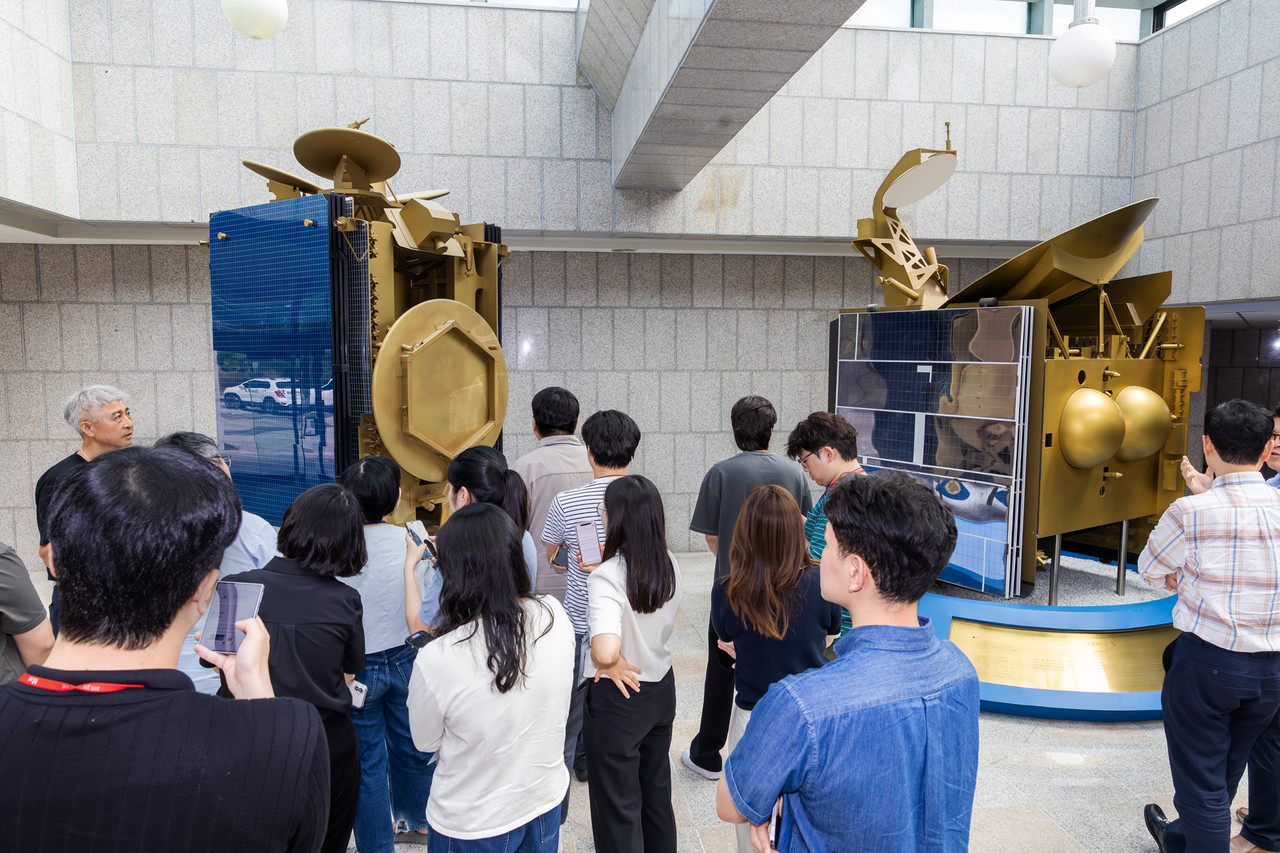
At the exhibition hall of KT sat’s Yongin Control Center, Lee Hoon-cheol, head of KT sat, explained the history of satellite control. At the entrance to the Yongin Satellite Control Center, models of Mugunghwa Satellite 1 and 5 are on display, showing KT sat’s history and significance in satellite operations.
Mugunghwa Satellite 1 was launched in 1995. It marked a turning point away from reliance on leased foreign satellites and is regarded as a satellite that laid the foundation for an independent satellite communications infrastructure. Mugunghwa Satellite 5 was the country’s first civil-military dual-use geostationary communications satellite, built through cooperation among KT, the Agency for Defense Development, and France’s Alcatel, now Thales Alenia Space.
Since opening in 1995, KT sat’s Yongin Satellite Control Center has continued the launch and operation of a total of 9 satellites. At present, the geostationary satellites directly operated by KT sat are 5 Mugunghwa satellites: K5, K6, K7, K5A, and K6A.
To support this, KT sat operates a dual control system, with the Yongin Control Center as the main control center and the Geumsan Control Center as the backup control center. The Yongin Control Center directly controls and operates satellites, while the Geumsan Control Center handles connections to terrestrial communication networks and stable satellite communications services.
The Yongin Satellite Control Center is made up of three organizations: the Satellite Technology Team, the Satellite Consulting Team, and the Satellite Operations Team. It operates control infrastructure with 5 sets of control antennas linked one-to-one with each satellite, as well as control systems.
Geostationary satellites orbit at the same speed as the Earth’s rotation, so they appear to stand still from the ground, but in fact they move at about 3.1 km per second at an altitude of about 35,786 km above the surface. As a result, stable communications services require continuous monitoring of satellite status and position, and when necessary, precise adjustments to orbit and attitude must be made.
In line with this operational need, KT sat pushed to localize its satellite control system following the launch of Mugunghwa Satellites 5A and 7 in 2017, and developed the Flight Dynamics Subsystem (FDS) in cooperation with the Electronics and Telecommunications Research Institute (ETRI). Through this, it secured a domestic technology base that does not depend on foreign systems, and satellite orbit analysis and prediction became possible using Korean technology.
KT sat is also applying its satellite control capabilities to creating cases of satellite reuse after end of life. KT sat set out to find a new use for Mugunghwa Satellite 6. Launched in 2010, Mugunghwa Satellite 6 was scheduled for disposal after the end of its 15-year design life, but KT sat reviewed the satellite’s condition and remaining fuel and confirmed its potential for reuse.
As a result, the reuse of Mugunghwa Satellite 6 led to the provision of services in the Oceania market. This is an example that shows how KT sat’s control capabilities can be used to explore new applications.
Kim Ki-young, team leader of the Satellite Consulting Team at KT sat’s Satellite Control Headquarters, explained that the satellite production base is a verified system and that a satellite’s typical design life is about 15 years. He said the risk of failure inevitably increases once the design life has passed, but that maneuvers are possible if fuel remains. He added that services can be provided if customers willing to accept the risk are secured, and that the target customers are businesses for which satellite use is essential and customers that need backup satellites.
Mugunghwa Satellite 6 is a satellite that required additional control work for use in Oceania. That is because the satellite’s original design direction was toward the Northern Hemisphere, making it difficult to use immediately for Southern Hemisphere services such as Oceania. Accordingly, KT sat pushed a 180-degree attitude reversal based on the Earth-pointing axis to support Southern Hemisphere services.
The maneuver carried out in this process was a 'Flip Maneuver.' KT sat also carried out an additional measure to reposition the orbit to fit the service area.
At KT sat’s Yongin Control Center, a field demonstration was conducted in line with the theme of securing integrated control capabilities for multiple satellites. A company official demonstrated the azimuth adjustment of a dish antenna, and there are 19 antennas installed outside the Yongin Satellite Control Center. A 4.6-meter dish antenna was also confirmed at the site.
During the site check, the antenna was seen actually rotating in response to Azimuth (AZ) adjustments. However, the antenna’s rotation speed was so slow that it was barely noticeable. This is because precise adjustments are needed to ensure stable signal transmission and reception with satellites, down to tiny angles. Photo source: KT.
The antenna used in the demonstration held on the 25th at kt sat’s Yongin Control Center in Yongin, Gyeonggi Province was not a satellite control antenna but a device for monitoring a satellite’s carrier signal. The purpose of the demonstration was to explain the process of maintaining the exact direction of ground antennas and ensuring stable signal transmission and reception in actual satellite control.
A photo from the day shows Kim Ki-young, team leader at kt sat’s Satellite Control Headquarters, explaining kt sat’s control capabilities. Kim said the essence of satellite control lies in continuously checking satellite status from the ground and sending the necessary commands.
Kim said geostationary and low-Earth orbit satellites differ in orbital characteristics. However, he said the basic principles of control are the same.
He explained that monitoring satellite status, executing commands, controlling orbit and attitude, and responding to anomalies are the core principles of operations. He said that, regardless of the differences between geostationary and low-Earth orbit satellites, these principles are the same.
Kim said kt sat has long experience operating geostationary satellite control, and that this foundational capability can be extended into the low-Earth orbit era.
Unlike geostationary satellites, low-Earth orbit satellites move quickly relative to the ground, so additional capabilities are needed in the operating process. Operating low-Earth orbit satellites requires satellite tracking and signal level adjustment. In addition, because the low-Earth orbit environment is characterized by hundreds to several thousand satellites forming a single network, a control system capable of integrated operation of multiple satellites beyond individual satellite management is needed.
Kim said the company has accumulated common know-how through operating geostationary satellites. However, he said additional capabilities are needed to apply this know-how to low-Earth orbit satellite operations. He added that the company understands the elements required for low-Earth orbit satellite operations and is working to prepare and secure related capabilities.
KT sat has accumulated control capabilities through efforts such as localizing control software. Based on this, the company plans to expand its control capabilities into the low-Earth orbit and Multi-Orbit environments.
Kim said the key to national projects that the government will pursue in the future lies beyond satellite production and launch. He cited the ability to operate satellite networks stably and the ability to provide continuous services to customers as key elements. He also said the company plans to advance its accumulated control capabilities through AI and secure integrated operating capabilities spanning both ground and space.
Source: IT DAILY · Seong Won-young
Original: https://www.itdaily.kr/news/articleView.html?idxno=241204
References
This article was produced with the help of an automated content generation algorithm.
Source: IT DAILY
View originalThis article was summarized and organized by BizCrush based on the original article from IT DAILY. For exact quotations and full details, please refer to the original article.