Apple Turns the Mac Into a 'Local AI Workstation' With Dual-Track Push on M6 and M5 Ultra
IT DAILY · · 1 views
✦ AI Summary
Apple unveiled the new Mac mini and Mac Studio, signaling a shift in desktop Mac competition from CPU and GPU performance to the size and speed of local AI model execution.
The Mac mini comes with M6 and M5 Pro, while the Mac Studio comes with M5 Max and M5 Ultra, and the M5 Ultra supports up to 512GB of unified memory.
The two products will be available for pre-order starting at 10 a.m. on the 27th and will launch on the 22nd of next month.
Apple is moving to shift the benchmark for desktop Mac competition in its new Mac products away from CPU and GPU performance and toward the size and speed at which local AI models can run. The new products are notable for more than just adding generative AI features. Through them, Apple is signaling an effort to expand the Mac's role beyond a terminal for calling cloud models.
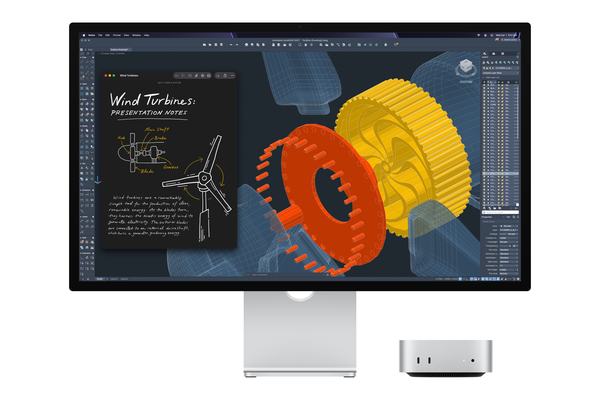
To that end, the new Mac mini features Apple's first 2-nanometer M6, while the Mac Studio is equipped with the M5 Ultra. The M5 Ultra supports up to 512GB of unified memory. Based on this configuration, Apple is expanding the Mac lineup from personal AI PC devices to professional AI workstations.
Apple also showed how multiple Mac mini units can be linked into a local AI cluster. As a result, the Mac is expanding into a platform that can run AI models, fine-tune them, and handle agent workflows on its own. This is seen as part of Apple's strategy to position the Mac as a computing platform.
Apple unveiled the new Mac mini and new Mac Studio on the 25th. The new Mac mini comes with M6 and M5 Pro, while the new Mac Studio uses M5 Max and M5 Ultra.
The two products will be available for pre-order starting at 10 a.m. on the 27th and will launch on the 22nd of next month.
At the center of the new Mac mini is the M6, which is built on Apple's first 2-nanometer process. The M6 features a 12-core CPU, a 12-core GPU, dual 16-core Neural Engines, up to 32GB of unified memory, and up to 170GB/s of memory bandwidth.
The M6's CPU configuration consists of 2 super cores, 4 performance cores, and 6 efficiency cores. Apple said the M6 delivers up to 1.2 times the multithreaded performance of the M5 and up to 2.4 times that of the M1. It also said that Neural Accelerators for AI tasks have been applied to each GPU core, and that peak GPU compute performance for AI is about 30% higher than the M5 and more than 8 times higher than the M1.
Apple has placed two 16-core Neural Engines in the M6. Unlike the previous single-Neural Engine design, the M6 was designed to expand on-device AI throughput. The System framework can use both Neural Engines at the same time, making it possible to improve model execution speed for AI applications. In addition, the M6's unified memory bandwidth is 10% higher than that of the M5.
With this configuration, users can run large language models, or LLMs, on the Mac mini without sending data to the cloud, and they can also run personal AI agents on the Mac mini. However, with unified memory capped at 32GB, Apple positions the M6 as suitable for lightweight to mid-sized models in the several-billion-parameter range and everyday agent tasks.
For larger models and professional workloads, Apple offers the M5 Pro model. The Mac mini with M5 Pro supports up to an 18-core CPU, a 20-core GPU, 64GB of unified memory, 307GB/s of memory bandwidth, and Thunderbolt 5. Thunderbolt 5 supports transfer speeds of up to 120Gb/s.
Apple emphasized that multiple M5 Pro Mac mini units can be linked to form a local AI cluster. Using LM Studio Bionic and exo, AI models larger than the memory limits of individual devices can be run in a distributed way, and multiple AI agents can also be run in distributed fashion.
With this approach, the Mac mini is being positioned as more than a traditional compact desktop and could be used as equipment for building a small in-house AI testing environment for development teams and research organizations. It also drew attention for enabling internal processing without sending sensitive code or corporate data to the cloud.
That ability to process data internally was presented as a differentiator in the enterprise market. Apple then introduced the Mac Studio as well.
The new Mac Studio comes in two chip configurations: M5 Max and M5 Ultra. Of these, the M5 Max features an 18-core CPU and up to a 40-core GPU, along with up to 128GB of unified memory and up to 614GB/s of memory bandwidth.
The M5 Max is aimed at professional AI workloads such as high-resolution video editing, 3D graphics, large-scale code compilation, LLM execution, and AI image generation.
The M5 Ultra is the first Apple silicon product to use a quad-die architecture. It links two M5 Max chips with UltraFusion so that 4 dies operate like a single SoC, and inter-die bandwidth exceeds 4.4TB/s. The M5 Ultra supports up to a 36-core CPU, up to an 80-core GPU, a 32-core Neural Engine, up to 512GB of unified memory, and 1.2TB/s of memory bandwidth.
Based on this structure, performance has also been improved. CPU multithreaded performance is up to 1.3 times higher than the M3 Ultra, and graphics performance is up to 40% better. Neural Accelerators are included in each GPU core, and Apple said peak GPU compute performance for AI is up to 4.5 times that of the M3 Ultra.
The key AI performance factor in this product is the up to 512GB of unified memory. Because the CPU and GPU share a single memory space, the need to copy data to separate GPU memory is reduced, and on that basis Apple said it is possible to run a frontier-scale LLM with hundreds of billions of parameters entirely on-device.
The Mac Studio product page presents the Mac Studio as a local AI execution environment, along with the message: "No cloud tokens" ... "Bring datacenter AI to your desk." Product page examples included local deployment of Gemma, Kimi, and Mistral, as well as image generation using Stable Diffusion and FLUX.
It also cited examples such as researchers running MATLAB simulations and local AI models at the same time, and developers operating code agents without going through external APIs and running their own models. Through this, Apple showed a trend of researchers and developers reducing external dependence and directly running models and agents.
M5 Ultra also highlighted stronger performance for video production equipment. For the M5 Ultra-equipped configuration, Apple cited H.264 and HEVC hardware acceleration and 4 ProRes encoding and decoding engines. It also said the system can play back up to 33 streams of 8K ProRes 422 video simultaneously at 30 frames per second and supports connection to up to 8 displays. This was linked not only to AI tasks but also to high-resolution video production and multi-display operation.
This announcement is seen as an attempt to expand the Mac's role from a terminal for accessing cloud AI services into an independent AI execution device. Apple stressed that the M5 Ultra can run frontier-class models "without cloud tokens," which is consistent with that view.
Cloud AI has the advantage of allowing users to tap computing resources as needed, but rising costs tied to increasing model calls and the possible issue of transmitting corporate data outside the company are seen as limitations. Local AI, by contrast, requires upfront investment in equipment, but it has the advantages of lower repeated inference costs and stronger data control.
To support this, Apple has configured not only the hardware but also development tools such as Core AI, Core ML, Metal, and Xcode to work together across the CPU, GPU, and Neural Engine. As a result, developers can run and fine-tune their own models on the Mac, and they can also combine agent capabilities with applications using Apple Foundation Models and App Intents.
The performance improvements Apple presented are based on measurements using Apple-selected systems and specific benchmarks, and the scale and processing speed of models that can run locally vary depending on model precision, quantization method, context length, and the software used. Accordingly, the implication was that interpreting the performance figures requires caution.
Separate from that, the new lineup points to Apple's approach of targeting the local AI market with a range of products rather than a single high-performance device. The M6 Mac mini is positioned to handle AI agent execution for individual developers and general users, the M5 Pro Mac mini for small-scale AI development and cluster setup, and the M5 Ultra Mac Studio for large models and professional workloads, reflecting a local AI segmentation strategy by use case.
Cloud AI growth has been driven by massive datacenter GPU resources, but Apple's strategy is to bring certain AI tasks onto users' desks, led by unified memory and power efficiency. As a result, the key variable in the new Mac's success is presented as not CPU benchmarks but how smoothly developers and companies can move actual AI models to local execution.
Source: IT DAILY · Lee Jae-young
Original: https://www.itdaily.kr/news/articleView.html?idxno=241198
References
This article was produced with the help of an automated content generation algorithm.
Source: IT DAILY
View originalThis article was summarized and organized by BizCrush based on the original article from IT DAILY. For exact quotations and full details, please refer to the original article.