Anthropic’s “Claude Science” Draws Attention From Pharma and the Scientific Community — Here’s Why
IT DAILY ·
✦ AI Summary
Anthropic unveiled the AI research platform “Claude Science” for life sciences and drug development.
Claude Science autonomously carries out research tasks according to scientists’ instructions and includes result reproducibility and code traceability features.
Anthropic plans to offer it to pharmaceutical companies and university laboratories, and to use it in its own research into rare disease and neglected disease drug candidates.
As expectations rise that generative AI will transform drug development in the pharmaceutical industry, Anthropic last month unveiled “Claude Science,” an AI research platform for life sciences and drug development. It has drawn attention as a factor behind growing expectations for the use of generative AI in the pharmaceutical industry.
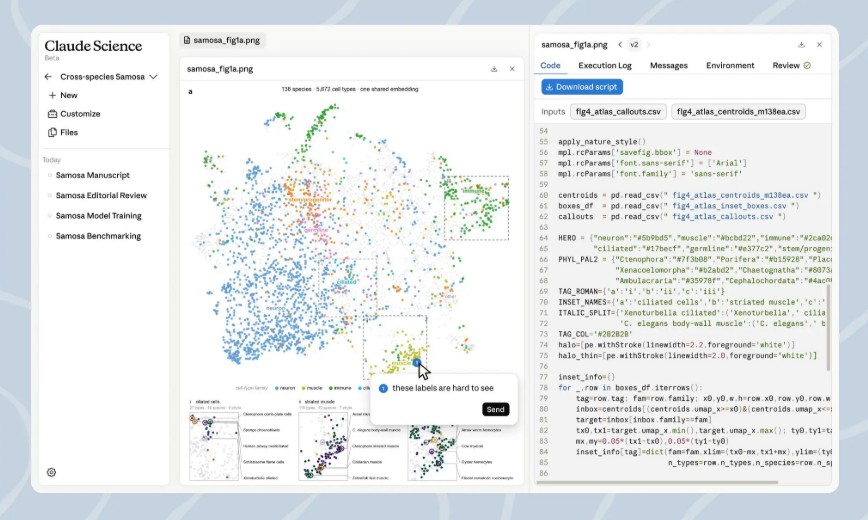
While targeting the developer market with “Claude Code,” Anthropic has positioned scientific research as a core AI business area through “Claude Science.” Claude Science features protein molecule state visualization, reproducibility of all results, and code traceability. Google DeepMind has long led the AI market for science, but with Claude Science entering the field, observers say full-fledged competition in AI for science has begun.
MIT Technology Review described Google DeepMind as a singular AI research platform for the scientific community, but predicted that the market landscape is likely to shift in the future. Behind that outlook is Anthropic’s rise, with Anthropic also being cited as a company that threatens the position of OpenAI, which has pioneered and led the generative AI market.
Anthropic unveiled Claude Science at an event attended by executives from the pharmaceutical industry, biotech founders, and scientists. Claude Science is designed so that AI can autonomously carry out a substantial level of research tasks according to scientists’ prompt instructions, and it is available to all paid Claude subscribers.
Claude Science connects with a range of research tools used for computational biology and drug development, and it also includes coding support and code execution on high-performance computing clusters. Anthropic has already offered AI features for scientific research, but this time it has introduced a standalone product that goes further by including autonomous research task execution and integration with research tools and computing resources.
Before Claude Science, Anthropic had already applied AI to scientific research, and in October last year it unveiled “Claude for Life Sciences,” a plugin that connects scientific software and databases to Claude. Claude Science, however, was presented as going beyond the level of a feature-expansion plugin.
Claude Science was developed as an independent product and is classified alongside Claude Code and Claude for Work collaboration tool Claude CoWork as a core product line. This shows that Anthropic views scientific research as one of AI’s key growth areas.
Claude Science was designed as an extension of the existing Claude Code and Claude CoWork functions so that it could be used for programming, which is often necessary in scientific research, taking into account that most scientists are not specialized software engineers. Anthropic has presented the potential for a significant boost in research productivity as the rationale for adopting AI assistance, and has highlighted reproducibility of research results as a core element of Claude Science.
According to the detailed description of Claude Science on Anthropic’s official website, the tool integrates fragmented tools into a single research environment and supports scientists through every stage of their work. It supports literature analysis, multi-step research execution, and the creation of detailed outputs, while allowing figures and manuscripts to be repeatedly revised until publication-ready. It preserves records of the creation process for all outputs, enabling users to trace the sources of AI-generated and AI-analyzed results and verify their accuracy and validity. It also says that results can be verified and reproduced based on those process records.
Among Claude Science’s advantages are claims about computing resource management and the ability to scale as needed. The tool claims to support the planning of protein analysis, and says users can request advance approval before using new resources and review or cancel every decision before writing and submitting tasks.
Its scope covers a wide range of scientific fields, with current focus areas including molecular biology, cell biology, and drug development. It can connect with tools in genetics, chemistry, and protein biology, and supports research into new therapies and drug candidates. Over the past few months, scientists have used the Claude Science beta version to carry out single-cell RNA sequencing analysis, CRISPR screening design, protein structure prediction, and cheminformatics work.
MIT Technology Review described Alexander Tarashansky as the person leading the development of Claude Science. At the event, Tarashansky demonstrated Claude Science autonomously searching for new drug candidates for Phenylketonuria (PKU). Phenylketonuria (PKU) is a genetic disorder in which the body cannot metabolize phenylalanine, one of the amino acids in the human body.
Anthropic is offering the platform to pharmaceutical companies and university laboratories. At the same time, it plans to pursue research into treatments for rare diseases and neglected diseases of its own, and it intends to deploy Claude Science in actual research projects in search of scientific results. It also plans to directly observe how the product operates in real research environments as part of product validation.
For more than 10 years, Google DeepMind has been regarded as the leading company in AI-based scientific research, and it has also been widely recognized as such. DeepMind CEO Demis Hassabis and researcher John Jumper jointly won the Nobel Prize in Chemistry for developing AlphaFold, an AI model for protein structure prediction. DeepMind has since expanded the scope of AI applications to meteorology, new materials research, and various scientific fields.
As LLM agent capabilities have advanced rapidly in recent years, the competitive landscape for AI scientific research has also been changing. Against this backdrop, Claude Science is drawing strong attention from the scientific community, and Matthew Schwartz, a physicist at Harvard University, said in an Anthropic blog that Opus 4.5’s ability to carry out scientific projects is roughly comparable to that of a second-year doctoral student.
Adding to that is John Jumper’s announcement that he is joining Anthropic, which has further raised expectations for Anthropic’s scientific AI business. Jumper is a key figure behind AlphaFold development and a Nobel laureate.
In this context, Anthropic has chosen drug development as a key application area. The reason for that choice is a business advantage, and within the AI industry, disease treatment and drug development are regarded as the most important social applications of general-purpose AI technology. Global pharmaceutical companies have very large R&D budgets and continue to make large-scale R&D investments, and for Anthropic, an enterprise-focused B2B AI company, there are opportunities to win contracts with major pharmaceutical firms.
Claude Science is seen as a signal that AI’s autonomous capabilities have moved beyond the existing stages of code writing and document generation and into actual scientific research and drug candidate discovery. This has raised expectations that, with this as a trigger, the competitive arena for the AI industry will expand into the scientific community, including the pharmaceutical industry.
Source: IT DAILY · Jo Min-soo
Original: https://www.itdaily.kr/news/articleView.html?idxno=241160
References
This article was produced with the help of an automated content generation algorithm.
Source: IT DAILY
View originalThis article was summarized and organized by BizCrush based on the original article from IT DAILY. For exact quotations and full details, please refer to the original article.