Why Are AI Data Centers Moving to the Provinces? China’s 'East Data, West Computing' Shows the Power Logic
IT DAILY ·
✦ AI Summary
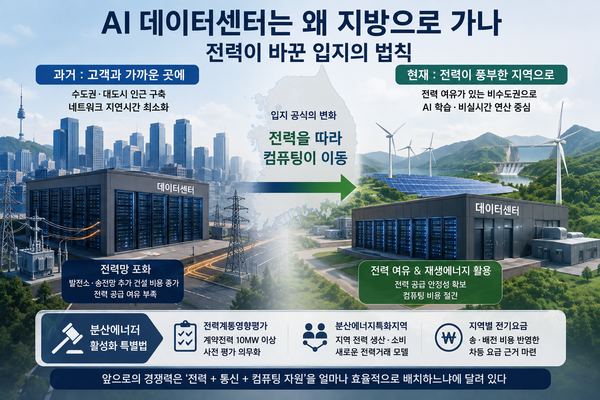
In the past, data centers were typically located near the Seoul metropolitan area and other major cities, but as AIDC grows larger, site-selection criteria are shifting toward securing power.
China has been promoting Dongshu Xisuan (East Data, West Computing) since 2022, linking eastern demand with the west’s abundant power and moving non-real-time computation westward.
South Korea is also moving to ease capital-region concentration and encourage dispersion to non-capital regions through the Special Act on Activation of Distributed Energy and power system impact assessments.
The location formula for AIDC is changing. In the past, the conventional wisdom for data center siting was to build near the Seoul metropolitan area and other major cities. The reason was to reduce network latency and process data closer to customers.
However, as AIDC has grown larger, the surrounding environment has changed, and the criteria for choosing sites are changing as well. A hyperscale AI infrastructure can operate hundreds of thousands of GPUs, and its core requirement is a stable supply of massive amounts of power. At the same time, a lack of spare capacity in power grids around major cities is emerging as a real constraint.
As a result, moving computing resources to regions with abundant power is emerging as an alternative to adding more power plants and transmission networks. China’s response to this shift has developed into a national strategy, and the project began in earnest in 2022. The Chinese project is called Dongshu Xisuan (East Data, West Computing).
Dongshu Xisuan involves transmitting large volumes of data generated in the east to the west, while advancing computation and storage in west-region data centers, cloud, and big data infrastructure. China’s buildout targets 8 national computing hubs and 10 national data center clusters. The 8 national computing hub regions are Beijing-Tianjin-Hebei, the Yangtze River Delta, the Guangdong-Hong Kong-Macao Greater Bay Area, Chengdu-Chongqing, Inner Mongolia, Guizhou, Gansu, and Ningxia.
As AI spreads and the importance of this strategy increases, China is trying to reduce the mismatch between the eastern regions where demand is concentrated and the western regions with abundant energy. The fact that 5 of the 8 national computing hubs are located in the west also fits this context.
This serves both the purpose of utilizing western energy resources such as wind and solar power and the purpose of reducing computing costs. Therefore, this strategy cannot be seen simply as a plan to build data centers in provincial regions or as a balanced regional development policy. Its essence lies in aligning the location of power with the location of computing.
If data centers continue to be built around major cities in the east, the target areas would be Beijing, Shanghai, and Shenzhen. In that case, additional power generation facilities, transmission networks, and substations would be needed. In addition, the operating structure of data centers around major eastern cities requires the sustained procurement of power from distant locations.
Taking these factors into account, China chose to build large data centers in regions with relatively abundant energy resources such as wind, solar, and hydropower, and to move portable computing workloads to those regions.
China’s National Development and Reform Commission and the National Data Administration are pushing ahead with Dongshu Xisuan, connecting eastern demand with western resources. China is pursuing policies that promote the execution of non-real-time computations, such as AI training and batch inference, in the west.
Specifically, it is encouraging the relocation of AI model training and inference, machine learning, video rendering, offline analysis, and data backup tasks to western regions. It is also implementing a policy to increase the share of green power used by new data centers in national hub regions.
This direction is linked to the possibility that this model will become more economical in the AI era. AI training is a task that performs large-scale computation over long periods and does not require an immediate response.
Tasks with low immediacy have a lower need to be processed close to the user. Accordingly, China is promoting a division of labor in which non-real-time computation is handled in the west and low-latency work is handled in the east, while also pushing for low-latency critical tasks such as finance and industrial control to be processed in the east.
In the end, China is presenting a structure in which non-real-time tasks are placed in the west and latency-sensitive tasks in the east. This is where the difference between AIDC and existing data centers emerges.
Online shopping, financial transactions, gaming, and real-time video services all require fast response times. As the physical distance between the user and the data center increases, network latency may rise, which is why data centers near major cities have long held high value.
AI training, by contrast, has characteristics different from response-time-oriented services. Because large volumes of data are processed in GPU clusters over weeks to months, data centers for AI training face relatively few issues even if they are hundreds of km away from users.
Instead, for AI training data centers, the amount, price, and supply reliability of power capable of stably operating tens of thousands to hundreds of thousands of GPUs are important. Accordingly, the site-selection criteria for data centers in the AI era are shifting from customer proximity to secure, stable power.
The Chinese government's goals reflect this change. The Dongshu Xisuan policy aims to leverage the advantages of regions rich in wind, solar, and hydropower resources, and to expand the share of green power used by data centers. According to the National Data Administration, the average power usage effectiveness, or PUE, of the 8 national hub data center clusters is about 1.3, and some cutting-edge facilities have seen PUE fall to 1.04.
China is using network performance improvements and data center cluster expansion to offset the network-cost disadvantage of data centers located farther from demand centers, with network technology development supporting the shift. According to public data from the National Data Administration, network latency between the eastern and western national hubs has generally met the target of 20ms, and as of March 2024, more than 1.46 million standard racks had been built across the 10 national data center clusters. As of the same point in time, the overall utilization rate of the 10 national data center clusters stood at 62.72%. China is trying to offset these cost weaknesses through ultra-fast networks and distributed computing workloads.
Guizhou is presented as a representative region for this strategy. According to an announcement by China’s National Energy Administration, the share of intelligent computing in the Guizhou national computing hub exceeded 98%. Last year, electricity use by large data centers in Guizhou was 2.957 billion kWh, and electricity use by large data centers in Guizhou is expected to increase more than fivefold during the next five-year plan period.
China is not limiting its response to adding power generation facilities. It is advancing a power-computing coordination system called 'computing-power collaboration,' broadening its response so that AI computation and power operations are not separated but coordinated together.
Under this system, AI computations whose timing can be adjusted are shifted to periods when the grid has spare capacity or when renewable generation is high, and computing workloads are also allocated across regions according to power conditions. In this way, the plan is to reduce grid strain and increase the use of renewable energy by adjusting the timing and regional distribution of computation to match power conditions.
Guizhou’s energy authorities are also promoting the use of adjustable loads at data centers. The goal is to reduce peak grid demand and expand green power consumption. As a result, AIDC is being seen not only as a one-way power-consuming facility but also as a new type of power consumer that can adjust computation volume and timing according to power conditions.
This trend, together with China’s Dongshu Xisuan strategy, offers implications for domestic AIDC policy as well. In South Korea, institutional changes to disperse data center locations have begun, with the aim of shifting from the Seoul metropolitan area, where power demand is concentrated, to non-capital regions that have power generation facilities and spare supply capacity. A representative measure is the Special Act on Activation of Distributed Energy.
Under the Distributed Energy Act, facilities using 10 MW or more of contracted power are subject to mandatory power system impact assessments, and this system targets large-scale power users. The assessment examines in advance whether the power system can maintain reliability after electricity is supplied and how much new or reinforced power infrastructure, such as substations and transmission lines, will be needed.
Data centers are directly affected by this system because their electricity consumption can range from tens to hundreds of MW. In particular, the Seoul metropolitan area is a region of concentrated power demand, so the availability of power system capacity and the reinforcement of transmission and substation facilities will be key variables for building large-scale AIDC there. The government is using the power system impact assessment system as a means to ease excessive concentration of data centers in the Seoul metropolitan area.
On the other hand, new opportunities are emerging in regions with many power plants and ample power supply capacity. In special regions for distributed energy, it is possible to apply a variety of power trading models based on local consumption of locally produced electricity. As large power consumers, AIDC can be located near power sources, which would reduce the burden of building additional long-distance transmission networks and allow locally produced electricity to be used for AI computation.
In the long term, there are views that regional electricity pricing systems could affect AIDC location decisions. The Distributed Energy Act provides a basis for applying differentiated regional electricity rates that reflect transmission and distribution costs, and there are discussions that system cost differences between regions rich in power generation and the Seoul metropolitan area, where power demand is concentrated, could eventually be reflected in electricity rates. Because AIDC operators are characterized by massive power consumption, there are expectations that reflecting system cost differences could increase the economic incentive for AIDC operators to move outside the capital region. However, the method for calculating regional rates is still in the process of being institutionalized, and the actual size of interregional price differences has not yet been determined.
Global big tech investment trends in AIDC are showing a similar pattern. Microsoft, Google, Meta, and Amazon are being cited as investors, and when building large-scale AIDC, they are increasingly treating grid connection and renewable energy procurement as more important investment conditions than site acquisition. Recent data center location competition in the U.S. is also shifting from network-hub-centered to power-availability-centered.
If AI infrastructure expands in South Korea as well, large-scale power demand is likely to emerge. If the government’s National AI Computing Center moves ahead in earnest, power demand in the hundreds of MW is expected, and when private AIDC projects move into full gear, power demand in the hundreds of MW is also expected. In this context, analysis suggests that the existing data center siting strategy centered on the Seoul metropolitan area alone may be insufficient to meet AI-era computing demand.
The industry sees the competitiveness of the data center sector as depending not only on the number of servers or GPUs, but also on how efficiently power is secured and used. Until now, thinking has largely centered on a model in which power is delivered to consumption sites through the existing grid, but going forward, the strategy of moving computing to where the power is may become the new standard.
An official in the IT services industry said that, in the past, the top priority for data centers was proximity to customers. But in the AI era, proximity to power is becoming more important, he explained. He added that China’s Dongshu Xisuan and South Korea’s distributed energy policy share the same goal, and predicted that an era in which data centers move in step with power is approaching.
Source: IT DAILY · Lee Jae-young
Original: https://www.itdaily.kr/news/articleView.html?idxno=241107
References
This article was produced with the help of an automated content generation algorithm.
Source: IT DAILY
View originalThis article was summarized and organized by BizCrush based on the original article from IT DAILY. For exact quotations and full details, please refer to the original article.