“Defense AX” Market Expands as SKT and KT Join AI Model and Infrastructure Race
IT DAILY ·
✦ AI Summary
SK Telecom and KT are entering the competition in defense AX.
5 defense AX hubs are expected to be established this year in Yongsan in Seoul, Pangyo and Daejeon, Yangjae, and Busan.
Andong-wook, chairman of Miso Information Technology, said there is a need for a system to process sensitive military data into a form that can be used by AI, as well as data processing workflows suited to battlefield conditions.
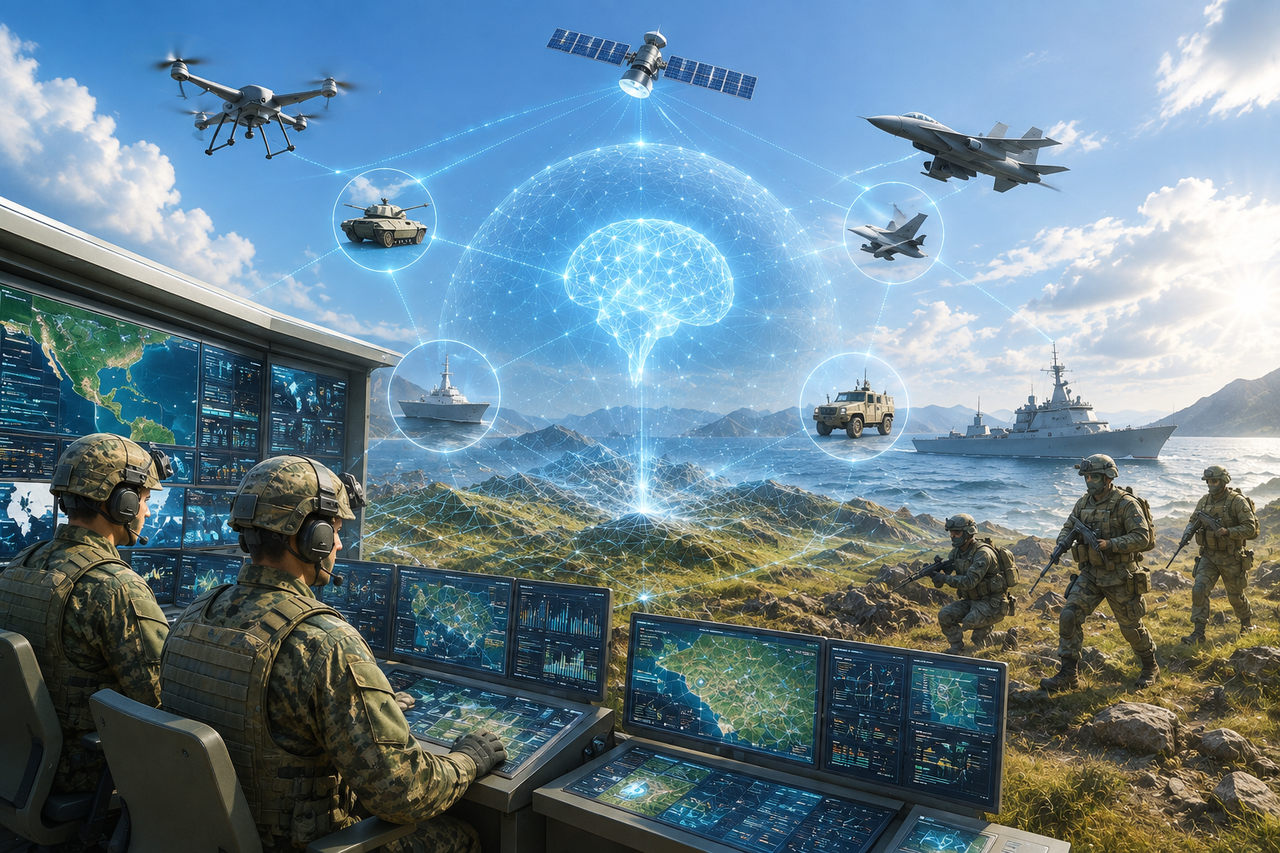
Image created with AI. As mobile carriers have recently set AX as a new growth engine, moves are emerging among companies including SK Telecom and KT to enter defense AX. The article focuses on SK Telecom and KT joining the competition in defense AX.
Against this backdrop, projections were raised that 5 defense AX hubs will be established this year. Along with the hub rollout, expectations were also raised that it will provide a foundation for private companies to verify defense AI use cases and to build a data utilization base.
The hub locations are Yongsan in Seoul (Joint Chiefs of Staff), Pangyo and Daejeon (Army), Yangjae (Air Force), and Busan (Navy and Marine Corps). The 5 hubs to be set up across the country are being cited as a basis for expanding AX in the defense sector.
Amid this trend, Andong-wook, chairman of Miso Information Technology, said at the '2026 8th Defense AI Innovation Network Seminar' that a key task for defense AX is the need for a system that processes sensitive military data into a form that can be used by AI. The seminar highlighted how military data should be handled as a major point of discussion.
Chairman Andong-wook explained that military data can be likened to food such as puffer fish, which is poisonous, and that rather than simply avoiding its use because it is sensitive, there is a need to review the processes for processing and using it. At the seminar, the need for a system that can process sensitive military data so it can actually be used in AI was raised.
The speaker stressed that data processing workflows must function normally even in wartime situations. He also pointed to the need for data processing that takes the battlefield environment into account and said a structure must be prepared so processed data can be used immediately. This awareness of the issue led to an emphasis on the need to lighten AI models.
SKT’s proprietary AI model and KT FDE-based approach to defense AX.
The article explained that the AI use environment on the battlefield faces poor network conditions and that operational stability for battlefield infrastructure is also difficult to guarantee. It added that defense data are distributed across the Army, Navy, and Air Force, creating major constraints on data processing and utilization.
For this reason, the article noted that defense AI faces a higher degree of difficulty in data integration and utilization than AI in general industries. SK Telecom (SKT) was described as taking these defense-specific conditions into account in its approach.
SKT said it does not limit defense AX to a simple AI introduction model. It also presented a defense AI full stack that encompasses infrastructure, data, and lightweight models, and signed an MOU with the Ministry of National Defense on the use of the 'Ministry of Science and ICT’s proprietary AI foundation model in the defense sector.'
The components of the defense AI full stack are AI infrastructure (GPU and cloud based on security and closed networks), defense ontology, digital twins for operational simulation and mission rehearsal, AI data, and defense-specific AI models.
Kim Myeong-guk, who is in charge at SK Telecom, stressed that this 'defense AI full stack' is aligned with the 'AI full stack' SK Telecom has built up internally. He added that SK Telecom has data center construction capabilities, possesses its own AI foundation model 'A.X K1,' and even has experience applying a digital twin developed in collaboration with NVIDIA to SK hynix, thereby securing capabilities across AI as a whole.
In the defense sector, where security and data sovereignty are important, the application of proprietary AI models is presented as a core element of defense AX. SK Telecom is currently expanding its participation in defense AX by promoting its proprietary AI model, and in May it signed a defense AI transformation (AX) MOU with the Ministry of National Defense and the Ministry of Science and ICT, agreeing to use its in-house AI model 'A.X K1' in the defense sector.
KT has completed development of 3 types of quantized models based on A.X K1, reducing model memory usage and improving processing efficiency through the application of quantization technology. KT plans to use these models in units under the Army, Navy, Air Force, and Marine Corps, and also announced plans to apply A.X K2 in the second half of this year.
The photo shows KT Agent Camp participants giving presentations, and the photo credit is KT.
KT has shifted its corporate stance to an 'AX Platform Company.' At the same time, KT has moved to concentrate on defense AX based on its experience in defense infrastructure projects.
Over the past 3 to 4 years, KT has continued pursuing business in the defense sector, with its focus on upgrading existing aging infrastructure. The background to this effort is the decline in troop numbers, and the goal is to improve facility management and work efficiency within units. KT is also concurrently pursuing smart unit projects.
KT has experience in designing, building, and operating large-scale nationwide networks over the past year. The Defense Broadband Integrated Network has construction and operation experience worth 700 billion KRW, the maritime satellite communications system has construction and operation experience worth 90 billion KRW, and the 5G wireless infrastructure has construction and operation experience worth 20 billion KRW. The next-generation defense integrated data center has been completed at a scale of 150 billion KRW.
KT continues this year to build up its capabilities in defense digital infrastructure. The routes for this accumulation are the next-generation intelligent SDDC (Software-Defined Data Center)-based defense integrated data center project, the defense broadband integrated network construction project, and the smart unit construction project.
On this foundation, KT is expanding its AX business capabilities as a way to solve on-site problems with AI. To this end, it has established an on-site and data integration AX execution system centered on FDE (Forward Deployed Engineer) deployments, and the FDE method involves dispatching engineers from client companies and business departments to diagnose on-site business problems and derive solutions. KT is also working to expand the expertise of its internal workforce by running an in-house 'Agent Camp' based on its Palantir partnership.
KT said it has formed an FDE-based squad organization and announced that it is carrying out projects that identify and solve problems jointly with business departments.
A dedicated organization for battlefield and support-system projects has been formed internally. This dedicated organization is responsible for preparing optimal AI solutions for the next-generation integrated facility information system project, the smart air base project, the GOP scientific surveillance project, and the Republic of Korea Armed Forces Command and Control System (KCCS) project.
By contrast, LG Uplus has so far shown no clear business moves related to defense AX. However, LG Uplus has recently been expanding into the public AX sector based on cooperation with AWS.
As a concrete step in that expansion, LG Uplus registered the cloud infrastructure as a service (IaaS) intermediary service 'LG Uplus intermediary service for Amazon Web Services' in the Digital Service Use Support System. As a result, public-sector users can access LG Uplus AWS cloud infrastructure intermediary services via the Digital Service Use Support System.
Source: IT DAILY · Seong Won-young
Original: https://www.itdaily.kr/news/articleView.html?idxno=241083
References
This article was produced with the help of an automated content generation algorithm.
Source: IT DAILY
View originalThis article was summarized and organized by BizCrush based on the original article from IT DAILY. For exact quotations and full details, please refer to the original article.