[On Site] “There Is No Failed PoC, But...” For Enterprise AI, the Deciding Factor Is Company-Wide Rollout
IT DAILY ·
✦ AI Summary
Enterprise AI use is moving beyond PoC and into company-wide rollout and performance measurement.
The gap between AI adoption and actual business results was highlighted, and cases were presented showing that organization-wide rollout determines success or failure.
As KB Financial Group, HD Hyundai, and Lotte Shopping expand AI use, they are also grappling with intermediate KPIs that can connect AI to sales and profit, as well as the challenge of translating it into financial performance.
Enterprises' use of AI is moving beyond proof of concept (PoC) and into the stages of company-wide rollout and performance measurement. On site, examples were presented in which task completion time for experienced workers fell from 1 hour to 1 minute, and design workloads were shortened by several weeks' worth of man-hours. As a result, two enterprise tasks came to the fore: spreading AI efficiency in individual work across the organization, and linking AI use to management outcomes such as sales and profit.
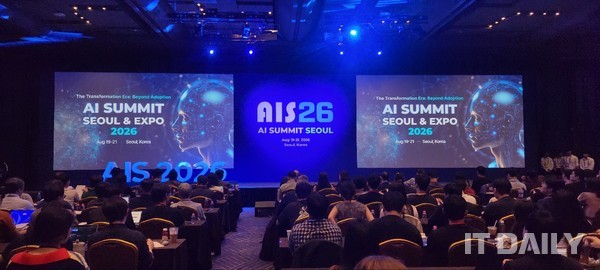
Against this backdrop, a session titled "Is LLM Really Helping Enterprise Productivity?" was held on the 19th at COEX in Gangnam District, Seoul, as part of "AI Summit Seoul 2026." Professor Lee Jun-gi of Yonsei University's Graduate School of Information served as moderator, and Kim Young-ok, CAIO at HD Hyundai; Kim Jong-hwan, executive vice president at Lotte Shopping; and Lee Kyung-jong, executive vice president at KB Kookmin Bank, shared their companies' AI adoption and expansion experiences.
A general view of the venue for "AI Summit Seoul 2026," held on the 19th at COEX in Gangnam District, Seoul, was captured in a photo. The photo was taken by photojournalist Kim Byeong-ju.
The professor pointed to the gap between enterprise AI adoption and actual business results. In McKinsey's "State of AI 2025" survey, 88% of respondents' organizations were using AI in at least one task, but in the same survey, only about 6% of high-performing companies were assessed as creating "substantial value" by having AI contribute to more than 5% of EBIT.
The professor said the core of the problem lies downstream. He also explained that the key issue is whether visible productivity improvements follow AI adoption.
The three company cases unveiled that day also shared the view that actual organizational adoption, rather than PoC performance, determines the success or failure of AI investment. Executive Vice President Lee Kyung-jong explained that there is essentially no such thing as a failed PoC; initial tests are mostly successful, but most cases fail in the rollout phase. He added that the reason rollout stalls is user differences.
KB Kookmin Bank said it took a photo of CEO Lee Hwan-joo and KB AI Dev Center head Kim Ji-young at the KB AI Dev Center in Yeouido, Seoul, to mark the opening of the "KB AI Dev Center." The photo was provided by KB Kookmin Bank.
KB Financial Group presented a case in which AI applications are being expanded across real-world operations such as branches, screening, and compliance. Executive Vice President Lee introduced a case in which KB Financial Group's AI agents have spread widely across business operations.
KB Financial Group began building a platform for agentic AI development in 2024 and unveiled the platform in April 2025. Based on this, the group currently operates about 100 AI services across the entire group.
KB Financial Group aims to expand its AI services to more than 300 through AX initiatives. Executive Vice President Lee said about 90% of the intended AI agent users are using them, and the actual number of users exceeds 8,000.
KB Financial Group is moving from the stage of expanding AI services to the stage of measuring actual productivity. The group's AI expansion status and utilization levels show that, along with service expansion, the focus is shifting to usage rates, user scale, and productivity measurement.
KB Kookmin Bank's AX application initially focused on changing the work styles of individual customers and branch employees, and later introduced agents to support PBs and RMs. It is now expanding into middle and back-office areas, including loan screening, risk management, legal affairs, and compliance. AX expansion is underway for employees, and customer-facing AX is also being prepared.
The main target is IT development. KB Kookmin Bank recently established an "AI Dev Center," with the goal of establishing an AI-native development process. To that end, the bank is creating a process in which first-stage development is done in an external R&D environment using SaaS tools such as Claude Code, and the results are then brought into the internal network through secure procedures.
However, a practical problem was raised: in the financial sector's network-separation environment, it is difficult to directly introduce the latest AI technologies. Executive Vice President Lee said the pace of technological progress is outpacing the pace of strategy formulation, and explained that if initial plans are rigidly followed, it becomes difficult to absorb rapidly evolving technologies.
As a photo of the HD Hyundai Heavy Industries Ulsan shipyard was released, HD Hyundai is pushing to apply AI to manufacturing sites such as production and design, and is expanding this into physical AI that connects AI with facilities and equipment. Since ship design tasks are not easily solved with a general-purpose LLM, HD Hyundai is focusing on an approach that directly combines AI with manufacturing production and design processes.
HD Hyundai has been advancing manufacturing AI for about 4 years, and its AI strategy has evolved in the process. At first, it focused on applying AI to individual production and design tasks such as drawing creation and quality review, with the goal of improving productivity at the task level.
But later, it concluded that AI would not remain firmly embedded in manufacturing sites through the success of individual projects alone. Accordingly, it is now focusing on spreading AX across the broader site network, including Ulsan and Yeongam.
Executive Vice President Kim Young-ok explained that HD Hyundai's AI strategy consists of two pillars. The top-down approach aims to shorten production and design lead times and innovate across the product life cycle, while the bottom-up approach focuses on improving employee productivity.
Kim introduced cases in which LLM and VLM were applied to design work such as wiring and outfitting, presenting examples of actual time savings. He said that for certain design tasks, AI can make it possible to complete the work within a week, and compared with not using AI for the same task, it can save about 3 weeks' worth of man-hours.
However, Kim said it is difficult to measure, through simple arithmetic, the effects of reducing material, fixed, and labor costs. He therefore raised the need to convert saved time into corporate results, emphasizing that reinvesting and using the time saved by AI back into the business is an important task.
He also said the need to build a proprietary manufacturing- and industry-specific model was confirmed on site. He pointed out that when asking a general-purpose LLM such as Gemini or Claude about design guidelines for a specific ship type or vessel, it is difficult to obtain answers that meet on-site requirements.
According to Kim, models that have not learned site-specific data and the company's own production and design know-how are not easy to use directly. HD Hyundai is therefore fine-tuning internal data based on open-source models and using manufacturing- and industry-specific models. Its specialized targets by value-chain process are production, design, sales, and estimating.
HD Hyundai is focusing on datafying tacit knowledge, including site techniques and know-how that may be lost as skilled workers retire, while advancing process-specific optimization. It plans to connect AI intelligence to manufacturing facilities and equipment in the future, and through this expand its application range into physical AI.
Lotte Shopping's e-commerce platform, LotteON, introduced a conversational search service called "Fashion AI." The article included a screen of "Fashion AI," which works by having users enter the style or situation they want, and then AI recommends fashion products that match the conditions. The photo was provided by LotteON.
Lotte Shopping presented the phrase "1 hour of work for an experienced worker, 1 minute." However, for Lotte Shopping-related tasks, the linkage to financial performance was presented as the challenge.
In Lotte Shopping's case, the gap between AI-based work time savings and corporate financial performance was laid bare. Executive Vice President Kim Jong-hwan said Lotte Shopping's AI project has two pillars: customer service and internal work productivity. For internal work, he explained that there were many cases in which tasks that normally took 1 hour for an experienced worker were completed in 1 minute.
However, converting such reductions in work time into higher sales or profits, or lower fixed costs, remained a separate challenge. Trial and error also occurred in customer-facing AI services. Lotte Shopping launched "Beauty AI" last year, but its effect on traffic and customer acquisition fell short of expectations.
Executive Vice President Kim Jong-hwan pointed to rising consumer expectations from general-purpose LLMs as one of the reasons. He said users have already accumulated experience with the search, recommendation, and conversational styles of ChatGPT, Gemini, and Claude, making it difficult for individual company AI services to deliver user experiences on par with general-purpose models.
For "Fashion AI," which it built this year, Lotte Shopping applied fashion-product metadata collection. It also applied customer data platform (CDP) ontologization. A product recommendation method using long-term memory was also applied to "Fashion AI."
However, Kim said that even that level is somewhat insufficient. He said the company is focusing on whether this actually leads to sales and profit.
This awareness of the issue converged across the three companies' experiences into a problem of how to measure AI productivity. The structure of the retail sector, in which there are many variables between AI projects and final sales, was also raised.
Accordingly, Lotte Shopping is exploring a direction that does not immediately evaluate AI results in terms of sales and profit. Instead, it is reviewing a method of setting intermediate key performance indicators (KPI) that lead to final results.
The approach is to first measure indicators that AI can directly affect and then link them to sales and profit. Examples included using AI to discover new products and brands, raise CTR, and improve CVR.
The view was raised that companies should not evaluate AI performance directly in terms of sales and profit, but should instead agree on and manage intermediate KPIs that support those outcomes. Kim said direct sales and profit KPIs should be avoided, and that intermediate KPIs to support them are needed. He also said the company is working on establishing KPIs based on agreement among employees and executives.
Kim said companies should be wary of a corporate culture that demands early proof of AI investment returns through financial metrics. He noted that not much time has passed since the emergence of LLMs, and said there have been many distortions due to the impatient culture of large South Korean companies. He also said guidance from management and C-level executives is necessary, and explained that refining intermediate KPIs is a condition for reaching the goal.
HD Hyundai is paying attention to the issue of linking design man-hours reduced by AI to actual business performance. Executive Vice President Kim Young-ok said reinvesting and utilizing resources saved by AI back into the business is an important task.
Competition in enterprise AI productivity is moving beyond the stage of proving the technical performance of individual PoCs and into the stage of spreading effectiveness across the organization and converting it into sustainable business performance. In this transition, the actual users performing the work are emerging as a key variable, and the importance of factors beyond technology is also being emphasized.
Executive Vice President Lee Kyung-jong distinguished between the PoC phase and the rollout phase, explaining that in the PoC phase, the users are people who studied enthusiastically, but in the rollout phase, the pattern changes because the users change, so the two cannot be viewed in the same way.
Source: IT DAILY · Kim Byeong-ju
Original: https://www.itdaily.kr/news/articleView.html?idxno=241080
References
This article was produced with the help of an automated content generation algorithm.
Source: IT DAILY
View originalThis article was summarized and organized by BizCrush based on the original article from IT DAILY. For exact quotations and full details, please refer to the original article.