CJ Group Affiliate Develops Bioplastics Made From Sugar
IT DAILY · · 5 views
✦ AI Summary
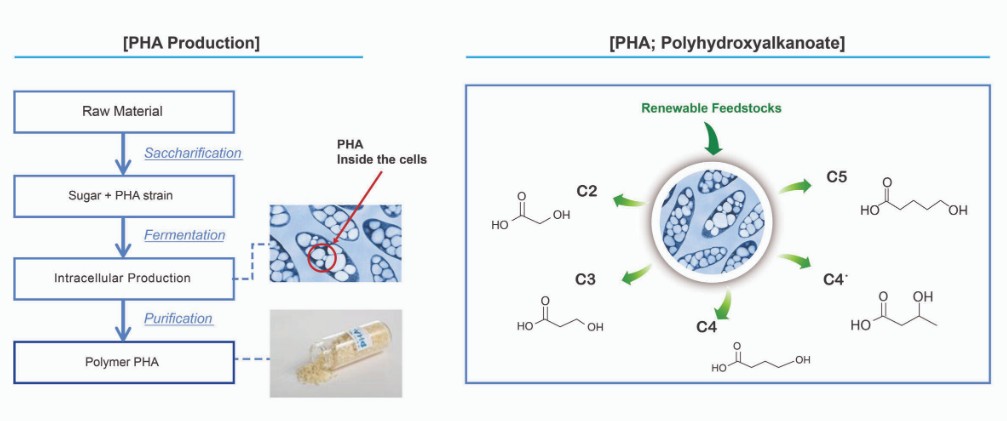
CJ BioMaterials has developed a technology to produce PHA by feeding sugar to microorganisms.
PHA, or polyhydroxyalkanoate, is biodegradable in soil and marine environments and can be used in forks, straws, cups, food containers and packaging films.
Bioplastics still account for about 0.5% of the overall plastics market, but demand is rising.
As microplastics are increasingly cited as a major environmental pollutant, interest in bioplastics as an alternative to conventional plastics is growing. Among them, sugar is emerging as a promising raw material, and technology to produce plastic materials through microbial fermentation of sugar is drawing attention.
The PHA produced through this method stands for polyhydroxyalkanoate, a bio-based polymer. CJ BioMaterials, under CJ, has developed a PHA production technology that feeds sugar to microorganisms, and the resulting PHA is intended for use in forks, knives, packaging materials and other products. Because PHA is biodegradable in soil and marine environments, it can break down naturally after use without leaving microplastics, and it is regarded as an eco-friendly solution.
AP reported the details. CJ BioMaterials' research and development base is in Woburn, Massachusetts, where the PHA technology is being advanced in the direction of developing a range of single-use plastic alternatives.
The manufacturing method developed by CJ BioMaterials' laboratory uses microbial metabolism. When sugar is supplied to microorganisms, PHA is produced as the microorganisms use the sugar as an energy source, and the resulting PHA is then recovered.
The recovered PHA goes through a pelletizing process, and the resulting PHA pellets can be supplied to plastic product manufacturers. Manufacturers can melt-process the PHA pellets, using a process similar to that for conventional plastic pellets. Items that can be processed include forks, straws, cups, food containers and packaging films.
The Woburn laboratory has begun experiments to apply this material to actual products. The research team made forks by feeding PHA pellets into a molding machine, and also produced food-packaging film by rolling out melted material.
Some of the test forks were made thin enough to be home-compostable. Those thin forks bent more easily than conventional plastic forks, and by adjusting certain molecular arrangements, it was possible to achieve rigidity similar to that of ordinary plastic forks.
Conventional food-packaging films have high strength but lack stretchability like wrap. Accordingly, the research team is focusing on developing compostable materials after use while securing properties similar to those of existing plastics.
One reason bioplastics are drawing attention is how they are disposed of after use. Petrochemical-based plastics remain in the natural environment for dozens to hundreds of years, and microplastics and nanoplastics are generated during the decomposition process.
Microplastics have been found in the ocean, the atmosphere, food and drinking water, and recently even in the human body, and they have been shown to have adverse effects on the environment and health. In this sense, post-use disposal is presented as an important criterion in material selection.
CJ BioMaterials' website explains that its PHA is broken down by microorganisms after disposal. CJ BioMaterials also said that PHA plastics decompose within about 6 months in a compost pile, and said they can be composted within up to 6 months, reducing concerns about microplastic residue.
Bioplastics are classified in two ways, by raw material and by decomposition characteristics. Bio-based plastics refer to materials made from renewable resources such as corn and sugarcane, while biodegradable plastics refer to materials that are completely broken down by microorganisms and other agents through natural processes. The two criteria do not always match, so bio-based but non-biodegradable materials exist, and petroleum-based but biodegradable materials also exist.
Under this distinction, the PHA developed by CJ BioMaterials uses sugar, a renewable raw material, and has biodegradability in soil and marine environments, making it an example of both bio-based and biodegradable characteristics. The company's main target for substitution is single-use plastics that are difficult to recycle because of food contamination. Existing plastic containers stained with food waste require separate handling in the recycling process, but compostable PHA containers can be sent to composting facilities together with food waste. PHA containers also help reduce methane emissions during the decomposition of food waste in landfills.
PHA products are on display inside the laboratory, and the exhibits include tableware, straws, beverage-coated cups, frozen food pouches, sushi trays, ramen containers and reusable paper towels. Commercialization of PHA-applied products in the United States and Tous Les Jours' use of PHA straws show that products using PHA are already in use in some markets.
However, bioplastics still account for only a tiny share of the overall plastics market. According to European Bioplastics, global annual plastic production exceeds 400 million tons, and bio-based plastics account for about 0.5% of that total.
Even so, demand continues to rise and new application areas are expanding. Production is projected to roughly double by 2030. Major exporters of natural polymer materials are China, Sweden and the United States, and trials are also under way to apply bio-based packaging materials and tableware at major sports stadiums and at global restaurant chains such as McDonald's.
By contrast, bio-based plastics are seen as limited by their higher production costs compared with conventional petrochemical-based plastics. In regions lacking composting facilities, the inability to take full advantage of product benefits is also cited as an obstacle to wider adoption.
WWF sees bioplastics as one possible solution to pollution problems, and experiments to verify their effectiveness are continuing accordingly.
5 Gyres Institute, a U.S. environmental research group, conducted a 64-week experiment on 22 products made from alternative materials such as conventional plastic, bio-based and biodegradable materials, paper and bamboo. After placing straws, tableware, thin films and bottles in various environments in Florida, California and Maine and observing the changes, the researchers found that some biodegradable materials had largely disappeared or developed holes and cracks on the surface, and they confirmed the decomposition process of some biodegradable materials. By contrast, most fossil fuel-based conventional plastics remained.
5 Gyres released those findings in 2023 and has since been conducting follow-up research to assess the post-use disposal environment for next-generation packaging materials.
The response to the plastic problem is also said to require efforts to reduce plastic production in parallel, and especially if bioplastics become successfully established in areas such as food packaging that is difficult to recycle and in single-use items, progress is expected in solving the microplastics problem and the nanoplastics problem.
Source: IT DAILY · Jo Min-su
Original: https://www.itdaily.kr/news/articleView.html?idxno=241078
References
This article was produced with the help of an automated content generation algorithm.
Source: IT DAILY
View originalThis article was summarized and organized by BizCrush based on the original article from IT DAILY. For exact quotations and full details, please refer to the original article.