Samsung Electronics to Build AI Data Center Liquid Cooling Line in Gwangju, Accelerating HVAC In-House Production
IT DAILY ·
✦ AI Summary
Samsung Electronics said it will build a production line for data center HVAC equipment, including CDU, at the third campus of its Gwangju plant to localize FläktGroup's AI data center cooling technology into its domestic manufacturing system.
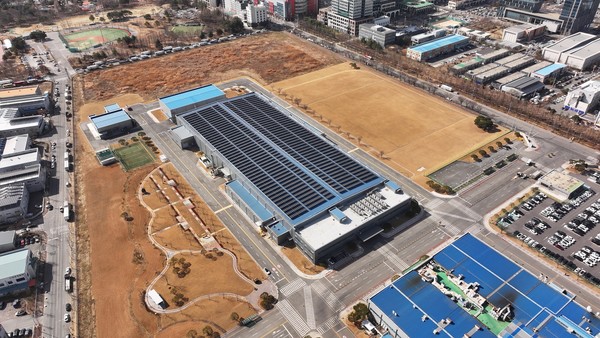
The investment target is the third campus of the Gwangju plant in Buk-gu, Gwangju, Jeollanam-do, and Samsung Electronics will invest about KRW 240 billion.
The line will produce CDU, FWU, CRAH, and AHU, and product production is scheduled to begin in early 2028.
Samsung Electronics said on the 19th that it will build a production line for data center HVAC equipment, including CDU, at its Gwangju plant to localize the AI data center cooling technology of FläktGroup, which it acquired last year, into its domestic manufacturing system. The investment target is the third campus of the Gwangju plant in Buk-gu, Gwangju, Jeollanam-do, and Samsung Electronics will invest about KRW 240 billion.
The facility to be built will be a 21,800-square-meter production line for air-conditioning products, or about 6,600 pyeong, and the line will be about the size of three soccer fields. Product production at the line is scheduled to begin in early 2028.
As a result, the role of the Gwangju plant will expand beyond its existing position as a home appliance production base. In addition to serving as a hub for AI home appliance production, the Gwangju plant will also handle industrial HVAC equipment for data centers and advanced manufacturing facilities, while also taking on a new role of expanding its B2B base.
After acquiring FläktGroup, Samsung Electronics began integrating its business operations, spanning product production and market expansion. This investment marks the first full-scale deployment in Korea of the central air-conditioning technology and manufacturing capabilities secured through the acquisition of FläktGroup.
The key product of the new production line is CDU for AIDC liquid cooling systems. A CDU is a device that manages coolant flow between a data center chiller and the cold plates inside servers, serving as the link between data center cooling infrastructure and servers. In the process, it precisely controls the pressure and temperature of the coolant generated by the chiller, removes impurities from the coolant, and then supplies it to the servers. After passing through the servers and absorbing heat, the coolant returns to the chiller through heat exchange in the CDU.
The role of such CDUs is growing in importance as AI servers become more widespread. Compared with conventional general-purpose servers, AI servers offer higher computational performance but also consume more power and generate more heat. Traditional air cooling circulates cold air with fans, but in high-density server environments, air cooling alone has limitations in achieving efficient cooling.
Accordingly, liquid cooling is also gaining importance as a technology that delivers coolant closer to the servers. To manage server heat effectively, the need for liquid cooling in data center cooling systems has increased, and at the center of that system, the CDU handles coolant control and circulation.
To improve the performance and stability of such CDUs, FläktGroup enhanced power efficiency, applied redundant design, and added anomaly detection functions. Through this, it strengthened the energy efficiency and stability of data center operations.
The Gwangju production line will produce CDUs, fan wall units (FWU), computer room air handlers (CRAH), and air handling units (AHU) for large buildings. FWU is equipment used in data center air-cooling systems. The line, in which Samsung Electronics will simultaneously produce liquid cooling and air-cooling equipment, reflects a strategy to supply a hybrid cooling system tailored to the power density and facility conditions of data centers.
FläktGroup is a central air-conditioning specialist with more than 100 years of history. It operates 14 production lines and 8 research centers in the U.S., Europe, and Asia, and has supplied HVAC equipment to data centers, industrial manufacturing facilities, hotels, airports, and museums. The Gwangju production line is FläktGroup's 15th global production facility.
Samsung Electronics plans to target domestic and overseas AI data centers and advanced manufacturing facilities based on the Gwangju production equipment. This is seen as part of an effort to expand production capacity and improve responsiveness to the Asian market by combining technologies secured through overseas acquisitions with domestic manufacturing infrastructure.
The Gwangju plant was established in 1989 and started out as a home appliance production base. It currently produces the 'Bespoke AI Family Hub' refrigerator, the 'Bespoke AI Combo' washer-dryer, and the 'Bespoke AI WindFree' air conditioner. It also serves as a channel for spreading advanced manufacturing technologies to overseas production subsidiaries, and the Precision Mold Development Center was established within the Gwangju plant in 2010.
This is the first large-scale production facility investment in the Gwangju plant in 37 years. Samsung Electronics plans to use the plant's existing production infrastructure and manufacturing capabilities to develop the Gwangju plant into a global hub for simultaneous production of AI home appliances and HVAC systems.
Based on this, Samsung Electronics aims to become a leading global HVAC company by 2030. Kim Cheol-gi, head of Samsung Electronics' DA Business Division and vice president, said he intends to push for rapid expansion of the HVAC business and explained that building the Gwangju production line would provide the foundation for securing differentiated HVAC competitiveness.
Source: IT DAILY · Lee Jae-young
Original: https://www.itdaily.kr/news/articleView.html?idxno=241071
References
This article was produced with the help of an automated content generation algorithm.
Source: IT DAILY
View originalThis article was summarized and organized by BizCrush based on the original article from IT DAILY. For exact quotations and full details, please refer to the original article.