Snowflake Expands 'Cortex AI Gateway' With Dynamic Model Routing to Improve 'Intelligence Efficiency'
IT DAILY ·
✦ AI Summary
Snowflake announced on the 19th that it is introducing Dynamic Model Routing to Cortex AI Gateway and its AI products.
The company said the feature automatically selects the right model for each task, reducing the need to choose and manage models directly for every request and helping lower inference costs.
It also said it is expanding access to open models such as DeepSeek V4 Flash 0731 and GLM-5.32 through Snowflake Cortex AI, while allowing governed data to remain within Snowflake.
Snowflake announced on the 19th that it is introducing 'Dynamic Model Routing' to 'Cortex AI Gateway' and its AI products. The new feature is based on Cortex AI Gateway, which was announced last month.
Cortex AI Gateway is an integrated foundation for agent connection management, intelligent request routing, and AI consumption optimization. Snowflake said it is introducing 'Dynamic Model Routing' to its AI portfolio based on this foundation.
Snowflake said that as companies expand the operation of AI applications and agents, using a single model for every task can lead to sharply higher costs. It also said that the need to individually evaluate and manage multiple models places a burden on development teams.
The company cited cost efficiency for AI workloads and improved 'intelligence efficiency' as use cases for the feature. It explained that 'intelligence efficiency' refers to the degree to which computing resources, models, data, and context are converted into business outcomes.
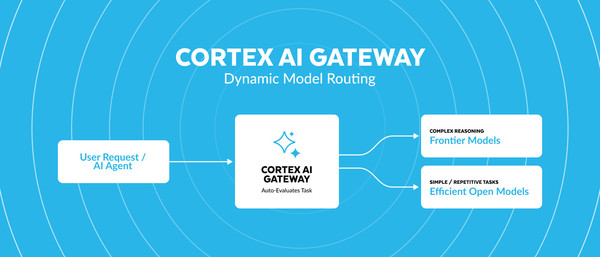
Snowflake said it is offering automated model selection along with access to open and commercial models to reduce the burden of choosing models. Cortex AI Gateway automatically selects models by balancing quality and cost for each task, and this Dynamic Model Routing feature applies to Snowflake Coco, Snowflake Co-work, and third-party AI agents that use Cortex AI Gateway.
Snowflake said it allocates cost-efficient models for repetitive and less complex tasks, and frontier models for tasks that require deep reasoning. The company said customers therefore do not need to select and manage models directly for each request, which can reduce inference costs.
At the same time, Snowflake is expanding customer access to open models such as DeepSeek V4 Flash 0731 and GLM-5.32 through Snowflake Cortex AI. The company said it has added these models to its model library.
Customers can keep governed data within Snowflake while selecting models that match the balance of quality and cost. Snowflake said it also provides access to commercial models as well as open models through Snowflake Cortex AI.
The company said the purpose of the new feature is not simply to expand enterprise AI usage, but to help manage AI economics in the process. It described the feature as supporting task-specific model matching, reducing unnecessary costs, and helping achieve intelligence efficiency.
Shreeda Ramaswamy, Snowflake CEO, said companies are increasingly strengthening their evaluation of AI economics. He said the key criterion is whether AI usage is connected to meaningful business value, and described flexible use of the optimal model for each task in line with a changing environment as a condition for achieving intelligence efficiency.
He added that Snowflake's role is to handle complexity on behalf of customers and help them stay focused on outcomes. He also said the company supports this response by optimizing model selection at the foundational level.
Source: IT DAILY · Yang Seung-gap
Original: https://www.itdaily.kr/news/articleView.html?idxno=241074
References
This article was produced with the help of an automated content generation algorithm.
Source: IT DAILY
View originalThis article was summarized and organized by BizCrush based on the original article from IT DAILY. For exact quotations and full details, please refer to the original article.