SGA Solutions and Keepair Join Forces on PQC Zero-Trust Business Collaboration
IT DAILY ·
✦ AI Summary
SGA Solutions and Keepair announced an MOU exchange for PQC zero-trust business collaboration. The MOU exchange was carried out by SGA Solutions CEO Choi Young-cheol and Keepair CEO Lee Chang-geun on the 18th. The two companies plan to link the zero-trust platform with Keepair's PQC technology to build security models for public sector, finance, and defense applications and to pursue joint business opportunities.
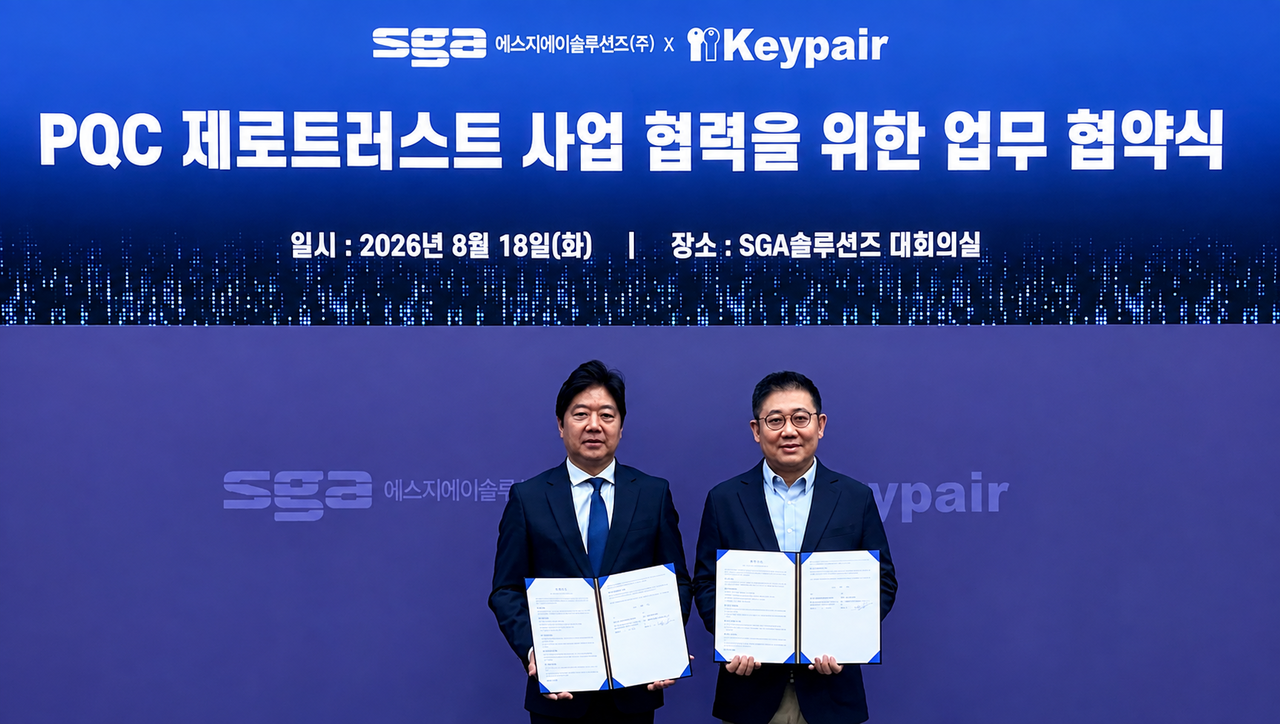
SGA Solutions, an integrated IT security specialist, and Keepair, a Post-Quantum Cryptography (PQC) specialist, announced on the 19th that they had exchanged an MOU aimed at "PQC zero-trust business collaboration." The MOU exchange was carried out by SGA Solutions CEO Choi Young-cheol and Keepair CEO Lee Chang-geun, and the exchange and commemorative photo session took place on the 18th.
The partnership was launched as concerns grew that data based on public-key cryptography could be decrypted in the future as quantum computing advances. In particular, "Harvest Now, Decrypt Later" (HNDL) is emerging, referring to the theft of data encrypted with public-key cryptography today and its later decryption using quantum computers.
Against this backdrop, public and private sector organizations are moving to transition existing cryptographic systems to PQC. Accordingly, the two companies plan to link SGA Solutions' zero-trust platform with Keepair's PQC technology and build security models for public sector, finance, and defense applications.
Based on the MOU, the two companies will pursue joint business opportunities, cooperate in sales and marketing, and connect sales channels. Through this, they aim to concretize a collaborative framework that combines the zero-trust platform with PQC technology.
As discussions continue in Korea on pilot PQC deployments across industries and on regulatory and institutional reforms, the two companies are moving to secure an early lead in the market by pursuing an integrated zero-trust and quantum-resistant security design following the start of the memorandum of understanding. This move comes as Korea is also discussing pilot PQC deployments and institutional reforms.
As the government has indicated a policy of fostering quantum technology as a future growth engine, demand for quantum security in highly security-sensitive sectors is expected to rise. SGA Solutions CEO Choi Young-cheol said this collaboration marks the starting point for designing next-generation security systems to respond to the quantum computing era, and explained that the company plans to implement a PQC zero-trust model that can be applied in the public sector, finance, and defense by combining PQC technology and zero-trust capabilities.
Keepair CEO Lee Chang-geun said that in a zero-trust environment, security across the entire process of cryptographic key generation, storage, and use, in addition to access control, is important. He said the two companies will pursue joint proof-of-concept work and commercialization based on their technologies and references, and added that they aim to set a new standard for quantum-resistant security in the zero-trust market based on their technologies and references.
Post-Quantum Cryptography (PQC) is a cryptographic technology designed to withstand attacks from high-performance quantum computers. In particular, the "Shor" algorithm is widely cited as a threat to current public-key cryptography. Public-key cryptography such as RSA and Elliptic Curve Cryptography (ECC) could be rendered ineffective in a quantum computing environment.
To address these risks, PQC is intended to replace or supplement existing public-key cryptography. As quantum computers could weaken conventional public-key systems, PQC is drawing attention as a countermeasure.
Standardization is also under way. The U.S. National Institute of Standards and Technology (NIST) finalized the first 3 PQC standards in 2024.
At the same time, the "Harvest Now, Decrypt Later" (HNDL) attack is also being discussed. This refers to an attack in which encrypted data that is currently difficult to decrypt is stolen and stored, then decrypted later using future quantum computers.
Long-term confidential information may be exposed in the future even if it is stolen today. This HNDL risk is one reason cited for the need to accelerate the transition to PQC. It is also presented as a backdrop for the need to speed up the shift to PQC in order to protect long-term confidentiality.
Source: IT DAILY · Kim Ho-jun
Original: https://www.itdaily.kr/news/articleView.html?idxno=241068
References
This article was produced with the help of an automated content generation algorithm.
Source: IT DAILY
View originalThis article was summarized and organized by BizCrush based on the original article from IT DAILY. For exact quotations and full details, please refer to the original article.