Robros to Deploy 9 Humanoid Robots Across Semiconductor, Auto, and Logistics Sites in Paid Pilot Program
IT DAILY ·
✦ AI Summary
Robros announced a plan to supply 9 of its self-developed bipedal humanoid robots, IGRIS-C.
The robots will be deployed to 9 organizations in the semiconductor, automotive manufacturing, and logistics sectors, including a semiconductor cleanroom, an automotive plant, and a refrigerated logistics center.
This pilot will verify the stable repeatability of bipedal walking and object manipulation in industrial environments with different temperatures, floor conditions, and work routes.
Homegrown bipedal humanoid robots will be deployed simultaneously at semiconductor, automotive, and logistics industrial sites. On the 19th, Robros announced a plan to supply 9 of its self-developed bipedal humanoid robot "IGRIS-C." The recipients include 9 organizations in the semiconductor, automotive manufacturing, and logistics sectors. Robros is a full-stack AI humanoid robot company.
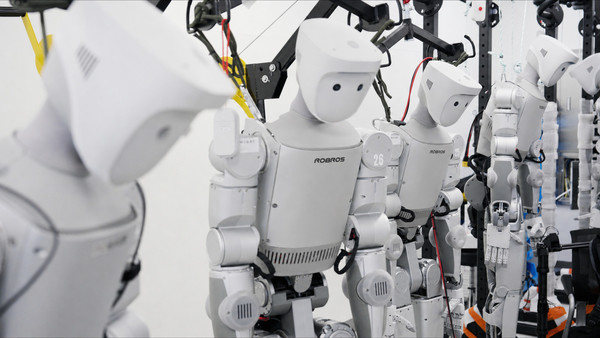
The robots to be supplied in this round are Robros' "IGRIS-C." This deployment is not a demonstration at a research institute or a one-off technology showcase. It is a paid supply in which the requesting organizations bear the cost. Photo courtesy of Robros.
This pilot will test conditions at industrial sites where temperature, floor conditions, and work routes differ. The verification items include the stable repeatability of bipedal walking and object manipulation. Through this, real-world work environments will be validated across multiple industrial settings.
This supply does not mean an immediate replacement of existing industrial robots or automation equipment. However, it is being seen as a sign that the domestic humanoid market has entered an early pilot stage. The plan is an example of the trend toward applying domestically developed humanoids in industrial settings.
The supply will be carried out through the "Humanoid Robot Pilot Support Project" overseen by the Korea Robot Industry Promotion Agency. Ten consortia were selected, and 3 of them adopted IGRIS-C as their pilot platform. The number of units to be supplied is 3 per project, or 9 in total, and the deployment sites are a semiconductor cleanroom, an automotive manufacturing plant, and a refrigerated fresh-food logistics center.
The key point of this pilot is not human likeness, but rather verifying whether the robot can actually operate in work environments that existing automation equipment struggles to handle. General industrial robots are typically fixed to the floor or move along predetermined rails, and they excel in repetitive task speed and precision. However, they have the limitation that equipment and work routes must be reorganized when processes change.
Autonomous mobile robots, or AMR, are well suited for transporting goods on flat floors. However, their use is limited in spaces with stairs, slopes, or complex obstacles. This pilot focuses on whether the robot can actually operate in environments where existing industrial robots and AMR face constraints.
Humanoids are drawing attention because they can potentially be deployed without major modifications to existing work sites. Because they move on two legs and handle objects at a human-like height, they can potentially use human doors, stairs, worktables, and tools. As a result, they could broaden the scope of automation in environments with diverse, small-batch production and frequent process changes.
However, bipedal walking is more complex to control and consumes more energy than wheeled robots. Additional challenges include the risk of falling, work speed, battery life, and recovery in the event of a failure. In the end, competitiveness at industrial sites depends not on walking demonstrations, but on whether the robot can reliably repeat designated tasks for long periods and offer a reasonable cost compared with existing labor and equipment.
This project involves deploying the same humanoid platform into 3 different environments. The target environments are a semiconductor cleanroom, an automotive plant, and a refrigerated logistics center. Semiconductor cleanrooms require cleanliness maintenance and precise movement, while automotive plants require handling heavy parts and complex work routes. In refrigerated logistics centers, low temperatures can affect battery and drivetrain performance, and the project is expected to serve as a test bed for confirming both versatility and environment-specific limitations.
IGRIS-C is a bipedal humanoid robot that stands 154 cm tall and weighs 56 kg. It is designed to move through narrow and complex spaces such as laboratories, factories, and warehouses. Robros said it applied reinforcement learning-based whole-body and walking control algorithms, which allow the robot to maintain balance on slopes and stairs.
IGRIS-C has collision detection and control functions for operation in the same space as human workers. It is equipped with external impact detection and control methods, with an eye toward reducing the risk of collisions with people and surrounding equipment. The LED on the head indicates the robot's operating status.
IGRIS-C can replace its end effector depending on the task. An end effector refers to the robot's hand. Supported models include the "5-finger humanoid hand," "electromagnetic gripper," and "1-degree-of-freedom gripper." The "5-finger humanoid hand" has a shape similar to a human hand and is used for various tasks, while the "electromagnetic gripper" is for transporting metal parts. The "1-degree-of-freedom gripper" is designed for structural simplification and improved operational stability.
Robros has an in-house system that develops and provides not only the robot body, but also walking and whole-body control AI models, precision-manipulation remote-control equipment, mobile applications, and an AI data labeling platform.
After the robots are supplied, the company will provide technical support and operational training. It also plans to use data generated during the pilot process, with the aim of improving work performance.
The 9 units in this supply are all under paid contracts, and cumulative sales of IGRIS-C have increased from 9 to 18 units. Total cumulative production stands at 36 units. The 18 unsold units will be used for in-house R&D, technology demonstrations, and customer testing. Robros CEO No Seung-jun said real-world industrial-site performance is the most important competitive edge, and added that the company will push for commercialization of the domestic humanoid industry through continued production expansion and stable supply.
Source: IT DAILY · Lee Jae-young
Original: https://www.itdaily.kr/news/articleView.html?idxno=241065
References
This article was produced with the help of an automated content generation algorithm.
Source: IT DAILY
View originalThis article was summarized and organized by BizCrush based on the original article from IT DAILY. For exact quotations and full details, please refer to the original article.