Korea PMO Association to Recruit 25th Class for PMO Expert Course ... 14-Week Program Starts Next Month 4
IT DAILY ·
✦ AI Summary
As AI projects increase, the role of PMO is expanding from schedule and budget checks to managing data and model uncertainty, as well as risks.
The Korea PMO Association said on the 18th that it will recruit trainees for the 25th PMO Expert Course.
The course reflects changes in the AI Basic Act, which took effect on January 22, and PMBOK 8th edition, and includes AI project management, the AI development process, and agile methodology.
As AI projects increase, the role of PMO is also expanding. The focus is shifting from traditional project management centered on schedule and budget checks to managing data and model uncertainty, as well as AI-related risks.
Reflecting the characteristics of AI projects, in which all functions and performance are difficult to finalize before a project begins, PMO training programs are also changing. Taking these changes and the nature of AI projects into account, the Korea PMO Association said on the 18th that it will run the 25th PMO Expert Course and recruit trainees.
The program will run from next month 4 to December 18, and the training period is 14 weeks. Classes will be held every Friday at 2 p.m.
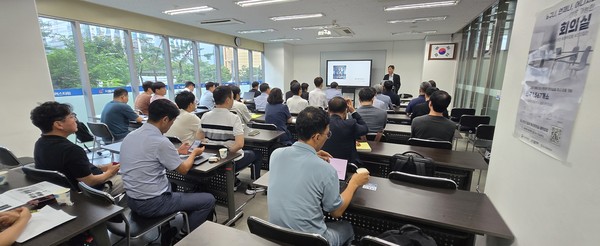
This course reflects the Basic Act on the Development of Artificial Intelligence and Establishment of Trust-Based Foundations, which took effect on January 22, as well as changes in PMBOK 8th edition. The curriculum includes AI project management, the AI development process, and agile methodology, and it focuses on helping trainees secure practical project management capabilities that can be applied in the field. The photo shows trainees taking part in a class for the 23rd PMO Expert Course.
AI projects have characteristics that differ from conventional informatization projects, which develop and deliver predefined functions. Even for the same AI model, performance can vary depending on the amount and quality of training data, the operating environment, and user questions, and data cleansing and retraining may be needed as a project progresses. Development direction may also change as new models and technologies emerge, requiring management different from that used for conventional informatization projects.
For this reason, the PMO's management scope in AI projects is expanding. Where the traditional scope covered scope, schedule, budget, and quality, it now also includes data, model performance, ethical risks, legal and regulatory compliance, and agreement on performance standards among stakeholders. Another background to this change is that simply checking whether requirements are met at the procurement stage is not enough to adequately manage AI project outcomes and project value.
With the enforcement of the AI Basic Act, transparency and safety requirements for high-impact AI and generative AI have become more specific, increasing the need to consider AI impact assessments, risk management, and data quality management from the outset of projects. As cloud migration expands and the use of external AI models and services increases, data transfer, security, service continuity, and vendor lock-in are emerging as areas for PMO review.
The Korea PMO Association said it reflected a change in the structure of the 25th class curriculum to match the changed environment and set the goal of strengthening practical capabilities needed to carry out AI projects. Specifically, it set goals of strengthening the ability to manage the uncertainty unique to AI projects, the ability to draw consensus among stakeholders such as procuring organizations and executing companies, and the ability to realize strategic project value.
Accordingly, the course is focused on teaching field-proven know-how related to the enforcement of the AI Basic Act. Key topics include systematic competency development based on a PMO competency model, new approaches to project management in the AI era, and case-based simulations drawn from practical know-how of field experts.
The association designed the curriculum with PMBOK 8th edition and the AI Basic Act in mind. The curriculum design is based on a four-layer, 18-item PMO competency model, and the trainees' learning foundation consists of technology, methodology, relevant systems, and understanding of AI projects.
Trainees will learn scope management, schedule management, quality management, risk management, and stakeholder management. The association said scope, schedule, quality, risk, and stakeholder management are core PMO tasks.
This training covers consulting capabilities for delivering project value based on problem-solving, communication, and facilitation, and is designed to extend beyond individual project management to organizational governance and project portfolio management capabilities. The training method is designed as a step-by-step program that also develops strategic insight capabilities, and the theme is new approaches to project management in the AI era.
The training separately covers the characteristics that distinguish AI projects from conventional informatization projects. The AI project characteristics covered include data dependency, uncertainty in model performance, and ethical considerations. Based on this, the program will cover methods for identifying and responding to inherent risks in AI projects, changes in development methodology in the AI era, the changing role of PMO, domestic and overseas AI policy trends, and the structure of AI projects.
Reflecting these differences, agile methodology is incorporated into the training. The background is the view that managing AI development only with the traditional waterfall approach has limitations, and the core of the learning is to understand a management method that refines goals after repeated data validation and model performance evaluation rather than requiring fixed deliverables at the outset.
This course is a practical training program aimed at improving field adaptability. Working experts who have handled next-generation system development, information strategy planning (ISP), and PMO projects in the financial, public, and energy sectors will participate and share project experience and problem-solving cases. Case-based simulations will be conducted for trainees, covering responses to changes in project scope, delays in schedule, disagreements over quality standards, and conflicts between procuring organizations and executing companies.
The program is designed to help participants learn how to respond to problems that can arise in the field and in AI projects. Accordingly, training on AI project cases is also planned, and the cases will cover situations where an AI model fails to meet target performance and where data acquisition is delayed.
The Korea PMO Association highlighted a 14-week joint training-based human network as a feature of this course. Project managers from procuring organizations and executing companies will participate in the training together, sharing experiences and perspectives from their different positions. Through this, it said, the association expects to reduce differences in understanding between procurers and executors and help form a collaboration-based network.
Upon completing the course, participants will be issued a registered private qualification certificate for PMO expert. The qualification is listed as private qualification No. 2022-002208. The association plans to offer graduates opportunities to participate in PMO projects and support referrals for employment at related companies.
Kong Bong-seok, vice president of the Korea PMO Association, said he values communication and networking among trainees. He also said graduates will be invited to conferences hosted by the association, supported through community activities such as golf and hiking, and helped maintain exchanges even after the training ends.
Those who wish to participate in PMO training can apply by filling out an application and submitting it to the Korea PMO Association by email.
Source: IT DAILY · Lee Jae-young
Original: https://www.itdaily.kr/news/articleView.html?idxno=241055
References
This article was produced with the help of an automated content generation algorithm.
Source: IT DAILY
View originalThis article was summarized and organized by BizCrush based on the original article from IT DAILY. For exact quotations and full details, please refer to the original article.