[Spotlight] Cloudera's Blueprint for a "Hybrid AI" Future
IT DAILY ·
✦ AI Summary
Cloudera held "EVOLVE26 Singapore" in Singapore on August 20 and unveiled "Cloudera Anywhere Cloud."
At the event, data location, where inference is run, cost control, and the scope of AI agent permissions were presented as core challenges for enterprise AI infrastructure.
Cloudera emphasized its hybrid strategy and a model of operating data and AI workloads by environment.
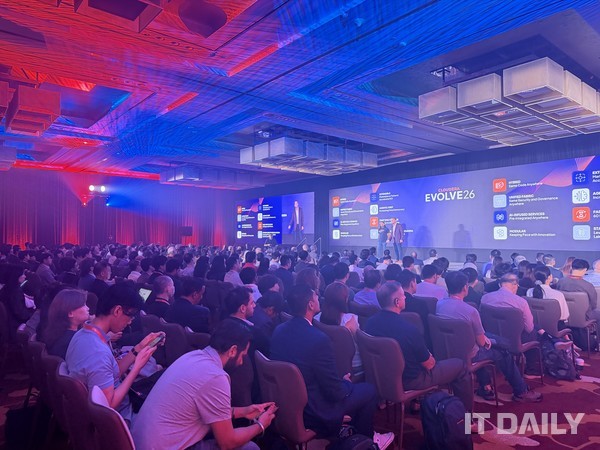
"EVOLVE26 Singapore" was held on August 20 at the Marina Bay Sands Convention Centre in Singapore local time. Photo credit: Yang Seung-gap.
As enterprise AI use moves from the experimental stage to actual operations, the criteria for evaluating AI infrastructure are changing as well. As a result, data location, where inference is run, how costs are controlled, and the scope of AI agent permissions are emerging as key issues rather than model performance.
These market shifts are tied to Cloudera's "hybrid" strategy. Cloudera presented a direction that lets companies choose execution environments based on data and workload characteristics, while also linking a single framework for security, governance, and data management across multiple environments.
On August 20 local time, Cloudera held its annual data and AI conference, "EVOLVE26 Singapore," at the Marina Bay Sands Convention Centre in Singapore and unveiled its new platform, "Cloudera Anywhere Cloud." The main theme of the event was Anywhere Cloud, and it broadly covered hybrid AI architecture, data governance, AI Factory, sovereign AI, agentic AI operating strategies, and real-world enterprise deployment cases. The morning main stage sessions presented the new platform, technology strategy, and customer cases.
The afternoon group interview broadened the discussion to the process of moving enterprise AI operating environments. The session covered data preparation, permission control, cost and performance, and market expansion challenges, while the EVOLVE26 venue highlighted how Cloudera's hybrid strategy is being implemented and where it is headed in the market.
A photo was released showing Cloudera Chief Technology Officer (CTO) Sergio Gago and Cloudera Chief Product Officer (CPO) Leo Brunnick speaking. The caption identified the scene as Sergio Gago, CTO of Cloudera, and Leo Brunnick, CPO, speaking, and the source was Cloudera.
In the first morning session, Sergio Gago and Leo Brunnick, who took the stage as speakers, presented the essential requirements for an enterprise data and AI platform: true hybrid capability, an integrated data fabric, AI-native services, modularity, scalability, agent-first design, and faster time to value.
They then explained that the key goes beyond supporting on-premises and public cloud environments at the same time. They said the core requirement is to operate the platform in the same way in any environment.
Examples of deployment environments included public cloud, private data centers, air-gapped environments, and sovereign environments. The two speakers said the goal of the deployment model is to maintain the same code regardless of environment and the same operating experience regardless of environment.
Anywhere Cloud adopts a modular structure that allows individual data services to be added or replaced independently. Under the old approach, changing a single service sometimes required upgrading other areas of the management tools and platform as well, but it was designed to reduce those constraints. Needed services can be selected from the marketplace, and the chosen services can run alongside the existing environment. Brunnick, CPO, introduced a case in which Spark 4 was added separately and used alongside an existing Spark 3 workload.
The basis for this flexibility was presented as an integrated data fabric that unifies multiple environments. To this end, the company said it uses open table formats and standard interfaces, and it also outlined a plan to connect with other data platforms and storage outside its own platform. It also presented a direction in which consistent access and governance are applied regardless of where the data resides.
Gago, CTO, stressed that the core of implementation difficulty is not simple service deployment. He explained that anyone can deploy a service on-premises, but deployment with high availability, disaster recovery, auto-scaling, and multi-tenancy is not easy. He then identified building a data fabric that ties everything together as the most difficult task.
Cloudera announced that it cut the average time from hardware preparation and internal review to live operation of data services from about 60 days to less than 60 minutes. Brunnick, CPO, said that one year ago on this stage he mentioned launching a 2030 data and AI platform in 2026, and at the time he had set an installation time of less than 1 hour. He said there was some skepticism at the time, but that the company has now reached that level one year later.
In a technology demonstration that day, the scenario assumed a cyberattack had crippled a data center. The session showed a flow in which an incident's cause was analyzed through a natural-language request.
An AI agent then accessed the data center, cloud, and databases to identify the cause of the failure, assess the financial impact, and identify affected customers. It also handled the process of shifting the service operating environment to another cloud and drafting a notice for impacted customers.
Brunnick, CPO, emphasized that the key lies not in the agent itself but in the foundation that enables it. He said a data and AI system with full governance across multiple environments is needed, and explained that a data fabric and guardrails are also required.
Cloudera presented its AI Factory strategy under the theme of a shift from the "model era" to the "system era." The photo shows Abbas Riki, Cloudera's Chief Business Officer (CBO) and head of Applied AI, discussing with Brian Martin, AbbVie's chief AI product officer. The source is Cloudera.
Abbas Riki said the center of the enterprise AI market is shifting from the models themselves to systems that can run continuously. He explained that the focus of enterprise AI is moving from the performance of individual models to the operating systems that run them reliably.
At present, a structure has emerged in which different models, GPU configurations, and architectures are combined for each copilot and AI application. Riki said that as use cases increase, the complexity of this structure grows as well.
Accordingly, he said the importance of a structure that develops and operates multiple AI applications and agents on a common framework is increasing. The idea is that instead of attaching different models and infrastructure to each service, multiple applications and agents should be managed on a shared foundation.
Riki said AI investment is also shifting from model training to inference and real-world operations. However, he said that even as token prices fall, total usage can rise due to the spread of agentic AI, increasing cost pressures. He also cited difficulty accessing AI's internal context and data sovereignty as barriers to transformation.
Cloudera presented an "AI Factory" strategy based on Anywhere Cloud. The concept is a framework that integrates a data fabric with enterprise context, combines inference capabilities in its own environment, and links an ecosystem of various models and AI tools.
AbbVie, a global biopharmaceutical company, was then introduced as a case linking internal enterprise data to practical AI use. The case was presented as an example of connecting enterprise data to actual AI applications.
According to Brian Martin, AbbVie's chief AI product officer, AbbVie's goal was to break down data silos in the R&D process. To this end, AbbVie connected more than 270 internal and external data sources to a single platform, and instead of merely aggregating the data, it organized the relationships into a knowledge graph so researchers could use integrated knowledge.
Brian Martin said it was unfortunate that something like Anywhere Cloud did not exist 4 or 5 years ago, because much of it had to be built in-house at the time. He also noted that if the way tools are used cannot be observed, the value delivered cannot be quantified.
Brian Rosso, Cloudera's Chief Revenue Officer (CRO), and Remus Lim, Senior Vice President for Asia Pacific and Japan, spoke about Cloudera's business expansion in their presentation. Cloudera said its business reach is expanding beyond traditional financial services and the public sector into manufacturing, energy, and other areas.
The two executives stressed that creating real customer use cases is important for this expansion. In particular, Remus Lim explained that if there is no actual deployment, it has no meaning.
Against this backdrop, ExxonMobil, the first design partner for Anywhere Cloud, took the stage. ExxonMobil is a global oil and gas company.
ExxonMobil was introduced as generating data at refineries and oil fields. These sites are equipped with sensors, gas meters, analyzers, and edge devices.
The data generated in this process was described as large-scale industrial and operational data that is continuously produced. The data types were presented as a mix of text, sensor, image, and streaming data.
Continuously moving large amounts of data between on-premises systems and multiple clouds is increasing cost and operational efficiency burdens. Accordingly, it was explained that analysis and AI need to run separately in data centers, cloud, and edge environments depending on data location and workload characteristics.
An ExxonMobil representative said the company prefers to place compute where the data resides rather than moving the data. The representative also pointed to shorter deployment time as a benefit.
The initial setup process took about 6 hours, including manual work. After that, setting up a new environment took about 65 minutes, and deploying 4 service environments including data engineering and data warehousing took about 20 minutes.
Brunnick, CPO, explained that operating Anywhere Cloud alongside an existing "Cloudera Data Platform (CDP)" environment makes it possible to apply the latest AI models, AI tools, and partner technologies without migrating the entire existing governed data lake.
The final presentation of the morning main stage was delivered by Charles Sansbury, Cloudera's CEO. The topic of Sansbury's presentation was why Anywhere Cloud is needed.
Sansbury, CEO, said the background to Anywhere Cloud's necessity is the dispersion of enterprise data and workloads. He explained that enterprise data is distributed across public cloud, private data centers, and edge environments.
He pointed out that as AI advances, the importance of deciding where and how distributed data is used is growing. He said cloud changed how technology is used, but it did not change where data exists, and that AI is further expanding the importance of data use.
Against this backdrop, Sansbury, CEO, argued that rather than placing all workloads in a single environment, execution environments should be selected based on workload characteristics.
He explained that tasks with steady computing demand over long periods may be better suited to in-house infrastructure. He added that short-term experiments or tasks with large demand fluctuations may be better suited to public cloud.
He also said edge is an option for latency-sensitive workloads. Sansbury, CEO, presented a direction of choosing the right environment according to workload characteristics rather than concentrating workloads in one place.
Charles Sansbury, CEO, explained that for some workloads with relatively steady compute demand, such as fraud detection in banking, operating them on public cloud could cost 4 to 5 times more than running them on in-house infrastructure. He said cloud is important in many initiatives, but in cost terms many companies view cloud as a relatively expensive resource rather than a simple commodity.
Sansbury, CEO, also mentioned changes in how companies perceive such cost burdens. The interview respondents were Charles Sansbury, CEO, and Abbas Riki, CBO.
Cloudera invested about USD 1 billion over the past 3 years for this product strategy. More than 80% of that amount was used for research and development (R&D).
The company plans to continue investing in the existing CDP. It also plans to develop Anywhere Cloud in parallel as a new platform tailored for hybrid environments. Photo credit: Yang Seung-gap.
The afternoon group interview was attended by Charles Sansbury, Cloudera CEO, and Abbas Riki, CBO, and the two focused on the challenges of enterprise AI transformation and the issues involved in moving from experimentation to actual operations. The interview highlighted that while companies have high expectations for AI, there are significant obstacles when moving it into real-world operations.
Charles Sansbury said the level of expectation and interest in AI is higher than any technology he has seen so far. He said the core issue is not a lack of interest, but actual implementation.
He said enterprise data is spread across multiple systems and that enterprise data structures are also intricately intertwined. He explained that significant data work must come first for proper model training and real deployment of AI applications, and pointed out that this complexity is not being discussed enough.
Abbas Riki said the reason companies are entering the practical deployment stage despite these difficulties is clear. He said most companies are in the early stage of actually applying AI in operations, but the value can be very large when AI is implemented properly.
Riki explained that the expected payoff is not just an incremental improvement. He said some banks, payment firms, and telecom companies are building AI applications that could fundamentally change the products and services they deliver to customers. He added that in some industries a winner-take-all structure could emerge, and failing to move fast enough could become a matter of survival.
Riki, CBO, said the spread of sovereign AI and private enterprise AI will affect demand for inference infrastructure. He forecast rising demand for inference in controlled environments without taking a company's own data out of its premises. He added that on-premises inference will be one of the fastest-growing areas going forward, and that the importance of secure control over proprietary data and the ability to run inference is increasing for many companies.
Riki, CBO, said that in light of these changes, customer infrastructure-model independence is important. He also stressed that customers must be able to choose where each workload runs for themselves.
Cloudera is helping turn experimental AI into practical work. The company is involved not only in providing the technology platform but also in identifying and building use cases, and field deployment engineers (FDE) and applied AI scientists co-create prototypes, blueprints, and solution accelerators with customers. The outputs produced in this way are then moved into real operating environments.
Sansbury, CEO, described the present as a stage for improving market understanding. He said the company is reviewing customers' real problems together with them.
Sansbury, CEO, forecast that new product requirements would emerge after the event. He also predicted that development milestones expected to be achieved over the next 6 months to 12 months would be reset.
Sergio Gago, CTO, and Leo Brunnick, CPO, responded in the interview. The two discussed the problems that arise in enterprise AI practical deployment.
They pointed out that AI agents are now accessing enterprise data and beginning to perform work. As a result, they explained, the importance of data governance is increasing and the importance of permission management is also expanding.
Gago, CTO, assessed that the data governance issues he has pointed out since last year have intensified. He also assessed that the complexity issues he identified last year have intensified.
Gago, CTO, explained that expectations for efficiency and the required level of performance have risen as AI has spread. He also said that as companies try to expand deployment of use cases, constraints have increased. In addition, he said there are limits to pouring unlimited token costs into AI, and AI-related spending is becoming a real management item.
He then pointed out that the more fundamental problem in operating agents is data access rather than cost. Enterprise data is distributed across multiple environments, including data centers, databases, and public cloud, and he explained that for agents to do real work, they need access to these distributed enterprise assets.
Gago, CTO, said even powerful agents are powerless without data. At the same time, he explained that allowing full access to data creates both greater usefulness and greater risk. On the other hand, he said if access to data is blocked, it becomes difficult for agents to play their role.
In an agentic AI environment, a dilemma arises in which agents may need broad system access permissions to do their work, but the range of data users can view through agents should be limited to the users' existing permissions. The conclusion presented is that agent access rights and user rights need to be managed separately.
Brunnick, CPO, used a payroll system example to explain that an agent for a payroll system built by the IT department may need broad data access for work purposes. However, when employees use it, the information they can view should be limited to the originally permitted scope, such as their own payroll or the payroll of employees they manage, and an agent created directly by a general employee cannot exceed the permissions granted to that employee.
As a result, the scope of governance also expands. Previously, IT and data organizations managed who could access which data, but in an agentic AI environment, actual records of agent behavior and control become additional items to manage.
Gago, CTO, said that to safely deploy AI, strong model-level guardrails are needed. He also said audit, logging, and permission management functions are necessary, and explained that control over what agents can access and what they can execute is also required.
Gago, CTO, said that without such a control system, the meaning of AI infrastructure investment is weakened. He then said data fabric and governance are central to AI strategy, and that without data fabric and governance, the value is limited regardless of GPU prices.
He also said sovereign AI is implemented through Anywhere Cloud. Gago, CTO, and Brunnick, CPO, said sovereign AI is not just about the physical location of data, but about control over AI models and infrastructure.
They explained that if dependence on a specific external vendor or technology grows too high, regulatory changes could affect a company's business continuity. They also noted that if dependence on a specific external vendor or technology rises, changes in the geopolitical environment could likewise affect business continuity.
Gago, CTO, pointed out that AI models and infrastructure are becoming core national and corporate infrastructure, and explained that if access to leading AI capabilities is lost, an organization's competitiveness could be severely damaged. He identified infrastructure control as the necessary element.
Along the same lines, Gago, CTO, said the concept of sovereign AI does not exclude public cloud. The key, he explained, is to use public cloud services in normal operations while securing the ability to move workloads to another cloud or in-house infrastructure when needed.
Gago, CTO, said the demands of companies and governments are not to abandon public cloud. Rather, he said they need the ability to move workloads to another environment with the press of a button or a single API call when circumstances change.
Anywhere Cloud aims for a consistent operating structure for data and AI workloads across heterogeneous environments to meet these demands. It is a direction for operating data and AI workloads in the same way across multiple environments.
As ROI and TCO are emerging as criteria for judging AI investment and separating the viable from the nonviable is becoming more pronounced, Brunnick, CPO, said the market agrees with Anywhere Cloud's direction. However, unlike the usual feature and cost objections raised when new products are introduced, the most common question about Anywhere Cloud was whether it could actually be implemented.
Brunnick, CPO, said the key task going forward is proving execution. Cloudera is running a design partner program for this purpose, and there are currently 9 companies participating in the Anywhere Cloud design partner program.
Among them, ExxonMobil joined as the first design partner in May and has completed its first use case. Other design partners are validating their initial use cases individually.
Cloudera said that in the first month after the program was opened to its customer community, more than 100 companies expressed interest in participating. The photo shows Remus Lim, Senior Vice President for Asia Pacific and Japan, and Brian Rosso, CRO.
Brian Rosso, CRO, and Remus Lim, Senior Vice President for Asia Pacific and Japan, explained how purchasing criteria are changing in the enterprise AI market and the strategy being aligned with that shift. The two also addressed changes in enterprise AI buying criteria, industry expansion, and partner strategy.
Brian Rosso, CRO, said the focus of executive questions in the AI market has recently shifted from whether to adopt the technology to actual results. He explained that one of the topics he frequently discusses with top executives is ROI.
Brian Rosso, CRO, said large investments in AI by technology and consulting firms are increasing the demand for results and returns on investment. He noted the high difficulty of AI and cited that difficulty as one of the reasons many AI projects fail.
He explained that this pressure for ROI is linked to a broader reexamination of infrastructure TCO. Brian Rosso, CRO, said it is necessary to compare the economics of data centers and cloud by workload characteristics.
Rosso, CRO, compared the difference in cost structures between cloud and data centers to car leasing versus direct purchase. He said cloud is similar to car leasing, while a data center is like buying hardware directly. He also said the total cost of a data center is clearer to identify than the total cost of cloud.
Rosso, CRO, then presented a business results case. He described a large energy company with about 400,000 employees and said that after the company installed and operated a cybersecurity solution on employee devices, the average time to detect cyber threats was cut by about 90%. He added that, beyond the investment amount, specific use cases and results are becoming increasingly important.
Against this backdrop, the range of people involved in AI purchasing decisions is also expanding. Lim, Senior Vice President, said AI is no longer just an IT issue, and explained that IT can handle the infrastructure. He added that the organizations using the platform vary, including data teams, AI teams, and business units.
Because priorities differ by industry when adopting data and AI, Cloudera's customer base is expanding beyond its traditional financial services and public sector base into a variety of industries.
Lim, Senior Vice President, explained that banks, telecom companies, and government agencies place importance on large-scale data processing and regulatory requirements.
He also said some manufacturing companies consider commercial platforms when trying to scale and maintain enterprise-level capabilities in self-built platforms.
In shipbuilding, Lim, Senior Vice President, said some companies initially considered public cloud but chose a private environment after concluding that security compromises were difficult given the nature of the business and that storing data in public cloud was not possible.
Based on such industry-specific demand, Cloudera recognizes opportunities to expand its customer base in Korea, and Lim, Senior Vice President, identified shipbuilding, marine engineering, electric vehicles, automobile manufacturing, and batteries as areas of business opportunity growth.
As the market expands, the importance of Cloudera's partner strategy is growing. Cloudera sees partners not simply as implementation and sales channels, but as a core pillar connected to customer outcomes and the company's own growth.
Rosso, CRO, explained that partner success leads to improved customer outcomes, which in turn drives Cloudera's growth. He said the partner role is not limited to technical implementation.
Rosso, CRO, then said partners need to build their own solutions. Accordingly, Cloudera is expanding the role of partners so they can create their own solutions.
The way Cloudera works with global systems integration (SI) and consulting firms is also changing. Lim, Senior Vice President, explained that SI and consulting firms are important partners who discuss strategy with customers.
Lim, Senior Vice President, said the role of SI is not limited to system building. He said the entire ecosystem is changing around AI, and that the roles of SI firms are being redefined accordingly.
The partner strategy in Korea is also going beyond simply expanding sales channels. Cloudera is broadening partner relationships in a way that can support the entire customer journey, from consulting and architecture design to implementation and operations.
At "EVOLVE26 Singapore," held on August 20 at the Marina Bay Sands Convention Centre in Singapore local time, Lim, Senior Vice President at Cloudera, identified partnerships as one of the key areas of the Korean market. He said partners are needed that can support the full customer journey, and outlined the scope as consulting, architecture design, implementation, support, and ongoing operations. Photo source: Cloudera.
Lim, Senior Vice President, then presented the next step as embedding Cloudera technology into partners' operations. He said the target of that embedding is their own products and services, with the goal of bringing new AI solutions to market.
At the same event, Sansbury, CEO, spoke about the importance of cloud. He said many companies are starting to see cloud as a luxury rather than an essential from a cost perspective, but explained that this does not mean cloud itself is becoming less important. However, the issue raised was the need to reexamine the economics of putting all workloads in the cloud.
As enterprise data and AI infrastructure strategies change, companies are moving away from the approach of operating data and workloads in a single centralized way. Accordingly, companies are moving toward selecting execution environments based on data and workload characteristics, with public cloud, private data centers, and edge presented as the target environments.
As inference demand increases and companies must consider data sovereignty, security, and cost together, a broader hybrid strategy is expected to become increasingly important. In this context, Cloudera is drawing attention, and its strength is being described as its ability to integrate and manage hybrid data and AI environments. The key point to watch is whether Cloudera can expand its global market position.
Source: IT DAILY · Yang Seung-gap
Original: https://www.itdaily.kr/news/articleView.html?idxno=241295
References
This article was produced with the help of an automated content generation algorithm.
Source: IT DAILY
View originalThis article was summarized and organized by BizCrush based on the original article from IT DAILY. For exact quotations and full details, please refer to the original article.