KT to Tackle AI Agents' Trust and Cost Challenges in Joint Research with Seoul National University and KAIST
IT DAILY ·
✦ AI Summary
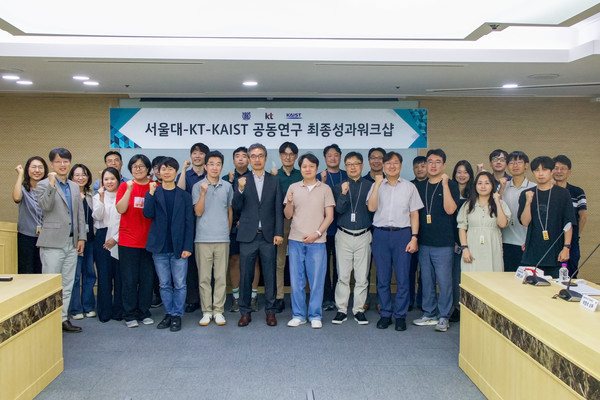
KT said it held the "Seoul National University-KT-KAIST Industry-Academia Joint Research Final Results Workshop" at KT's Uiwon Research Center in Seocho-gu, Seoul, with researchers from Seoul National University and KAIST.
The joint research with Seoul National University focused on autonomous agents' understanding of context and situation and responsible AI (RAI), while the joint research with KAIST focused on prompt compression technology.
KT said it plans to verify the applicability of the research results to actual models, platforms, and services, and to accumulate them as internal technology.
KT said it had held a "Joint Research Final Results Workshop" with researchers from Seoul National University and KAIST. The event took place at KT's Uiwon Research Center in Seocho-gu, Seoul.
KT said its R&D focus has moved beyond improving AI model performance to solving problems related to reliability, inference efficiency, and real-world service deployment. The joint research topic with Seoul National University was autonomous agents' understanding of context and situation, as well as responsible AI (RAI), while the joint research topic with KAIST was prompt compression technology. This research focused on accurately understanding user intent in AI agents, generating trustworthy responses, and reducing token usage and processing burden, rather than expanding large AI models.
KT said it plans to verify the applicability of the research results to actual models, platforms, and services, and to accumulate the results as internal technology.
KT, Seoul National University, and KAIST said on the 30th that they had held the "Seoul National University-KT-KAIST Industry-Academia Joint Research Final Results Workshop" at KT's Uiwon Research Center in Seocho-gu, Seoul. About 50 researchers from the three institutions attended the event.
The workshop was organized to share the results of industry-academia joint research conducted over the past year and to discuss how the technologies secured can be applied to KT AI models, platforms, and services. The focus was on sharing the outcomes of the one-year joint research by KT, Seoul National University, and KAIST and connecting them to KT's AI business elements.
In particular, KT and Seoul National University conducted research centered on technologies needed for autonomous AI agents to reliably carry out tasks in real-world environments. The issue was that, for AI agents to perform user proxy tasks such as search, reservations, and consultations, they need to understand conversational flow and user context beyond simply processing individual commands.
Accordingly, the research projects included context and situational understanding and reasoning for autonomous agents, responsible AI evaluation standards and reliability improvements, securing Korean datasets and developing behavior prediction models, and a reinforcement learning framework based on user feedback.
As AI agents can make incorrect judgments that may lead to real-world actions, safety and reliability evaluation, along with model accuracy, was presented as a necessary criterion. At the workshop, the parties also discussed ways to apply the technologies secured through these research results to KT AI models, platforms, and services.
As datasets that reflect the language and behavioral characteristics of Korean users are seen as one of the factors determining service quality, KT said it secured data suited to domestic usage environments through this research. KT also said it secured behavior prediction technology and laid the groundwork for incorporating user feedback into AI training.
KT and KAIST studied technology for compressing and optimizing prompts entered into large language models (LLMs). The core of the technology is to reduce input tokens while preserving key information from long contexts, with the aim of easing the processing burden on AI models.
KT said one expected effect of the research is improved inference efficiency for AI models and agent services. It also said the work provides a foundation for achieving cost efficiency in operating AI services for large numbers of users.
Lee Jae-wook, head of the Seoul National University AI Research Institute, said the significance of the joint research lies in linking the university's research capabilities with real-world technical challenges in industry and jointly verifying the potential for practical application of the research results. He also expressed his commitment to developing an industry-academia cooperation model that connects academic achievements to AI technology innovation and stronger industrial competitiveness.
KT said it will push ahead with technical verification and internalization of the joint research results so that they do not remain at the paper or original technology stage. To that end, it plans to identify follow-up tasks that reflect the needs of business divisions and technology organizations.
KT plans to expand the scope of industry-academia cooperation based on its collaboration with Seoul National University and KAIST, with areas of expansion including agentic AI, RAI, physical AI, and token efficiency. Park Jae-hyung, head of KT AX Future Technology Institute and vice president, said KT aims to complete the core AI technologies it needs through cooperation with Seoul National University and KAIST, and added that it will expand a research and development cooperation model that grows together with universities to connect research results to KT AI competitiveness.
Source: IT DAILY · Lee Jae-young
Original: https://www.itdaily.kr/news/articleView.html?idxno=241288
References
This article was produced with the help of an automated content generation algorithm.
Source: IT DAILY
View originalThis article was summarized and organized by BizCrush based on the original article from IT DAILY. For exact quotations and full details, please refer to the original article.