Humanoid Robot Shipments Up 300% as China’s Agibot, Unitree Hold 74% Share
IT DAILY ·
✦ AI Summary
Global humanoid robot shipments rose about 300% from a year earlier.
Global shipments in the first half of 2026 were estimated at 19,100 to 22,000 units, and shipments by Chinese manufacturers exceeded 30,000 units.
According to Counterpoint Research, all of the top five companies were Chinese, with Agibot and Unitree taking first and second place.
As the humanoid robot market enters full-scale mass production, shipments are rising sharply. This is the first time shipment figures for humanoid robots have been made public, and according to Counterpoint Research, global humanoid robot shipments rose about 300% from a year earlier.
Global humanoid robot shipments in the first half of 2026 were estimated at between 19,100 and 22,000 units, depending on the organization. Smart Analytics Global (SAG) estimated shipments at 19,100 units for the same period, while a Forbes report citing Counterpoint Research said global humanoid robot shipments in the first half of this year exceeded 22,000 units.
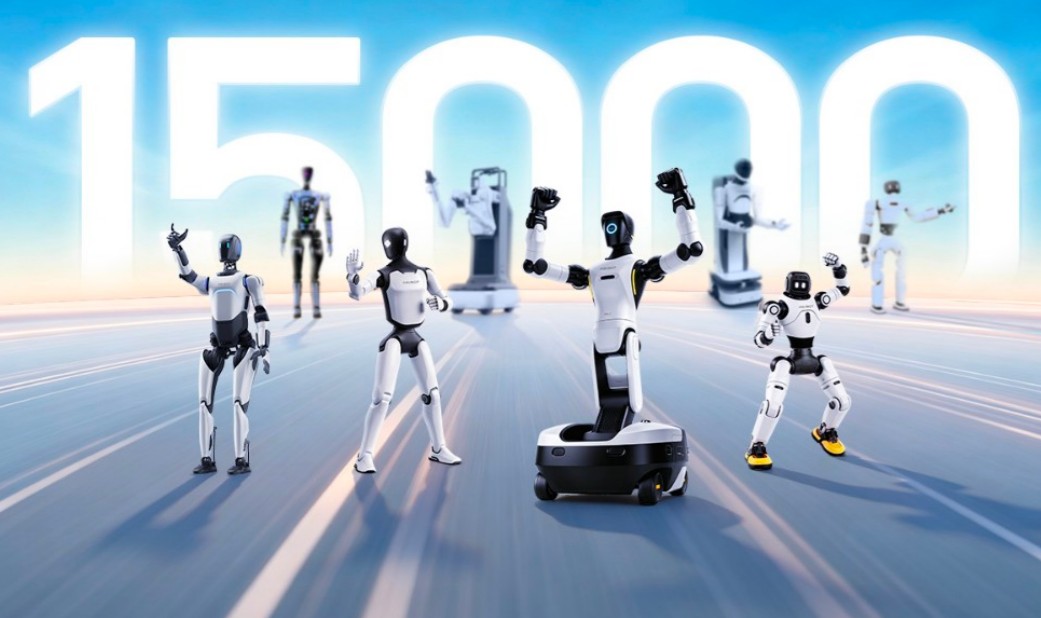
Chinese figures were even higher. According to estimates by Chinese industry groups related to humanoid robots, shipments by Chinese manufacturers exceeded 30,000 units, and data from the Humanoid Robot Application Alliance (HRAA) also showed that shipments by Chinese manufacturers were above 30,000 units. Based on information on Agibot’s website, 15,000 humanoid robots had been shipped as of August.
Based on Counterpoint Research’s shipment table by company, global humanoid robot shipments were led by China’s Agibot and China’s Unitree, which took the top two spots by a wide margin. Agibot ranked first with about 9,700 units shipped and a market share of more than 43%, while Unitree ranked second with more than 7,000 units shipped and a 31% market share.
The combined share of the two Chinese companies was about 74%. In other words, the two Chinese companies accounted for about three-quarters of global humanoid robot shipments, showing a market structure concentrated in the top two Chinese players.
Galbot ranked third with more than 1,100 units shipped and about a 5% market share, while UBTECH ranked fourth with more than 1,000 units shipped and a 4.4% share. Leju Robotics ranked fifth with 650 units shipped and a 2.9% share, and other companies outside the top five were estimated at about 3,000 units and roughly 14%. All of the top five companies were Chinese.
The ranking by share in the Smart Analytics Global survey was the same: Agibot, Unitree, Galbot, UBTECH, and Leju. In the Smart Analytics Global survey, Unitree’s share was estimated at 31%. This shows that leadership in the humanoid robot market is effectively concentrated among Chinese companies.
Humanoid robot shipments have surged. However, some say it is difficult to interpret the sharp increase in shipments as the same thing as expanding actual demand in industrial settings.
According to Counterpoint Research, more than 60% of current humanoid robot shipments are concentrated in entertainment and research. Services and guidance account for about 19%, according to Counterpoint Research. Smart manufacturing accounts for 13%, according to Counterpoint Research.
Warehouse and logistics account for 5%, according to Counterpoint Research. Still, the warehouse and logistics segment is being discussed as a key market in the future. Amazon and Tesla are planning roadmaps for deploying humanoid robots. Given those roadmaps, the share of humanoid robots in warehouse and logistics is expected to expand.
As humanoid robots spread in China, the share of shipments for industrial and commercial use is expanding. At the same time, according to a Financial Times report, Chinese humanoid robot manufacturers have a sales structure tied to government-supported robot training centers. At these training centers, robots perform real tasks based on remote human operation, and the data generated in that process is fed back to manufacturers. Manufacturers count sales to the training centers as shipments while also securing the learning data produced there.
Through this structure, shipment performance is expanding while robot AI training data is being accumulated at the same time. However, it still requires separate verification to determine how much training-center sales reflect final demand in ordinary industrial settings.
Meanwhile, real-world industrial deployment cases are also emerging. Agibot’s industrial robot, G2, has been introduced to Longcheer Technology’s home appliance production line and is carrying out actual production tasks. Agibot said in June that it had produced and shipped its 15,000th robot, which can be seen as an example of humanoid robots beginning to move beyond the research and demonstration stage and into manufacturing sites.
Because organizations use different coverage scopes and classification standards, their 2026 shipment forecasts vary. Counterpoint Research expects global humanoid robot shipments in 2026 to exceed 50,000 units, up 210% from the previous year. SAG projects shipments of about 60,000 units and a market size of about USD 1.6 billion in 2026. China’s HRAA expects shipments in China to exceed 85,000 units and production capacity to top 100,000 units. However, HRAA’s figures include only shipments by Chinese manufacturers, and its classification criteria are presumed to include wheeled robots as humanoid robots.
Despite the differences in forecasts, the common direction is a sharp annual increase in shipments. This shows that humanoid robots are moving from the research and demonstration stage to mass production and shipment at a scale of tens of thousands of units. The nature of this stage change is a rapid shift into industrialization.
Against this backdrop, the global top tier is emerging as dominated by Chinese companies. This means China has secured overwhelming advantages in the humanoid robot supply chain and mass production race.
Source: IT DAILY · Jo Min-soo
Original: https://www.itdaily.kr/news/articleView.html?idxno=241197
References
This article was produced with the help of an automated content generation algorithm.
Source: IT DAILY
View originalThis article was summarized and organized by BizCrush based on the original article from IT DAILY. For exact quotations and full details, please refer to the original article.