[Interview] "Hybrid Demand Set to Accelerate...Data and AI Market Push Intensifies"
IT DAILY ·
✦ AI Summary
As cloud migration costs, security requirements, and data sovereignty demands rise, companies are reconsidering infrastructure operations to better fit each workload's characteristics.
Brian Ross, CRO, cited rising costs from AI and token usage, security concerns, and data sovereignty as drivers of change, and presented hybrid architecture and "Cloudera Anywhere Cloud."
Cloudera said it provides common governance, security, and lineage, and supports customers in developing once and deploying anywhere they want.
As rising costs for cloud migration workloads, stronger security requirements, and growing demands for data sovereignty converge, corporate infrastructure strategies are changing. In response to this shifting environment, companies are adjusting how they operate their infrastructure.
AI investment criteria are also changing. As emphasis increasingly shifts from the technology itself to ROI, TCO, and actual business outcomes, the rise of hybrid architecture is becoming more pronounced, and its role in supporting enterprise data and AI strategies is coming into sharper focus.
In line with this trend, Cloudera is working to strengthen its market push based on its hybrid data and AI platform capabilities. IT Daily conducted an on-site interview on the 20th (local time) in Singapore at EVOLVE26, with Cloudera CRO Brian Ross and Remus Lim, Senior VP for APAC and Japan, as the interviewees. The topic was the company's market response strategy amid the spread of hybrid demand.
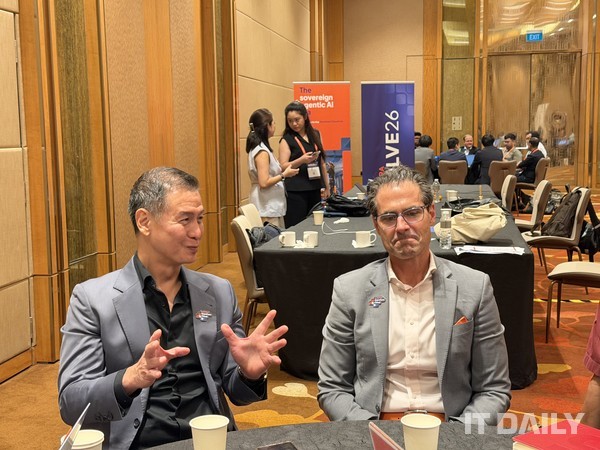
On the 20th (local time) at EVOLVE26 in Singapore, Cloudera APAC and Japan Senior VP Remus Lim and CRO Brian Ross explained market changes in a press briefing centered on the spread of hybrid demand and market response strategies.
They said that over the past few years, data migration to the public cloud had continued across the enterprise infrastructure market.
However, they said demand is now shifting away from concentrating all workloads in the cloud and toward operating environments suited to the characteristics of each workload. Brian Ross, CRO, said this change has become notably stronger over the past year.
Brian Ross, CRO, said the market has seen a very dramatic change over the past 9 to 12 months. He cited rising costs from AI and token usage, security concerns, and data sovereignty as the drivers of that shift.
As a response to these changes, Cloudera introduced "Cloudera Anywhere Cloud." Cloudera Anywhere Cloud is designed for public cloud, sovereign infrastructure, and private data centers, and is built to deploy and manage AI and data services without moving or duplicating data.
Ross said the goal is to provide common governance, security, and lineage in a single integrated data and AI platform. He also explained that it helps customers develop once and deploy anywhere they want.
With the expansion of AI adoption, what companies need to manage is expanding beyond where data is stored to where models are run and inference is performed. In particular, in heavily regulated environments such as finance and the public sector, and in environments handling sensitive data, demand is emerging for greater use of AI while maintaining control over data and AI infrastructure. Alongside rising demand for private and sovereign AI, Ross identified private AI factories and sovereign AI factories as major opportunity areas.
Cost burdens are prompting companies to reconsider workload placement. Ross noted that more companies are experiencing higher-than-expected costs after moving a significant number of workloads to the cloud. As a result, companies are reexamining operating costs after cloud migration and reviewing where each workload should be placed.
Ross said it is important to place each workload in the environment that best fits it. He explained that customers are now examining total cost of ownership and actual returns on technology investments much more closely. He also said flexibility is not just a technical issue, but an economic one as well.
Interest from companies is no longer limited to reducing infrastructure costs. As AI investment accelerates, customer demands are also changing. Customers are beginning to check whether investment costs are actually translating into returns and business outcomes.
Ross said it is not enough to prove that the technology works. What customers want, he explained, are measurable outcomes. In that context, customers' criteria are shifting from whether something can be technically implemented to TCO, actual returns, and measurable business outcomes.
A representative success case was presented in the edge sector. Ross described a case in which a major energy company applied Cloudera Edge solutions to endpoint devices used by about 400,000 employees.
The company operates a cybersecurity solution based on Cloudera Edge solutions. In this case, decisions were made near the point where data was generated rather than through centralized processing.
As a result, the average time to detect cyber threats was reduced by about 90%. Ross described this as a concrete business outcome showing the value of data and AI infrastructure.
Cloudera sees its partner ecosystem as a key element in connecting growing data and AI demand with customer adoption and results. Ross described partners as an important growth flywheel.
Ross said partner success leads to better customer outcomes. He also explained that customer success ultimately leads to Cloudera's growth. Remus Lim is Cloudera's Senior VP for APAC and Japan, and the photo credit is Yang Seung-gap.
Along with the outlook for expansion in the data and AI market, expectations are rising for the roles of consulting firms, SI providers, and MSPs. Data and AI projects tend to generate new use case and feature demands even after platform deployment, so the partner role extends from initial consulting and implementation to systems integration, operations, and support.
This structure is reflected in the Korean market as a link between partner strategy and market expansion. Cloudera has identified sovereign AI and hybrid architecture as areas where it has competitive strength in Korea, and it sees its architectural strengths as standing out in environments with strong governance and security requirements and in air-gapped infrastructure environments separated from external networks.
Senior VP Lim said that in the process of connecting these technical strengths to actual customer adoption, partner roles that understand local industry and regulatory environments are important.
Lim said partners that can support the full customer lifecycle are needed. He cited the scope of support as consulting, architecture design, implementation, support, and ongoing operations. He added that the next step is for partners to embed Cloudera technology into their own products and to drive the launch of new AI solutions from partners.
Cloudera already has a customer base centered on finance and manufacturing. However, as AI use expands across industries, it believes that data preparation, security, and governance must come before actual application deployment. Cloudera expects its platform to play a larger role in that process and sees room to expand its customer base into other industries.
Senior VP Lim said adoption is also taking place in sectors such as aerospace in Korea, beyond the existing major industries. He added that enterprises are moving ahead with new data and AI architectures. He said there is also ample room to expand the customer base through this.
The photo shows Cloudera CRO Brian Ross, and it was taken by Yang Seung-gap. This segment is in a Q&A format with Brian Ross, CRO, and Remus Lim, Senior VP for APAC and Japan, and the question topic is differences in how data and AI platforms are adopted across industries.
Remus Lim, Senior VP for APAC and Japan, said the way data and AI platforms are adopted differs by industry. He said banks, telecom companies, and government agencies were early enterprise data platform adopters because they have large-scale data needs, strong regulations, and complex organizational environments.
Lim said adoption in other industries takes different forms. He explained that some companies initially built their own platforms with open source technologies, but later chose Cloudera after realizing the limits of scaling and maintaining them at enterprise scale.
Lim said that in shipbuilding, companies initially considered cloud-based architectures. However, he added that some cases involved choosing private environments after determining that public cloud deployment was not possible for certain workloads due to data sensitivity and security requirements.
When asked how Cloudera supports the transition from experimentation to production in AI projects, Ross said the challenge for many companies is not a lack of AI ideas. He added that the difficulties lie in safety, governance implementation, integration with existing systems, and turning them into applications that can operate at enterprise scale.
To address this, Ross said technical experts, including field deployment engineers (FDE), work directly with customers. He explained that these experts help identify use cases and support their development through to production. He also said the company is building these capabilities in major Asian markets such as Singapore, Korea, and Japan.
When asked how about USD 1 billion in investment over the past 3 years relates to the current product strategy, Ross said acquisitions and product investments over the past 3 years form the basis of the current go-to-market architecture. He added that some acquisitions provided core capabilities needed for Anywhere Cloud, while others strengthened capabilities such as an integrated data fabric.
Ross explained that each investment was backed by a clear multi-year plan. He added that multiple elements are now coming together, and that even at the technology preview stage, real customers have begun using the features.
In response to a question about how new customers are acquired and whether there are new industry opportunities, Lim said the company is using a dual approach to market engagement, combining partner utilization with direct collaboration with customers. He added that the customer base is also expanding, moving beyond the company's traditional strengths in banking and the public sector.
Lim identified shipbuilding and marine engineering as opportunity areas in Korea. He also cited electric vehicles, automotive manufacturing, and battery manufacturing as fields where the company already has customers. He said the background for this expansion is that data and AI are becoming essential elements of business operations, and that as data and AI spread, opportunities are expanding across diverse industries.
Source: IT DAILY · Yang Seung-gap
Original: https://www.itdaily.kr/news/articleView.html?idxno=241169
References
This article was produced with the help of an automated content generation algorithm.
Source: IT DAILY
View originalThis article was summarized and organized by BizCrush based on the original article from IT DAILY. For exact quotations and full details, please refer to the original article.