[Interview] “Without Governance, There Are No AI Agents”
IT DAILY ·
✦ AI Summary
Cloudera said that for AI agents to access distributed data, they must be connected without moving data and managed under integrated governance across all data assets.
Based on that idea, the company unveiled the new platform "Cloudera Anywhere Cloud," saying it deploys and manages AI and data services across public cloud, sovereign infrastructure, and private data centers through a single console.
CTO Sergio Gago said audit, logging, and privilege management are needed to record and verify what agents actually access and execute, and that 9 design partners and more than 100 customer companies joined the first month of Anywhere Cloud.
The view that there can be no AI agents without governance is gaining traction. As companies begin deploying AI agents into actual work, a new challenge has emerged. For agents to perform their roles, they need access to distributed data, but that also means broader access and greater difficulty in controlling it.
As a solution, Cloudera proposed a connection method that avoids data movement. The company said it would connect distributed data across multiple environments into a single foundation for agent use while also implementing an integrated governance management structure for all data assets.
Building on that approach, Cloudera recently unveiled a new platform, "Cloudera Anywhere Cloud." IT Daily interviewed Chief Product Officer Leo Brunnick and Chief Technology Officer Sergio Gago on the scene at Cloudera's annual conference, EVOLVE26, held in Singapore on the 20th local time, and heard their views on data management strategies for the agent era.
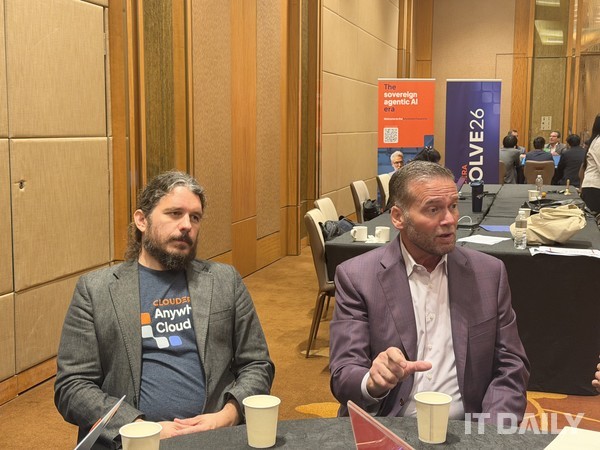
Cloudera CTO Sergio Gago and CPO Leo Brunnick took part in a press Q&A at EVOLVE26 in Singapore on the 20th local time.
At the event, CTO Gago identified data location as the top consideration for companies adopting agents, explaining that the starting point for adoption is figuring out where corporate data is dispersed. He said the key question is where the data is located.
He said corporate data can be stored across multiple systems, and that some workloads also run in public cloud environments. He added that the condition for AI usefulness is access to the enterprise data needed, and that agents must be able to access distributed data assets without individual approvals in order to perform their roles.
He noted, however, that usefulness and security come into conflict depending on how access controls are set. If access to necessary data is restricted, agent utility declines; if access is broadly allowed, security risks increase.
Accordingly, CTO Gago said a separate layer is needed to manage the range of access available to agents and the range of visibility available to users.
CTO Gago said that for an AI platform to be viable, such a layer must be in place, and that agents need access to the full data estate. At the same time, he explained that it is necessary to identify and control what each agent and each user can access.
Using a payroll system as an example, CTO Gago said that expanding agent use and controlling privileges must be designed together. He said a payroll agent built by the IT department needs access to the full system to perform its functions, but the employee using that payroll agent should be limited to viewing their own payroll and the payroll of employees they manage. He also said that an agent built directly by a regular employee cannot exceed that employee's privileges.
He went on to say that companies must respond on the assumption that uncontrolled or compromised AI systems may exist, whether inside or outside the organization. To do that, mechanisms are needed to record and verify what the agent actually accessed and what it executed, and audit, logging, and privilege management are necessary. He also stressed the need for clear controls over what agents can access and what they are allowed to execute.
The criterion for deciding where an agent runs is the nature of the data. Agents that handle sensitive information can operate inside the company's own data center. In that case, it is also possible to restrict them to models that run only on the company's own GPU resources.
By contrast, agents that handle only public information include use cases such as monitoring media coverage about the company. In those cases, public cloud models such as Azure can be used.
CTO Gago explained that the key is to ensure data access needed for AI while applying enterprise-grade governance at every stage. The idea is to vary the execution environment and available models according to data sensitivity while providing the necessary access and control together.
Anywhere Cloud is the productized version of that vision. The product is equipped to deploy and manage AI and data services across public cloud, sovereign infrastructure, and private data centers. It integrates these into a single management console, and can run AI workloads in their existing locations without moving or copying data. Access rights to scattered assets are also controlled through integrated governance.
CTO Gago said the convergence of data, big data, and AI is fundamentally changing how companies use data. He said he has continually asked what kind of data platform people want to use in the AI era, and that Anywhere Cloud is a platform designed with that change in mind.
The platform is being validated through a design partner program. Nine companies are currently participating, and more than 100 customer companies expressed interest during the first month.
The first design partner is ExxonMobil, the global oil and gas company. According to CPO Brunnick, ExxonMobil is collecting streaming data from thousands of edge devices installed at factories and refineries. He added that ExxonMobil believes it cannot predict in advance which patterns will become important later, so instead of filtering at the edge, it sends as much data as possible to a central data lake.
The cumulative data storage location was on-premises, and the data management framework was Cloudera Data Platform (CDP). That environment also had governance in place.
However, the arena for the latest advances in AI models and tools has mostly been the cloud. That made it difficult to use the latest AI without moving data.
ExxonMobil adopted Anywhere Cloud because it needed to connect on-premises data with cloud AI. CPO Brunnick said that running Anywhere Cloud alongside the existing CDP environment makes it possible to apply the latest AI models, AI tools, and partner technologies without migrating the entire governance-based data lake.
CTO Gago then said that when it comes to sovereignty regulations, who controls the infrastructure is more important than where the data is located. He said AI models and AI infrastructure are becoming core infrastructure for both countries and companies.
He also emphasized that if an organization suddenly loses access to leading AI capabilities, its competitiveness declines sharply. Accordingly, the importance of a structure that allows continued access to AI capabilities when needed has become more pronounced.
CTO Gago said the intention is not to reject public cloud. He said most companies and government agencies hope to continue benefiting from public cloud advantages. He also said the premise is to make use of public cloud innovation under normal conditions.
However, CTO Gago said that if regulations change or it becomes difficult to continue using a specific provider, workloads must be able to move to another environment, such as an in-house infrastructure. As the ultimate goal, he proposed a system that can move workloads when needed with only an API call or a very simple operational procedure. He added that control over critical workloads must be able to be restored immediately when necessary.
Cloudera CTO Sergio Gago and CPO Leo Brunnick posed for a commemorative photo at EVOLVE26 in Singapore on the 20th local time. The photo was taken by reporter Yang Seung-gab.
Asked about market reactions to Anywhere Cloud, CTO Sergio Gago said the response has been very positive. He explained that the company is reviewing feedback from customers, partners, analysts, and the media.
CTO Sergio Gago said Anywhere Cloud has the highest level of acceptance among the products he has seen so far. He emphasized the strong reception based on reactions from multiple stakeholders.
CPO Leo Brunnick explained that the usual objections at product launches are lack of features and cost concerns. However, he said the biggest objection to Anywhere Cloud is disbelief that full implementation is possible.
CPO Leo Brunnick said this trend is also reflected in analyst evaluations. He said Cloudera is being recognized as a leader in data fabric and data lake, and is also highly rated in vision and roadmap. He added that the market's alignment with the company's direction has been confirmed, and that the next challenge is proving it through execution.
Regarding the concrete meaning of "prove it through execution," CPO Brunnick said the key criterion is actual results rather than verbally explaining the validity of the technology. He pointed to the successful use of the technology by design partners as the starting point for those results.
CPO Brunnick said that over the next few months, more examples from diverse environments will be needed. He named Google Cloud, AWS, Azure, on-premises, air-gapped environments, and hybrid environments as the settings in which success cases should be shown, and said he is confident the architecture works.
Asked whether the operating structure of running CDP and Anywhere Cloud in parallel was intentional, CPO Brunnick said the parallel model was designed from the outset. He said the goal of Anywhere Cloud is to be a complete next-generation data and AI platform while also increasing the value of customers' existing CDP investments.
CPO Brunnick said Anywhere Cloud was designed so it can be used without moving all data and without rebuilding the environment. As examples of where customer data may reside, he cited object storage and HDFS, and said many customers have data volumes of several hundred petabytes. He then identified customer needs as preserving existing investments, using new AI technologies, and leveraging cloud-native technologies.
CTO Gago described customer situations as falling into two categories: new deployments and existing large-scale clusters. He said new customers can use Anywhere Cloud on its own, while customers with large existing cluster investments can use new features while keeping infrastructure in place even if moving that infrastructure would be difficult or effectively impossible.
He said the goal is to deliver the benefits of both environments at the same time. Asked about Cloudera's place in the AI technology stack, he said that having GPUs alone cannot solve the problem, and that deciding how to run LLMs is necessary.
He also said it is necessary to determine how prompts connect to enterprise data, how data will be stored and queried, who will have access to the data and to what extent, and how governance will be applied. He said Cloudera's role is to integrate GPU, models, and enterprise data management, and to sit in the position of making the entire system actually work.
Source: IT DAILY · Yang Seung-gab
Original: https://www.itdaily.kr/news/articleView.html?idxno=241145
References
This article was produced with the help of an automated content generation algorithm.
Source: IT DAILY
View originalThis article was summarized and organized by BizCrush based on the original article from IT DAILY. For exact quotations and full details, please refer to the original article.