Korean Society of Information Engineering Technology Signs Agreement with KT to Strengthen University AI/AX Capabilities Based on AICE Qualifications
IT DAILY ·
✦ AI Summary
The Korean Society of Information Engineering Technology, KT, and the Korea Junior College Industry-Academia Cooperation Office and Chiefs Council in the Gyeonggi region signed a business agreement on Aug. 21 at Nonghyup University to strengthen university AI/AX capabilities.
The three organizations decided to use KT's AICE certification as a common foundation to improve the artificial intelligence capabilities of students, faculty and staff, and internal and external short- and long-term trainees.
Areas of cooperation include use of AIDU, discounted AICE and Tesat exam fees, special exams for groups of 30 or more test-takers, and joint promotion by clearly identifying AICE partner universities.
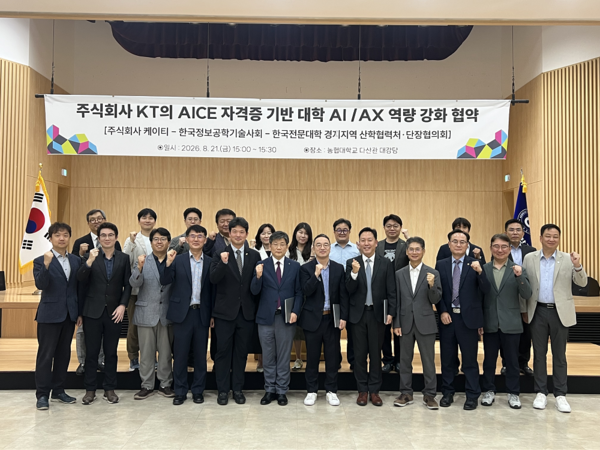
The Korean Society of Information Engineering Technology, KT, and the Korea Junior College Industry-Academia Cooperation Office and Chiefs Council in the Gyeonggi region signed a business agreement on Aug. 21 at Nonghyup University to strengthen university AI/AX capabilities. Kim Yoo-seok, president of the Korean Society of Information Engineering Technology; Lee Jong-hyung, managing director at KT; and Kim Jin-bae, president of the Korea Junior College Industry-Academia Cooperation Office and Chiefs Council in the Gyeonggi region, attended the signing ceremony along with representatives and officials from the participating organizations.
Based on the agreement, the three organizations decided to improve the artificial intelligence capabilities of university students, faculty and staff, and internal and external short- and long-term trainees using KT's AICE certification as a common foundation. AICE is KT's artificial intelligence competency certification exam, and its full name is AI Certificate for Everyone. Through this, they plan to promote stronger AI/AX capabilities, stronger artificial intelligence and economic capabilities, talent development, and the establishment of a cooperative system among specialized institutions.
After the agreement was signed, Kim Jin-bae, Lee Jong-hyung and Kim Yoo-seok, among others, posed for a commemorative photo.
The agreement calls for the three organizations to cooperate on the basis of the education infrastructure and expertise each one possesses, with the goal of strengthening the artificial intelligence and economic capabilities of university members and trainees and fostering practical digital talent. By combining their respective educational resources and expertise, the three organizations plan to advance cooperation in a structure that enhances the capabilities of university members and trainees and develops practical digital talent.
Areas of cooperation include strengthening artificial intelligence and economic capabilities for students, faculty and staff, and internal and external trainees; using AIDU, an artificial intelligence practice platform, in regular AI and SW classes; offering discounted AICE and Tesat exam fees; promoting greater awareness of AICE and Tesat; providing special exams for more than 30 group test-takers linked to school classes; and joint external promotion by clearly identifying AICE partner universities.
Kim Yoo-seok, president of the Korean Society of Information Engineering Technology, said the association would actively support efforts to strengthen the artificial intelligence capabilities of university members and trainees based on the specialized expertise of its professional engineers. He also expressed the group's commitment to fostering practical interdisciplinary talent suited to the digital era and said the Korean Society of Information Engineering Technology would play a key role in realizing educational innovation.
The Korean Society of Information Engineering Technology, founded in 1995, was established around ICT engineers in the information processing and telecommunications fields, and currently has more than 2,100 members, including information management engineers, computer system application engineers, information and communication technology engineers, and electronic application engineers. Externally, the group carries out volunteer work for people with disabilities, youth and college students; provides consulting and inspection services related to information and communications technology; supports hearings in information and communications technology disputes at the request of courts; selects and recommends outstanding companies in response to requests from public institutions for vendor recommendations; and performs duties entrusted by ministers of information and communications-related government ministries, all in an effort to contribute to the development of the nation's ICT sector.
Source: IT DAILY · Kim Ho
Original: https://www.itdaily.kr/news/articleView.html?idxno=241142
References
This article was produced with the help of an automated content generation algorithm.
Source: IT DAILY
View originalThis article was summarized and organized by BizCrush based on the original article from IT DAILY. For exact quotations and full details, please refer to the original article.