Fripwillin and Pearson Join Forces, Bringing Global Content to FuleeCampus
IT DAILY ·
✦ AI Summary
Fripwillin has signed a strategic partnership with Pearson.
Pearson will link its higher education content to FuleeCampus and initially provide more than 110 Korean-translated textbooks and content items.
The two companies plan to expand that to more than 150 items by 2028.
Fripwillin and Pearson are working together. Pearson is beginning the partnership by linking its higher education content to FuleeCampus, an AI courseware for university education, and will start providing about 110 Korean-translated textbooks and content items. The two companies plan to expand that to more than 150 items by 2028.
Fripwillin announced the signing of a strategic partnership with Pearson at its headquarters in Gwanak-gu, Seoul, on the 21st. The partnership commits the two sides to supplying Pearson higher education content, linking it to FuleeCampus, and expanding joint business targeting domestic universities. Through this agreement, they will also broaden cooperation in combining content and AI technology in the university education market.
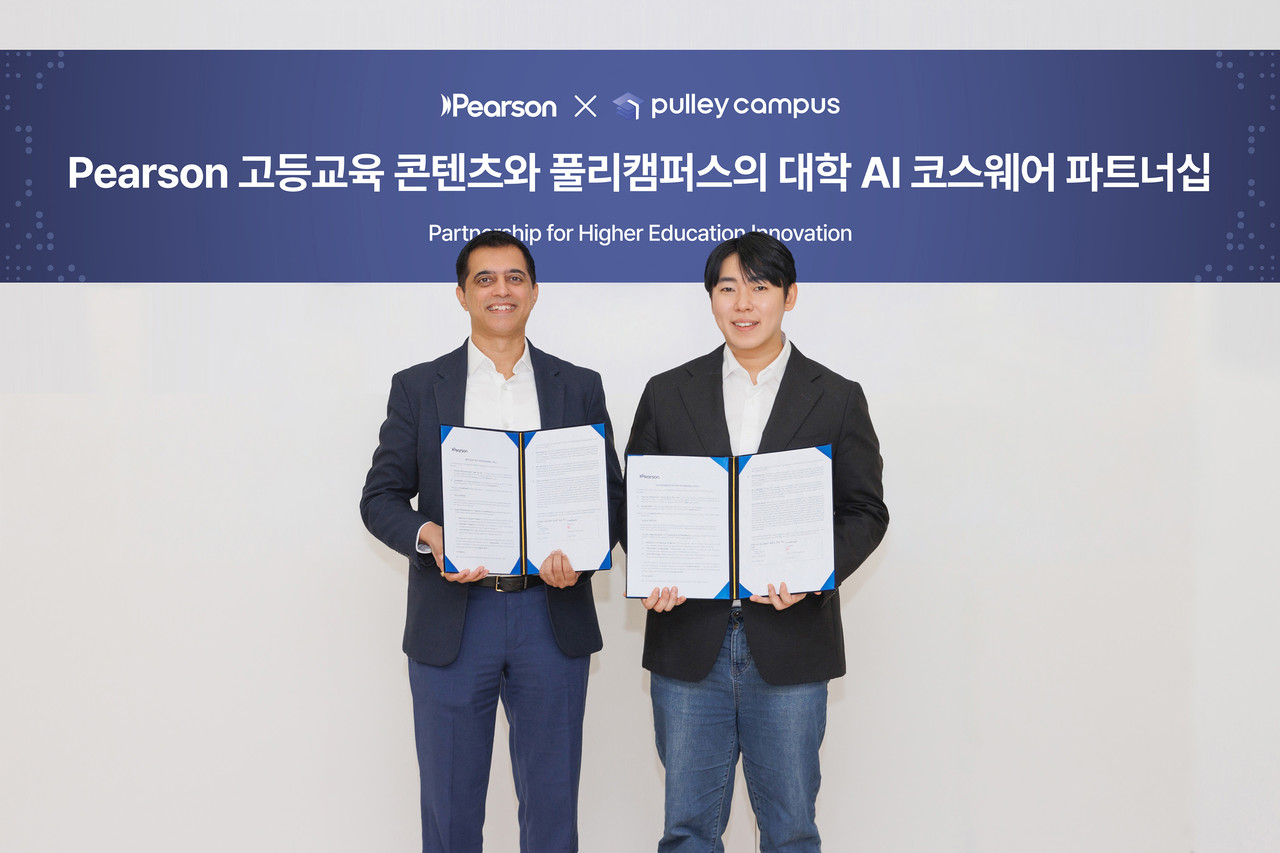
At the MOU exchange ceremony at Fripwillin's headquarters on the 21st, Eklavya Bhave, Head of Pearson HED Asia Pacific, and Kwon Gi-seong, CEO of Fripwillin, posed for a commemorative photo.
Global education company Pearson posted annual revenue of 3.577 billion pounds, or about KRW 6.7628 trillion, last year. Pearson has a strong presence in science and engineering fields at universities, and its textbooks are used in science and engineering majors and courses at domestic universities.
Through this collaboration, FuleeCampus will provide Pearson's higher education major content. The fields covered include mathematics, science, English, languages, medicine, health, and nursing.
The first materials to be released are more than 110 Korean-translated Pearson textbooks and content items, and the plan is to expand that to more than 150 items by 2028. Through this, FuleeCampus will broaden the range of Pearson content it offers.
FuleeCampus has built an API-based service integration environment. This environment is designed to make it possible to use Pearson content-based questions and learning materials in university classes. In addition, it has created a scope for connecting textbooks, learning materials, and assessments into an integrated workflow by combining this with FuleeCampus's existing AI-based diagnostic and personalized learning technology.
The service provides students with functions to check their major readiness and weak areas, as well as level-matched questions and supplementary learning materials. Instructors can review data on each student's learning process and achievement level and use it in class design and feedback. Universities and departments can also use learning data to assess basic academic ability and major readiness.
It was on the basis of these functions that Fripwillin and Pearson formed their collaboration. Kwon Gi-seong, CEO of Fripwillin, has repeatedly expressed his ambition since the company's founding to become 'Pearson in the AI era,' and he shared his thoughts on making this partnership with Pearson happen. He said it was a meaningful first step toward contributing to university education by combining trusted content with AI and learning data.
Eklavya Bhave, Head of Pearson HED (Higher Education) Asia Pacific, said FuleeCampus has an AI-based platform. He described the platform as capable of providing personalized learning for students and presented that as the reason for choosing Fripwillin as a partner. He also said the company would lead educational innovation and support better learning outcomes for students.
At the signing ceremony, Eklavya Bhave, Head of Pearson HED Asia Pacific, and Hwang Jae-cheol, head of FuleeCampus, each introduced their company's business in separate sessions. AI also emerged as a key topic at the event, which is a recent hot issue in the education industry.
Bhave explained that technological change is accelerating. Comparing the time it took to reach 100 million users, he said it took 75 years for the telephone, 15 years for the internet, and 7 and a half years for mobile phones, while OpenAI's 'ChatGPT' reached 100 million users in 2 months. He added that changes have continued within a short period after the emergence of generative AI.
Bhave said the challenge for education is the need for a rapid transition that keeps pace with the speed of change. He explained that 10 to 20 years ago, the useful life of skills acquired was at least 5 years, and university curricula in the past also remained in place for several years. By contrast, he said the cycle of AI model change is 3 months and the cycle for new companies to enter the market is 6 months, making curriculum changes inevitable in this environment.
He stressed that university curricula need to be rapidly reorganized and that content must also shift to student-specific formats. Along with the recognition that education must change in the AI era, the importance of designing individual learning paths was also highlighted.
Where learning media used to center on printed books, students today are showing more varied preferences for digital content, and their demands are also shifting toward expanded personalized education. As changes continue not only in educational content but also in learning methods, concerns have emerged that universities unable to respond to these changes may fall behind.
In response to these changes, Pearson presented a direction focused on promoting AI-based personalized education support for students and instructors. It also said it would move forward with providing higher-quality content through its collaboration with Fripwillin.
Bhave said FuleeCampus has an understanding of the Korean market and is working with multiple educational institutions. He described the partnership as a combination of global content and local expertise. He added that Pearson has various AI-based tools and content, while FuleeCampus has an AI-based learning platform, enabling more personalized educational content for students through the content-platform connection effect.
FuleeCampus, Fripwillin's AI courseware specialized in university education, was launched in 2024. The service provides basic academic ability diagnostic testing and analysis, customized curricula by student and department, and an AI teaching and learning support system. Its initial customers were Konkuk University and Soongsil University, and it is currently used by more than 80 universities nationwide.
Hwang said student satisfaction is not high even with the use of digital content such as online lectures at universities. He added that FuleeCampus offers specialized courses by academic achievement level and that those courses have been effective in improving basic academic ability.
Hwang said that demand for FuleeCampus also exists at junior colleges, not just four-year universities. He also said junior colleges are focused on basic academic ability and employment paths. Fripwillin expects the number of universities adopting FuleeCampus to reach around 100 by next year. Hwang said the company will update job certification courses while placing even greater focus on perfecting individualized education for students.
Source: IT DAILY · Kim Ho-jun
Original: https://www.itdaily.kr/news/articleView.html?idxno=241146
References
This article was produced with the help of an automated content generation algorithm.
Source: IT DAILY
View originalThis article was summarized and organized by BizCrush based on the original article from IT DAILY. For exact quotations and full details, please refer to the original article.