KT Says AI Infrastructure Competitiveness Depends More on Efficiency and Scalability Than Scale
IT DAILY ·
✦ AI Summary
KT announced that it would hold a special session at the Korea Electromagnetic Engineering Society's summer general conference to discuss the future direction of AI Data Center (AIDC) networks and infrastructure.
Kim Woo-tae, a vice president in KT's Network Division Future Network Lab, chaired the session, which was attended by officials from the Electronics and Telecommunications Research Institute (ETRI), Panmnesia, and Vertiv.
KT presented next-generation network technology, a CXL-based AIDC architecture, and modular data centers as key directions for advancing AI infrastructure.
KT discussed the future direction of AI Data Center (AIDC) networks and infrastructure with industry, academia, and research institution officials. On the 20th, KT announced that it would hold a special session at the Korea Electromagnetic Engineering Society's summer general conference, held at the Alpensia Resort in Pyeongchang, Gangwon Province.
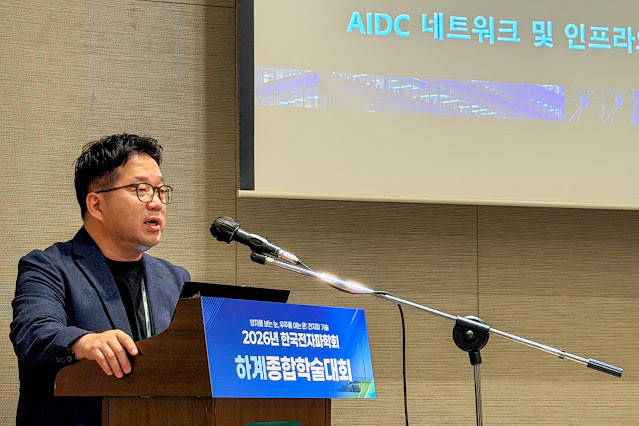
The special session was chaired by Kim Woo-tae, a vice president in KT's Network Division Future Network Lab. Kim gave a presentation on AIDC network and infrastructure at KT's special session during the Korea Electromagnetic Engineering Society's summer general conference.
Officials from the Electronics and Telecommunications Research Institute (ETRI), Panmnesia, and Vertiv attended the session. KT emphasized infrastructure efficiency during the session.
KT said that in the AI era, the key to competitiveness lies not in securing a large number of physical infrastructure assets, but in the efficiency of service delivery based on the same resources. It also said that in AI infrastructure competitiveness, efficiency and scalability matter more than scale.
To advance AI infrastructure, KT identified next-generation network technology, AIDC architecture, and AIDC construction methods as core areas for development. The purpose of next-generation network technology is to organically connect AI infrastructure, the purpose of AIDC architecture is to improve the utilization of computing resources, and the purpose of AIDC construction methods is to improve power and cooling efficiency.
KT introduced next-generation network technology designed to connect AI infrastructure more efficiently. Key elements of AI infrastructure were presented as GPU and server performance, as well as the fast and stable transmission of large volumes of data. KT also presented the development direction of network architectures that connect AI resources within a single system, across multiple servers, and between distributed data centers, along with optical communication technologies that support such networks.
KT also explained a CXL (Compute Express Link)-based AIDC architecture. In an AIDC, the amount of AI resources used can vary from server to server, and CXL supports flexible sharing of resources such as processors, memory, and AI accelerators across servers. KT said this makes it possible to perform more computations within the same AI infrastructure while improving operational efficiency and scalability.
The discussion topic was future applications of modular data center technology. A modular data center is an AIDC construction method in which modules that have been pre-integrated with power and cooling equipment are installed on site. This method helps reduce heat generation and power consumption, shortens construction time, and can be applied to AIDCs of various sizes.
Based on this discussion, KT plans to continue developing integrated AI infrastructure technology that organically connects AIDC and AI networks.
Source: IT DAILY · Seong Won-young
Original: https://www.itdaily.kr/news/articleView.html?idxno=241122
References
This article was produced with the help of an automated content generation algorithm.
Source: IT DAILY
View originalThis article was summarized and organized by BizCrush based on the original article from IT DAILY. For exact quotations and full details, please refer to the original article.