Q3 Smartphone Shipments Plunge 20%; Samsung and Apple Share Rises from 37% to 45%
IT DAILY ·
✦ AI Summary
According to Omdia, global smartphone shipments in the third quarter of 2026 fell 20% year on year to 254.7 million units, the lowest third-quarter level since 2013.
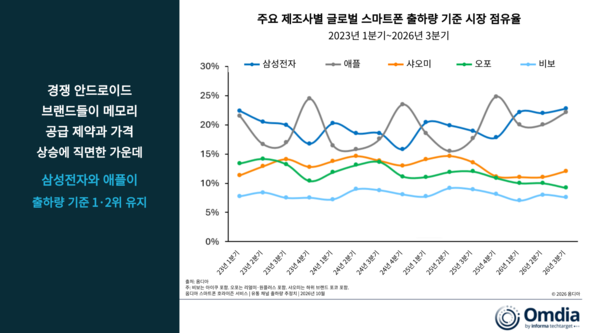
Samsung Electronics shipped 57.8 million units, down 5%, but raised its market share from 19% to 23%, while Apple held shipments at 56.5 million units and increased its share from 18% to 22%.
Xiaomi, Oppo and Vivo saw both shipments and market share decline, and Omdia forecast that market weakness would continue in 2026 and 2027 as rising prices and cost burdens weaken demand in emerging markets.
The global smartphone market was sluggish in the third quarter of 2026. According to figures released by Omdia on the 2nd, global smartphone shipments in the third quarter of 2026 came to 254.7 million units, down 20% from a year earlier. That was the lowest third-quarter level since 2013.
Rising prices weighed on the market contraction. The price burden had a major impact on demand in emerging markets and for lower- to midrange products. Even so, Samsung Electronics and Apple expanded their market shares relatively despite shipment declines or stagnation.
Samsung Electronics shipped 57.8 million units, down 5% from a year earlier, but its market share rose from 19% to 23%. Samsung retained the top spot. Apple shipped 56.5 million units, unchanged from a year earlier, and its share rose from 18% to 22%.
As a result, the combined shipment share of Samsung Electronics and Apple rose from 37% to 45% over the past year. The gap between Samsung and Apple shipments was 1.3 million units.
Although the overall market shrank 20% over the same period, combined shipments of Samsung and Apple fell only about 2.4% to 114.3 million units from 117.1 million units a year earlier. Their combined market share therefore rose by 8 percentage points.
By contrast, Xiaomi, Oppo and Vivo saw both shipments and market share decline. Xiaomi ranked third, with shipments of 30.7 million units, down 29%; shipments in China fell 20%, while shipments in India fell 28%. Oppo shipments fell 39% to 23.4 million units, a figure that included Realme and OnePlus. Vivo shipments fell 33% to 19.3 million units. Combined shipments of the three companies fell about 33% to 73.4 million units from 110.3 million units a year earlier, and their combined market share dropped 6 percentage points from 35% to 29%.
As price pressure and component cost pressure persisted, demand weakness was especially pronounced in emerging markets, a key market for Chinese vendors. As a result, the declines among major Chinese companies were relatively steep, and there was a wide divergence between shipment trends for Chinese vendors and those for Samsung and Apple.
Market research firm Omdia said on the 2nd that it had released third-quarter global smartphone shipment data, and that regional shipment gaps were clearly visible.
Samsung defended shipments by focusing on the Galaxy A series, its entry-level and midrange lineup. Samsung also launched the Galaxy Z8 series in August, and the Galaxy Z8 series expanded its presence in the premium market, helped by trade-in and upgrade programs.
Competing Android vendors faced memory supply constraints and also contended with rising prices. Under those conditions, price pressure intensified in emerging markets.
Apple offset weakness in major emerging markets with solid demand in China and North America. Apple’s shipments were supported by continued demand for the iPhone 17 and by distributors proactively securing inventory in anticipation of possible price increases.
Apple launched the iPhone 18 Pro and Pro Max in September, and also launched its first foldable model, the iPhone Duo, in September. In contrast, the launch of the standard iPhone 18 was pushed back to 2027. By region, smartphone shipments in Africa fell 39% from a year earlier, the steepest drop among regions, while shipments in Asia-Pacific excluding Greater China, the Middle East, and Latin America each fell by more than 20%.
According to Omdia’s analysis, rising prices and cost burdens are putting the most pressure on emerging markets, which had previously driven global smartphone shipment growth. Sanyam Chaurasia, Omdia’s principal analyst, said cost inflation is shifting manufacturers’ strategic focus. He explained that manufacturers are moving away from aggressively expanding market share and toward defending profitability, with more conservative strategies gaining traction.
In emerging markets, currency depreciation, inflation, and rising living costs are weakening consumer purchasing power. As a result, smartphone replacement cycles are getting longer and demand for refurbished devices is increasing. In some low-income markets, some consumers are also choosing feature phones.
North America, by contrast, has a market structure centered on premium products and continues to post relatively solid performance, supported by carrier financing, trade-in programs, and device upgrade programs. Omdia said that in an environment of rising prices, regional demand gaps are widening depending on consumer purchasing power and distribution and financing conditions.
Accordingly, manufacturers are responding by placing more weight on profitability than on shipment growth. Companies with a high share of entry-level products are adjusting RAM and storage specifications and reducing the number of SKUs they launch. They are also prioritizing more profitable markets and more profitable products, while some are increasing the share of higher-value products to counter rising costs.
The market slump is expected to continue through 2027. Omdia forecast that annual global smartphone shipments in 2026 will fall 12% from a year earlier.
Omdia said additional handset price increases and limited room for promotions will pressure demand during the year-end peak season. It therefore expects the smartphone market slump to continue.
The ripple effects of higher handset prices are expected to increase inventory burdens across distribution networks. If handset prices rise, the working capital needed to secure the same volume increases, and while carriers and large retailers have room to respond, individual retailers are expected to face greater exposure to slower inventory turnover and margin compression.
Amber Liu, Omdia’s chief executive officer, said that beyond higher component costs, inventory risks are increasing because manufacturers must balance existing inventory with new products. She also raised the possibility that restructuring among individual retailers could accelerate.
Omdia expects component costs to remain high, citing continued HBM supply shortages and ongoing constraints in general-purpose memory supply, and said this will lead to a continued year-on-year decline in global smartphone shipments in 2027. However, it said the pace of decline is expected to slow in 2027.
In this environment, manufacturers are expected to pursue optimization of operating costs, distribution costs, and marketing costs, and to expand revenue streams beyond handset sales. Examples of non-handset revenue sources include software, services, and post-sale add-on products. Omdia said future financial structure, inventory management, and operational efficiency will be key determinants of competitiveness for manufacturers and distribution partners.
Source: IT DAILY · Kim Byeong-ju
Original: https://www.itdaily.kr/news/articleView.html?idxno=242608
References
This article was produced with the help of an automated content generation algorithm.
Source: IT DAILY
View originalThis article was summarized and organized by BizCrush based on the original article from IT DAILY. For exact quotations and full details, please refer to the original article.