[2026 National Audit Wrap-Up 1] Expand 'Dokpamo' and 'Everyone's AI' ... Calls to Verify Everything from Investment Terms to Safety
TECHWORLD ·
✦ AI Summary
At the National Assembly’s Science, ICT, Broadcasting and Communications Committee audit, lawmakers called for clearer definitions of project-specific support ranges, investment terms, public service use, and safety measures as the government expands AI investment.
The relationship between the independent AI foundation model and frontier AI, the K-Moonshot responsibility structure, and the user burden and safety verification of Everyone's AI and AI agent services were key issues.
The audit discussions will then continue into the review of the 2027 budget proposal, with lawmakers calling for greater specificity in frontier AI investment targets and exit conditions, support methods for the independent AI foundation model, and responsibility by K-Moonshot project.
The 2026 audit of the National Assembly’s Science, ICT, Broadcasting and Communications Committee focused on calls to specify the scope of support by project, clarify investment terms, spell out measures for public service use, and define safety safeguards for public-facing services, in line with the government’s push to expand AI investment. The committee began its audit of the Ministry of Science and ICT on Oct. 6 and will end this year’s audit schedule with a comprehensive audit on Oct. 23.
During the audit, the relationship between the independent AI foundation model and frontier AI emerged as a major issue, and the responsibility structure for K-Moonshot was also placed under scrutiny. As the launch of Everyone's AI and AI agent services approaches, the audit discussions also included concerns over user burden and safety verification.
The issues raised during the audit will carry over into the review of the 2027 budget proposal. President Lee Jae-myung will deliver a budget policy speech at the National Assembly on Nov. 2, after which lawmakers are expected to review the government’s budget direction, the basis for pursuing AI projects, and the conditions for supporting AI projects.
As a plan for about KRW 4.7 trillion in investment in frontier AI was presented, its relationship with the existing independent AI foundation model came to the fore as a key issue. The government set a policy of advancing industrial and public use of the independent AI foundation model while also pursuing the development of top-tier models. In the process, the data support budget was reorganized, and lawmakers called for the two projects to be clearly distinguished. Rep. Kim Seon-min of the Rebuilding Korea Party released related materials on Oct. 2.
According to the materials, next year’s budget for the 'support to strengthen data competitiveness for frontier AI development' project was set at KRW 800 billion. Of that amount, KRW 750 billion was allocated to frontier-level AI data support, while KRW 50 billion was earmarked for building a training base for cyber security AI.
Rep. Kim Seon-min’s office said the contribution project used for purchasing and processing data for the independent AI foundation model this year amounted to KRW 25 billion. It also said that as the project was merged and restructured with other projects, it was expanded into a KRW 750 billion investment project. The project structure involves the government investing in the Korea Development Bank, which then invests in domestic AI companies.
Kim Seon-min’s office questioned the budget calculation method and the investment execution standards, noting that the data budget previously used for the independent AI foundation model had been described in a consolidated and expanded form. The office pointed out that the basis for calculation was presented as 'one set, KRW 750 billion.' It also said the criteria for selecting investment companies, equity terms, and exit conditions were unclear.
On Oct. 3, the Ministry of Science and ICT issued a press explanation and rejected rumors that the independent AI foundation model would be absorbed into or abolished in favor of frontier AI. It said that as a support measure for the independent AI foundation model, in-kind provision of government-purchased GPUs is possible, and support linked to a certain level of opening up frontier AI companies’ data is also possible.
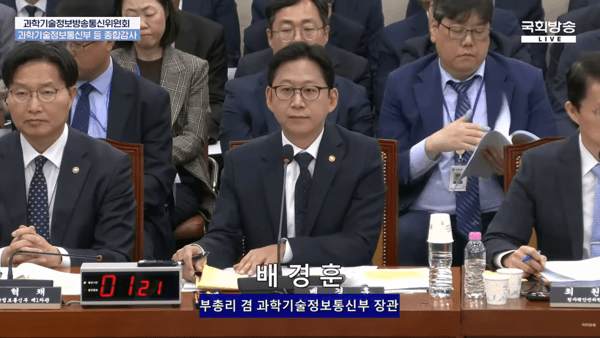
Later, Rep. Han Jun-ho of the Democratic Party of Korea said during the Oct. 6 audit that existing technology and personnel need to be utilized and that duplicate GPU and budget spending must be prevented. He also said the investment method was still undecided at the time of the comprehensive audit, and Deputy Prime Minister and Science and ICT Minister Bae Kyung-hoon explained in response to a question from Rep. Park Jeong-ha of the People Power Party on Oct. 23 that the plan for follow-up support for the independent AI foundation model had been changed to a separate open call and investment method out of concern that benefits could be concentrated on a specific company. However, he said whether to establish a special purpose company was still undecided, and that discussions were continuing on both an SPC structure and the possibility of other forms of investment.
K-Moonshot is being pursued under the theme of solving major science and technology challenges using AI, but lawmakers continued to raise questions about accountability. The government aims to solve 12 national missions by 2035 and plans to invest a total of KRW 1.3465 trillion in core projects and linked projects next year. Rep. Lee Jin-sook of the People Power Party pointed out on Oct. 6 that legal revisions were insufficient and the promotion structure was fragmented. In response, Deputy Prime Minister Bae said he would take overall responsibility for K-Moonshot.
Deputy Prime Minister Bae also said the government would gradually improve the goals, implementation plans, and relevant laws. The remark came as lawmakers were reviewing overall responsibility, the promotion structure, and whether legal revisions had been made in the course of advancing K-Moonshot.
The basis for classifying AI budget items also came under scrutiny. Rep. Lee Yun-hee of the Democratic Party of Korea presented an analysis from her office on Oct. 23, which found that among 278 national R&D projects analyzed, 85 had unclear or low relevance to AI. In response, Deputy Prime Minister Bae said the government would work with the Intellectual Property Office to verify the projects and prepare measures to prevent recurrence.
Meanwhile, the project that connects model development achievements to public services is called 'Everyone's AI.' The Ministry of Science and ICT selected three consortia -- SK Telecom (SKT), Kakao, and KT -- on Aug. 28, and as of Oct. 26, it was operating a beta service for service stakeholders. 'Everyone's AI' is scheduled for release in December, and preparations are under way for a launch within this year.
In his Oct. 6 audit remarks, Deputy Prime Minister Bae said the government plans to provide public AI agents linked to conversational services. These public AI agents will search for necessary public services, provide guidance, and handle applications on behalf of users, while customized services are being pursued in health, education, finance, and taxation. Later, in response on Oct. 23 to a question from Rep. Lee Hun-ki of the Democratic Party of Korea about easing the burden of AI and OTT subscription fees, Bae said 'Everyone's AI service' that citizens can use for free will begin in December.
This project is linked to the 'Agentic AI Initiative' announced by the government in July. The government plans to support AI in carrying out tasks by using external systems and tools, to support the development and distribution base for agents, and to promote industry-specific service development and demonstration. In addition, project evaluation will include not only model response performance but also verification of actual task-processing accuracy and user effectiveness.
Education and job creation links were also raised as tasks. Rep. Kim Hyun of the Democratic Party of Korea noted on Oct. 6 that seven divisions and teams and 13 specialized agencies within the Ministry of Science and ICT are promoting AI talent development projects, and called for measures that would lead to youth employment. In response, Deputy Prime Minister Bae said he would review ways to expand jobs by utilizing AI training centers.
Before the service spreads further, lawmakers said safeguards are needed to reduce the risks of misjudgment and misuse in agentic AI. That is because if AI carries out applications and tasks, a misjudgment could be turned into an actual action. The government identified misuse of authority, leakage of sensitive information, and deviation from objectives as risk factors in its agentic AI policy, and plans to draw up safety and trust guidelines reflecting those risks by year-end.
The National Assembly checked whether there are sufficient budgets and personnel to verify safety. Rep. Lee Ju-hee of the Democratic Party of Korea released materials submitted by the Ministry of Science and ICT on Oct. 6. According to those materials, the total amount of the ministry’s AI budget proposal for next year is KRW 9.4308 trillion, of which KRW 6.1490 trillion is allocated to performance and infrastructure, and KRW 27.4 billion to safety and trust. By the office’s classification standard, safety and trust account for about 0.3% of the total.
Rep. Lee Ju-hee of the Democratic Party of Korea called for a larger safety budget. She also urged the government to clearly define the external access scope of government-supported models and to make the suspension and reporting procedures clear in the event of abnormal behavior.
Deputy Prime Minister Bae said he agreed on the need to expand the staff and budget of the AI Safety Research Institute. He also said a master plan for building a national AI safety ecosystem will be announced in December.
The Ministry of Science and ICT said it has expanded next year’s private-sector information security budget to KRW 523.1 billion. However, because the KRW 523.1 billion budget range covers cyber security and private-sector information security overall, its scope differs from the KRW 27.4 billion tallied for model safety evaluation and verification.
In the subsequent budget review stage, lawmakers are expected to call for greater specificity in the frontier AI investment targets, the frontier AI exit conditions, the support method for the independent AI foundation model, and the responsibility structure for each K-Moonshot project. As the launch of Everyone's AI draws near, remaining pre-launch tasks include defining the scope of free use, setting agent execution permissions, and determining how to reflect responsibility for errors in the service operation plan.
Source: TECHWORLD · Kim Seung-gi
Original: https://www.epnc.co.kr/news/articleView.html?idxno=409061
References
This article was produced with the help of an automated content generation algorithm.
Source: TECHWORLD
View originalThis article was summarized and organized by BizCrush based on the original article from TECHWORLD. For exact quotations and full details, please refer to the original article.