87% of APAC SMBs and Mid-Sized Firms Say They Have Experienced Cybersecurity Incidents, Boosting Security Investment
TECHWORLD ·
✦ AI Summary
Kaspersky released its "2026 SMB Threat Landscape Report."
The report surveyed whether APAC companies with fewer than 500 employees had experienced a cybersecurity incident over the past year.
The survey found that 87% had experienced such incidents, while 13% had not.
Kaspersky on the 7th released its "2026 SMB Threat Landscape Report." The report was based on a global company survey by Kaspersky's Internal Research Center and compiled whether companies in APAC with fewer than 500 employees had experienced a cybersecurity incident over the past year.
The survey found that 87% of APAC SMBs and mid-sized firms experienced a cybersecurity incident over the past year, while 13% had not. The report also noted a trend of sharp increases in cybersecurity budgets among SMBs and mid-sized firms amid the growing sophistication of cyberthreats.
By country, Vietnam had the highest incident rate at 97%, followed by Malaysia at 95%, Indonesia at 92%, and India at 87%. Thailand's incident rate was 82%, below the APAC average, while China's incident rate was 67%, also below the APAC average.
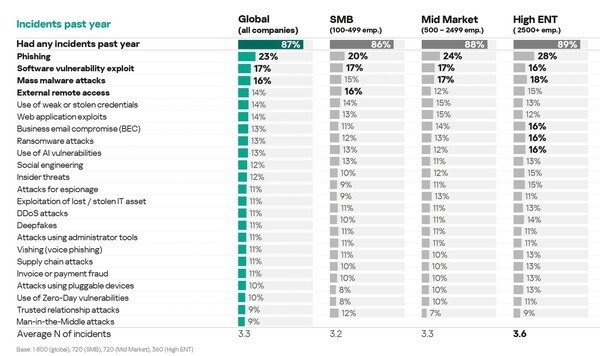
The survey also outlined the types and frequency of security incidents that APAC companies and SMBs experienced over the past year, as well as internal factors that increase the likelihood of successful attacks. APAC companies experienced an average of 3 security incidents over the past year. Among SMBs, the most common incident type was exploitation of software vulnerabilities at 20%, followed by phishing at 19% and large-scale malware attacks at 18%. Zero-day attacks were the least frequent, with 6% of companies reporting them.
The top factor increasing the likelihood of a successful cyberattack was a lack of security awareness among non-IT employees at 26%. This was followed by a lack of expertise among IT security personnel at 24% and outdated software or hardware at 23%. Lack of regular risk assessments and a shortage of necessary security solutions tied for fourth place at 22% each.
In response to this threat environment, 75% of companies in APAC plan to strengthen their IT security capabilities. Among SMBs, 78% have already increased their cybersecurity budgets this year. Of the SMBs that expanded their budgets, 48% allocated additional funds to expand their IT and IT security teams, while 32% made additional investments to transition to advanced IT security solutions such as XDR, NDR and SIEM.
In the industry, attacks continue regardless of company size, and security risks for SMBs, which have relatively weaker security infrastructure, are seen as significant.
Regarding this, Adrian Hia, Kaspersky's General Manager for APAC, said that SMBs in APAC are not merely collateral damage or secondary targets, and that the survey shows SMBs are a primary target for modern attackers. He also said the sophistication of attack techniques used against SMBs is the same as that used against large enterprises.
Adrian Hia, Kaspersky's General Manager for APAC, said the expansion of cybersecurity budgets at most SMBs signals that business leaders recognize the importance of cybersecurity. He added that future challenges include protecting core systems, strengthening the security capabilities of non-IT employees, and introducing managed security solutions that can scale smoothly as companies grow.
Source: TECHWORLD · Kim Hye-jin
Original: https://www.epnc.co.kr/news/articleView.html?idxno=407862
References
This article was produced with the help of an automated content generation algorithm.
Source: TECHWORLD
View originalThis article was summarized and organized by BizCrush based on the original article from TECHWORLD. For exact quotations and full details, please refer to the original article.