Naver Seller Coupon's Sales Effect Lasts 3 Months... Long-Form Reviews Also Lift Purchases
IT DAILY ·
✦ AI Summary
Naver said on the 30th that it had published the "D-Commerce Report 2026."
The report analyzes the relationship between platform features and sales performance based on actual operating data from SmartStore sellers, using research teams led by Professor Yoo Byeong-jun of Seoul National University and Professor Choi Bo-reum of Yonsei University.
The analysis found that seller coupons produced a sales increase of about 6.1 times in the first month after adoption and about 2.1 times even 3 months later, while purchases the following month rose by an average of 7.1% when cumulative one-month-use reviews doubled.
Naver said on the 30th that it had published the "D-Commerce Report 2026." The report analyzes the relationship between platform features and sales performance based on actual operating data from SmartStore sellers, using research teams led by Professor Yoo Byeong-jun of Seoul National University and Professor Choi Bo-reum of Yonsei University. The analysis drew on SmartStore activity data, including sales, purchases, product exposure, reviews, and Shopping Live usage.
The analysis found that stores that introduced seller coupons on SmartStore saw the sales boost last for 3 months. In the first month after adoption, the sales increase was about 6.1 times that of stores under similar conditions that did not use the feature, and even 3 months later it remained about 2.1 times higher. It also found that "one-month-use reviews," meaning reviews written a month after purchase, led to an average 7.1% increase in purchases the following month when their cumulative volume doubled.
Naver announced on the 30th the publication of the "D-Commerce Report 2026," based on joint research by Professor Yoo's team at Seoul National University and Professor Choi's team at Yonsei University. The report focused on verifying the effect of seller coupons among CRM tools that encourage repeat purchases from existing customers.
The research team compared stores that first applied seller coupons to actual transactions with stores that did not use them. The matching criteria were similarity in sales, number of transactions, cumulative reviews, number of products, and exposure volume. The comparison focused on sales trends before and after coupon adoption.
The analysis used propensity score matching (PSM) and an event study. The PSM method matched coupon-using sellers and non-using sellers as closely as possible on conditions before comparing sales changes over time. The adoption point was not defined by the coupon issuance date, but by the month when the discounted product was actually sold for the first time.
After adjusting for trends, the sales increase effect was about 6.1 times higher than that of non-using stores in the first month after coupon adoption. The effect was about 3.2 times higher after 1 month and remained about 2.1 times higher after 3 months. The research team analyzed seller coupons as a promotional tool that drives purchases at the needed moment.
An analysis of trend-adjusted sales effects before Naver seller coupon adoption showed that the sales effect in the month of adoption was about 6.1 times higher. The source of the data was Naver.
Naver seller coupons delivered a large sales effect immediately after adoption, and the effect persisted over time. Even 3 months later, the sales effect remained about 2.1 times higher.
In examining the differences in reviews accumulated after purchase, the number of reviews analyzed by the research team totaled 483 million. Of these, photo reviews accounted for 57.5%, one-month-use reviews for 24.2%, and repurchase reviews for 13.8%.
The analysis found that when cumulative one-month-use reviews doubled, purchases in the following month increased by an average of 7.1%. In product categories with high involvement, such as childbirth and childcare, the increase in purchases the following month was as high as 9.6%.
One-month-use reviews are reviews written after a certain period of use, rather than immediately after purchase. The research team said reviews built on actual usage experience help new buyers make decisions. It also said one-month-use reviews function as an accumulating information asset that leads to follow-up purchases.
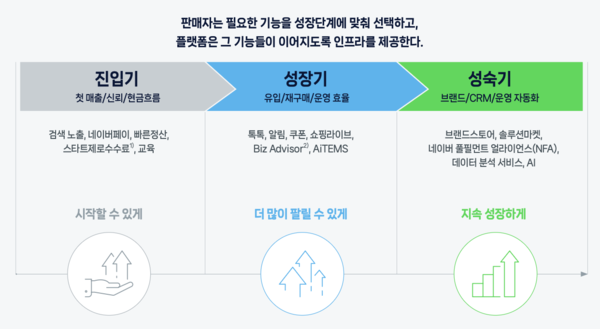
The level of platform feature use varied depending on the seller's growth stage. In particular, sellers just before moving up a tier showed 21.9 times higher product clicks, 12.1 times higher exposure, 10.8 times higher notification-follows, and 3.2 times higher Shopping Live participation than long-term entry-stage sellers.
Stores that operated Shopping Live had monthly sales 4.8 times higher, cumulative review counts 3.8 times higher, and monthly exposed user counts 3.3 times higher than stores that did not. However, the research team reviewed sales trends before adoption and found that sales at stores using Shopping Live had already been rising before broadcasts began. Accordingly, the strong sales at stores using Shopping Live reflected growth trends that had begun before adoption.
Cash flow and cost burden also affected seller retention in the early stages of business. Sellers who used "Start Zero Commission," a payment-fee support program for early-stage startups, had a 6-month cumulative active retention rate of 68.1%, while sellers eligible for the same program but who did not apply had a 6-month cumulative active retention rate of 60.1%. The program has now been integrated into "Growth Mileage."
Demand for seller support showed differences in the type of assistance needed by business scale. Entry-stage sellers cited financial support as the No. 1 reason for mainly operating SmartStore, with a response rate of 50.6%. The basis cited was low fees and fast settlement. Growth-stage sellers also chose financial support as the No. 1 reason for mainly operating SmartStore, with a response rate of 53.2%. Here too, low fees and fast settlement emerged as the basis for financial support.
By contrast, mature-stage sellers gave greater weight to business support as the reason for mainly operating SmartStore. Business support accounted for 48.3% among mature-stage sellers, while financial support accounted for 40.0%. Business support included marketing exposure and channel expansion. Many SmartStore sellers were selling on multiple platforms, and a 2025 survey found that 76% were operating on 2 or more platforms. Among those multi-platform operators, 65.1% chose SmartStore as their main platform.
Naver provides Brand Store, Commerce Solution Market, Naver Fulfillment Alliance (NFA), N Delivery, and data analytics and CRM features for mature-stage sellers. On Commerce Solution Market, outside developers can develop and register solutions for SmartStore sellers. The report analysis also looked at how key challenges change as sales scale expands, and identified brand management, logistics operations, automation, and securing stable cash flow as the main challenges when sales scale expands.
Professor Yoo Byeong-jun of Seoul National University said Naver has developed a technological infrastructure to support seller business expansion over the past 10 years, and he expects that this technology infrastructure, accumulated over a long period, can be used by sellers during the AX transition to leverage advanced growth infrastructure and expand their businesses.
Professor Choi Bo-reum of Yonsei University said SmartStore has linked search, payments, data, logistics, and financial infrastructure on top of a seller-led platform foundation. She added that SmartStore can be seen as a platform case that has built a support system by seller growth stage.
Source: IT DAILY · Kim Byeong-ju
Original: https://www.itdaily.kr/news/articleView.html?idxno=241925
References
This article was produced with the help of an automated content generation algorithm.
Source: IT DAILY
View originalThis article was summarized and organized by BizCrush based on the original article from IT DAILY. For exact quotations and full details, please refer to the original article.