SAS: Korea’s AI Trust Gap Narrows Sharply in a Year, From 28.9 Points to 1.5
TECHWORLD ·
✦ AI Summary
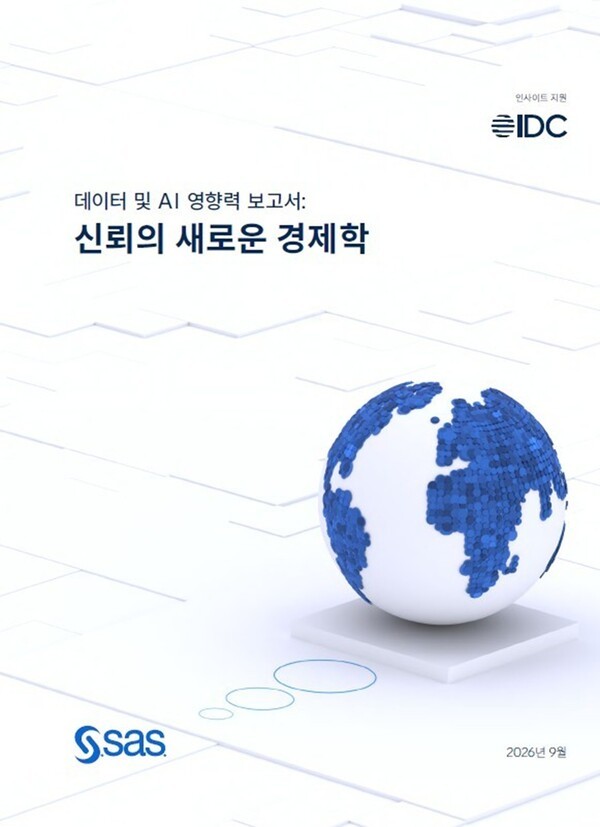
SAS announced the “Data and AI Impact Report: The New Economics of Trust” based on IDC Research Insights.
Korea’s AI trust gap fell from 28.9 points last year to 1.5 points this year, and perceived trust dropped from 73.9 points to 58.6 points.
The report identified data quality and explainability as top priorities for Korean companies going forward and said the adoption rate of agentic AI was 42.6%.
SAS announced, based on IDC Research Insights, that it has released the “Data and AI Impact Report: The New Economics of Trust,” saying the gap between Korean companies’ trust in AI and their actual governance capabilities has narrowed sharply over the past year. Korea’s AI trust gap fell from 28.9 points last year to 1.5 points this year.
The report presents an in-depth analysis of how companies are using AI and how well they are building trust, based on a survey of 2,699 business and IT decision-makers across 28 countries. The survey focused on the banking, insurance, life sciences, and public sectors.
According to the report, companies that have established a Trustworthy AI framework were 15 times more likely than those that had not to achieve ROI against target investment. It also found that the top group of companies with strong governance, data quality, and auditability were generating more than 2 times ROI through AI adoption.
Global survey results showed that companies with systematic data infrastructure, companies using AI models that can explain their decision-making process, and companies that prioritized an overall governance framework generated higher financial and operational value.
In this regard, SAS said that looking at leading companies with high AI maturity shows that building trust is not limited to a risk-mitigation strategy.
SAS said that building trust is the key driver behind effective AI scaling and the realization of sustainable business results.
Korea’s AI trust gap fell from 28.9 points last year to 1.5 points this year. The reduction in Korea’s AI trust gap was 27.4 points. The trust gap refers to the difference between a company’s perceived trust in AI and its actual governance capability, which is the level at which AI systems operate safely in practice.
In Korea, perceived trust in AI fell from 73.9 points to 58.6 points over the past year, while actual governance systems improved from 45 points to 57.1 points. As a result, Korea’s excessive expectations of AI weakened, and the two indicators — perceived trust and actual governance capability — were almost aligned.
SAS said the main reason for the narrowing gap was that Korean companies rapidly strengthened their AI governance and oversight systems. SAS reported Korea’s “model governance and oversight” score at 55.8 points. That was up 9.3 points from a year earlier, the largest improvement among the survey items.
However, the core foundations for AI were still found to be weak. “Explainability and fairness” scored 54.6 points, only a slight increase from a year earlier. “Data quality and governance” also scored 53.9 points, also only a slight increase from a year earlier. “Responsible AI policy” stood at 59.5 points, with no change in score.
Korean companies strengthened model governance and audit systems, but only 1.9% of Korean companies were found to make data quality management procedures mandatory for all projects.
Against this backdrop, the Data and AI Impact Report identified “data quality” and “explainability” as the top priorities for Korean companies going forward.
The report said 42.6% of Korean companies had adopted “agentic AI.” It explained that “agentic AI” refers to AI that can judge and act on its own, and that the share of AI handling work autonomously is also increasing as a result. The report noted that as autonomous decision-making expands through agentic AI, cases in which AI cannot explain the reasons for its decisions or learns from incorrect data could create serious business risks. It also said the biggest reason users actually ignore or manually revise AI recommendations is that AI cannot explain the basis for its judgments.
The report went on to say that the level of expectations for AI needs to be aligned with actual governance capabilities. It also said there is a need to establish stable data and governance systems. The report explained that these factors go beyond simple risk prevention and are directly linked to companies’ actual business performance.
The global survey found that companies with optimized data infrastructure were 4 times more likely to achieve high ROI. It also found that companies with optimized data infrastructure were 6 times more likely to make data quality and explainability controls mandatory.
Jeon Dae-il, a senior research fellow at IDC AI Research, said that as AI’s autonomous judgment and action expand, trust and usage issues surrounding systems that people do not fully understand are emerging as a new challenge. He identified strong governance and oversight, explainability, accountability, and a solid data foundation as essential conditions for successful AI scaling.
Lee Jung-hyeok, CEO of SAS Korea, said the AI trust gap among Korean companies had narrowed sharply over the past year. He described the narrowing of the trust gap as a positive sign of rapid progress in building governance and recognizing real-world risks, and said the tasks for linking Korea’s AI expansion to tangible business results include explaining the basis of AI judgments in parallel with governance building, and completing a data foundation with accuracy and reproducibility.
Source: TECHWORLD · Lee Gwang-jae
Original: https://www.epnc.co.kr/news/articleView.html?idxno=407554
References
This article was produced with the help of an automated content generation algorithm.
Source: TECHWORLD
View originalThis article was summarized and organized by BizCrush based on the original article from TECHWORLD. For exact quotations and full details, please refer to the original article.