Naver Cloud Unveils Defense AX Strategy: "The Military Must Retain Control of Data and Models"
TECHWORLD ·
✦ AI Summary
Naver Cloud held a Defense AI Day seminar at The Shilla Seoul on the 18th and unveiled its defense AX strategy. The core of the strategy is to rapidly turn private-sector AI technology into operational capability while the military retains control over data and AI models. To that end, it proposed a four-stage structure of gathering, connecting, validating and evolving, along with a plan to continuously enhance performance after field validation.
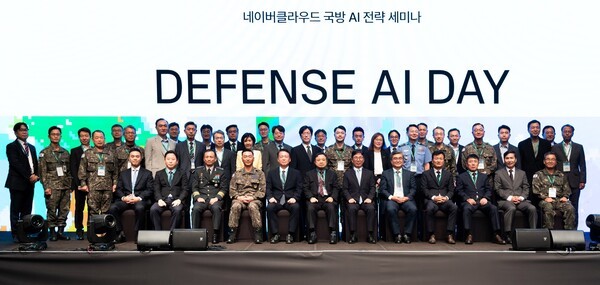
Naver Cloud proposed a defense sovereign AI strategy that applies private-sector AI technology to the defense sector while keeping the military in control of key decision rights. The strategy centers on maintaining the military's control over data and AI models, and its goal is to rapidly turn private-sector technology into operational capability. On the 18th, Naver Cloud held the Defense AI Day seminar at The Shilla Seoul and unveiled its defense AI transformation (AX) strategy.
The event was hosted by Naver Cloud, and 550 people attended, including officials from the Ministry of National Defense, the Joint Chiefs of Staff and the armed services. Based on an infrastructure-AI model-application linkage structure, Naver Cloud presented a framework for applying AI to the defense sector.
It also proposed a process of field validation followed by continuous performance enhancement. Kim Yu-won, CEO of Naver Cloud, said defense AI should not stop at simply introducing technology, but should begin with the military defining the problems it needs to solve, then go through on-site verification and continue through the process of operational deployment.
Naver Cloud presented a vision based on full-stack capabilities spanning AI models, services and infrastructure. It also said it would serve as a bridge connecting the military, defense companies, startups and research institutions.
Kim Seon-ho, former vice minister of national defense, identified the rapid operationalization of private-sector technology as the key task for defense AX. As a recommendation to achieve this, he proposed the Commercial First principle, which holds that the private sector should lead technological innovation and the military should quickly integrate it. He also pointed to civil-military convergence as the ecosystem needed to support this effort.
In response, Naver Cloud outlined a four-stage structure for private-sector technology. The four stages are gathering, connecting, validating and evolving. In the gathering stage, infrastructure, AI models and applications are the targets to be assembled, while the connecting stage calls for linking military data in a closed network environment.
For the validation stage, it proposed a step-by-step approach that begins with missions whose effectiveness can be measured. As a design principle for this process, it said the military should retain control over data and also retain control over the models. As for the subsequent operating structure, it disclosed a plan for field deployment engineers (FDE) to participate in system operations, with FDEs responsible for reflecting field requirements and continuously improving performance.
It also disclosed a technology direction for applying autonomous weapons systems. Seong Nak-ho, head of hyperscale AI technology at Naver Cloud, said that a "common semantic framework" is needed for different sensors and platforms to understand the same situation.
The proposed vision focuses on treating battlefield information through spatial intelligence and world models, linking situational awareness to judgment, action and learning in a single flow. To that end, it presented spatial intelligence for 3D spatial structuring of drone footage and sensor data, as well as the incorporation of battlefield variables such as terrain, weather and radar, and a world model for predicting the results of actions. It also envisioned an integrated system that connects the full intelligence process of situation understanding, judgment, action and learning.
Naver Cloud is planning to build an environment that is not tied to a specific AI model. The goal of this environment is to allow the military to directly control the models and data it needs. It also plans to focus on on-site validation and repeated operations rather than one-off technology supply, and to pursue continuous improvements in AI performance through that repetitive process.
CEO Kim Yu-won said the scope of defense AI does not end with the introduction of technology, but includes defining the military's required problems, on-site verification and operational deployment. He also expressed his willingness to support the efforts of the military, defense companies, startups and research institutions in turning their capabilities into real solutions for defense challenges.
Source: TECHWORLD · Kim Seung-gi
Original: https://www.epnc.co.kr/news/articleView.html?idxno=407148
References
This article was produced with the help of an automated content generation algorithm.
Source: TECHWORLD
View originalThis article was summarized and organized by BizCrush based on the original article from TECHWORLD. For exact quotations and full details, please refer to the original article.