Dell Says AI Performance Data Exists Separately; Companies Need a Data Strategy for ROI
TECHWORLD ·
✦ AI Summary
Although companies are increasing AI adoption and investment, the assessment was that actual business results are falling short of expectations. Lee Jun-kyu, executive vice president at Dell, said a data strategy is needed to convert data into an AI-usable form, prepare it, and keep it continuously operating in order to connect AI investment with ROI. He said that to respond to data silos, distributed environments, and the spread of AI agents, companies need to identify data locations, build a data foundation, and strengthen security.
Although companies are expanding AI adoption and investment, the view is that actual business results are falling short of expectations. Dell Technologies stressed that a data strategy is needed to connect AI investment with ROI.
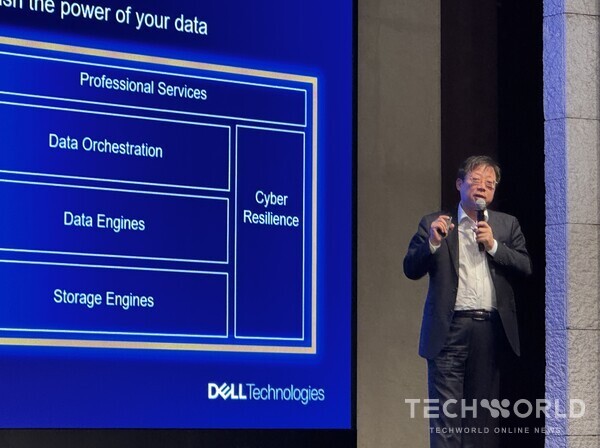
At the NABS 2026 (Nest AI&Big Data Summit 2026) keynote on the 18th, Lee Jun-kyu, executive vice president at Dell, spoke on the theme, "Data strategies that create results in the AI factory era." He said managing and operating data is important for connecting to corporate ROI.
Lee Jun-kyu said proprietary corporate data is a core competitive edge for creating results. However, he explained that some data cannot be used by AI, and that simply possessing data does not generate AI results. He added that a strategy is needed to convert data into a form AI can use, prepare it, and keep it continuously operating.
Simply holding large volumes of data does not guarantee AI results. He said this is because internal corporate data is scattered across distributed environments such as cloud, databases, storage, applications, production equipment, and robots, while data silos are common and there are many cases in which data locations or data reuse methods are undefined. Accordingly, he said a process is needed to prepare data so it can be used by AI.
He said these problems become even more severe when AI projects move from the pilot stage to actual production. In the pilot stage, it is possible to temporarily collect and use the necessary data, but in real operating environments, continuous data collection, data cleansing, data analysis, conversion into an AI-usable form, and maintenance of that pipeline are required.
He said it is inappropriate to view data integration as concentrating everything in one place. He explained that data integration should be seen as the integration of data preparation and the creation of AI-ready data, on the premise of minimizing data movement.
Accordingly, he said the approach of fully consolidating distributed data should be ruled out, and that a method using the storage location directly is needed. He also said only data requiring separate processing and analysis should be moved.
Referring to the spread of AI agents, he explained that the data used by agents is continuously updated, and that data locations, content, and tasks also change. He said responding to this situation requires identifying data locations and building a data foundation that enables AI use.
He also said stronger security is needed to prevent AI agent failures from leading to work stoppages. He added that the scope of protection should be expanded beyond data, and that the targets are agent applications and execution environments.
The speaker explained that when an agent stops, work also stops, and accordingly said the goal when a failure occurs should not be limited to data recovery but should focus on recovering the work the AI was performing.
Source: TECHWORLD · Kim Hye-jin
Original: https://www.epnc.co.kr/news/articleView.html?idxno=407142
References
This article was produced with the help of an automated content generation algorithm.
Source: TECHWORLD
View originalThis article was summarized and organized by BizCrush based on the original article from TECHWORLD. For exact quotations and full details, please refer to the original article.