Coupang and Naver Intensify Competition for Fast Delivery Leadership
IT DAILY ·
✦ AI Summary
Coupang has built a fast delivery advantage since introducing Rocket Delivery by directly expanding nationwide Fulfillment centers and delivery networks, and it is adding AI and automation.
Since launching NFA in 2021, Naver has expanded its logistics scope from connecting specialized logistics companies and sellers to N Delivery and FBN.
The fast delivery competition has expanded beyond delivery time to logistics overall, including inventory, order processing, and returns, with Coupang focused on in-house network efficiency and Naver on delivering consistent quality across external logistics networks.
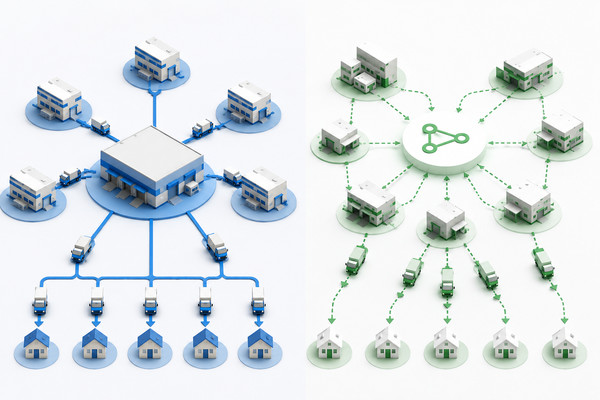
The competition between Coupang and Naver for leadership in fast delivery is heating up. The illustration is a generative AI image depicting direct-build and connected logistics operating models. Coupang has already captured the domestic fast delivery market, and since introducing Rocket Delivery in 2014, it has directly expanded its Fulfillment centers and delivery network to make fast delivery a core competitive advantage. Coupang says it will add AI and automation to the nationwide logistics network it has invested in for more than 10 years and will not allow rivals to catch up.
Naver, meanwhile, has been accelerating its challenge since launching the Naver Fulfillment Alliance (NFA) in 2021. Its early approach was to connect specialized logistics companies and sellers, choosing a model that combined specialized logistics infrastructure with N Delivery. The service has since evolved into Arrival Guarantee, N Delivery, and, in July this year, "N Delivery by Naver (FBN·Fulfillment by Naver)." Its scope of involvement in logistics operations has also gradually expanded.
Accordingly, the competition between Coupang and Naver is not one that formed overnight, and the scope of fast delivery rivalry is also expanding beyond delivery time to encompass logistics operations overall, including inventory, order processing, and returns. Naver is broadening its management scope to include Fulfillment and returns, and the focus of competition is shifting beyond simple delivery speed to logistics operations as a whole.
The domestic e-commerce market is shaped by a duopoly between Naver and Coupang. Naver said its 2024 commerce transaction volume was KRW 50.3 trillion, while Coupang's 2024 payment volume was estimated by Wiseapp·Retail at KRW 55.0861 trillion. By transaction volume, the two companies form the market's two main pillars.
The challenges facing the two companies, however, are different. Coupang's task is to raise utilization and productivity in the logistics network it secured through large-scale investment, with the goal of turning scale advantage into profitability. Naver, lacking a nationwide in-house network like Coupang's, must bring together the capabilities of specialized logistics companies, and its goal is to improve the delivery quality that consumers perceive.
The background to Coupang's leadership in fast delivery lies in years of direct investment. Coupang introduced Rocket Delivery, then expanded Fulfillment centers and customer delivery networks. In the process, it established an operating model that expanded storage, processing, and delivery networks at the same time.
Coupang's own operating system links inbound receiving, storage, picking, packing, outbound shipping, and delivery. As a result, Coupang has built a structure in which it directly manages the movement of products after an order is placed. This system became the basis for the fast delivery advantage that emerged after Rocket Delivery was introduced.
Coupang is expanding its logistics network to widen the service area for Rocket Delivery. In 2024, Coupang announced plans to build new Fulfillment centers, introduce advanced automation technologies, and upgrade its delivery network, saying it planned to invest more than KRW 3 trillion by 2026. At the time of the announcement, Rocket Delivery was available in 182 of the country's 260 cities, counties, and districts, and Coupang said it aimed to expand Rocket Delivery to about 230 cities, counties, and districts by 2027 and broaden the population able to use Rocket Delivery to more than 50 million, setting a goal of building a nationwide Rocket Delivery lifestyle zone.
At the same time as continuing to expand the scale of its logistics network, Coupang is also improving the productivity of existing facilities. To that end, it is using AI and machine learning to forecast demand by region and by product, and prepositioning products with a high likelihood of being ordered by consumers in the logistics networks of the areas where they are needed.
With this operating model, Coupang is reducing the distance products travel after an order is placed and shortening both outbound processing time and delivery time. The photo subject is an automated guided vehicle (AGV) at a Coupang Fulfillment Center.
This logistics center operation combines demand forecasting, automation equipment, and integrated data usage to improve efficiency from product placement to movement, packing, and delivery. Inside the center, AGVs, AMRs, and packing automation equipment are deployed, and demand forecasting is used to determine where products should be placed and in what volumes. In addition, by using a unified operating system for data from product intake through delivery, it boosts the speed and efficiency of product movement, picking, sorting, and packing by automation equipment.
A Coupang official explained that the company is directly pursuing logistics cost and packing efficiency improvements through investment in automation equipment and infrastructure based on direct operations. The official also said Coupang pre-receives products at logistics centers through AI-based demand forecasting and then ships and delivers them quickly after orders are placed.
However, as a directly operated logistics network expands, utilization becomes increasingly important. Because the costs of centers, automation equipment, labor, and delivery networks are rigid, they cannot be scaled down immediately even if orders temporarily decline.
On the other hand, if sufficient volume is secured, the amount of orders processed at the same facility can be increased. Accordingly, higher order processing volume leads to a fixed-cost spreading effect, and securing a steady flow of cargo is cited as a key condition for competitiveness in large-scale logistics networks.
Coupang's challenges surfaced in its second-quarter 2026 results. During the same period, active customers in Product Commerce rose 3% year over year to 24.7 million.
By contrast, Product Commerce profitability and margins deteriorated. Adjusted EBITDA for Product Commerce fell 42% year over year to USD 382 million, and the margin declined from 9.0% to 5.1%.
In the second-quarter earnings conference call, Coupang Inc Chairman Bom Kim explained that the company had planned logistics processing capacity and fixed costs based on expected demand, but actual sales fell short of those plans, expanding the share of related costs relative to revenue. He said Coupang did not reduce processing capacity in the short term despite changes in demand and maintained existing operating levels to preserve the customer experience.
In this situation, the remaining tasks were presented as expanding the nationwide logistics network, raising utilization of existing facilities, and improving productivity at those facilities.
Instead of building its own nationwide Fulfillment centers and delivery network, Naver entered the fast delivery competition by choosing a structure that connects Smart Store sellers with specialized logistics companies. Rather than directly expanding its own logistics infrastructure, it adopted a model that links sellers with multiple logistics firms.
The starting point for this approach was the NFA launched in 2021. Naver connected sellers with Fulfillment providers of differing capabilities, including CJ Logistics, Ourbox, Wekeep, Fasto, and Poongo, allowing sellers to choose logistics services tailored to product characteristics such as frozen, refrigerated, and same-day shipping.
Naver's key role in the NFA is data connectivity. Naver enabled inventory, outbound shipping, and delivery tracking information to be linked between sellers and logistics companies based on standardized application programming interfaces (APIs), as well as Smart Store order data linkage. The structure was designed so that, while logistics companies maintained their existing facilities and operating systems, Naver provided the point of information exchange between sellers and logistics companies.
As delivery competition intensifies, Naver has reworked its existing "Naver Arrival Guarantee" into N Delivery and expanded the platform's management scope through integration of individual logistics companies' services into N Delivery. Delivery options have also been segmented into same-day delivery, next-day delivery, Sunday delivery, and preferred-date delivery, while fast delivery offerings have expanded to include dawn delivery. Naver said that the number of products handled had increased 700% two years after introducing the Arrival Guarantee service.
Naver expanded its role through FBN, which began open beta in July. As a result, sellers can now use Fulfillment through Naver without having to sign separate contracts with logistics companies or connect systems on their own. After products are received, Naver supports inventory management, exchanges, returns, and customer service (CS), while the actual storage, outbound shipping, and delivery are handled by NFA logistics companies. This has reduced the steps sellers must take and created a structure aimed at improving small sellers' access to Fulfillment and expanding the range of products handled by N Delivery.
Naver aims to improve delivery quality by enabling sellers to manage delivery information and logistics data without separate contracts with logistics companies. A Naver official said the company expects this to expand the use of Naver Fulfillment services.
In line with this, the scope of N Delivery management is expanding from delivery to returns. Expansion of delivery time slots and product categories is also being pursued.
FBN has added dawn delivery and Sunday delivery to same-day and next-day delivery. The product categories covered by FBN have also expanded to fresh food, health supplements, and products for infants and children. The operating model relies on the infrastructure of specialized logistics companies capable of handling each delivery type.
There was also a case around this year's Liberation Day holiday during the so-called "courier break" period. Even when general parcel delivery was suspended, some specialized services such as dawn delivery and same-day delivery under N Delivery were operated through partner delivery networks. The structural feature confirmed by this case is that Naver does not directly operate a nationwide delivery network, but instead builds delivery services by combining the capabilities of partners.
Naver has pointed to transaction growth and coverage expansion as indicators of N Delivery's growth. In the second-quarter earnings conference call, Naver CEO Choi Soo-yeon said that as of June, Smart Store N Delivery transaction volume had increased 76% year over year. As of June, N Delivery coverage was tallied at more than 20%.
Choi also said Naver would accelerate N Delivery growth in the second half. She explained that the company plans to accelerate N Delivery growth in the second half by strengthening the virtuous cycle between membership and N Delivery. To that end, starting in October, it plans to support faster returns through a membership-only return center and to introduce dedicated dawn delivery.
At the same time, Naver is reorganizing FBN's return system. FBN is currently restructuring the return process after consumer delivery. Beginning August 21, Hanjin will handle retrieval of items entering Naver's integrated return center, regardless of the original delivery courier, and the collection channels that had been separated by courier will also be unified under Hanjin. The integrated return center is structured to handle inspection and return processing.
Naver said it is focusing on simplifying the usage process rather than adding separate operating requirements for sellers. A Naver official said the company is moving in a direction that simplifies the N Delivery process for sellers rather than increasing the things they must comply with. The official also said that a dedicated courier collects items for exchanges and returns of FBN products, and that the integrated return center supports a faster delivery experience.
Against the backdrop of a photo showing product sorting work at a Coupang Fulfillment Center, the article's theme is the possibility that Coupang's advantage could shift as Naver closes in.
Naver had considered securing its own logistics facilities to improve delivery quality. However, it decided to continue using specialized logistics companies' infrastructure, and a Naver official acknowledged that the company had reviewed the possibility of building its own logistics center, but said this was not a Coupang-style direct-build approach.
This aligns with Naver's strategy of choosing to use external infrastructure rather than directly expanding logistics assets. Naver is also continuing a strategy of expanding the scope of platform management.
Naver posted operating profit of KRW 520.3 billion and an operating margin of 15.4% in the second quarter of this year. Naver cited the strengthening of Naver Plus Store, membership, and N Delivery as drivers of commerce growth.
By contrast, Coupang is seen as having the edge in the physical infrastructure that underpins fast delivery. Coupang has directly built out nationwide Fulfillment centers and delivery networks for more than 10 years, and because of this difference, it is considered unlikely that Naver will catch up to Coupang's network scale and operational control in the short term even if it expands FBN.
The logistics competition between Naver and Coupang is contrasted by their different operational challenges. As Naver's role expands from NFA to N Delivery and FBN, the scope of competition is also widening accordingly. On the other hand, it is presented as difficult for Naver's pursuit alone to reverse Coupang's logistics advantage right away. The next factor that will determine the fast delivery market's direction is the operational competition between the two logistics models.
The benchmark for fast delivery competition is expanding. After next-day delivery, the options for same-day, dawn, and Sunday delivery have increased, reducing the room to create differentiation based on delivery time alone. Accordingly, the factors that determine competitiveness are shifting to demand-tailored inventory placement, stable order processing, and overall logistics quality including exchanges and returns. The efficiency of capacity utilization is cited as an important variable for sustaining logistics advantage.
Coupang's challenge is to connect the nationwide network it built directly to productivity and profitability. While maintaining the high level of control offered by its nationwide in-house network, it faces the task of securing sufficient cargo volume and productivity while spreading the burden of investment. The second-quarter decline in profitability is a sign of this burden. For Coupang, the key variable is efficient use of the capacity it has secured.
Naver's challenge is to deliver consistent delivery quality on a logistics network it does not own. Naver's key battleground lies not in the size of its logistics assets, but in delivering consistent N Delivery quality by combining the capabilities of different logistics companies. In an environment where delivery speed options are becoming more diverse, Naver must tie together external logistics networks to raise operating quality, while Coupang must connect the efficiency of its in-house network to profitability.
Source: IT DAILY · Kim Byeong-ju
Original: https://www.itdaily.kr/news/articleView.html?idxno=241310
References
This article was produced with the help of an automated content generation algorithm.
Source: IT DAILY
View originalThis article was summarized and organized by BizCrush based on the original article from IT DAILY. For exact quotations and full details, please refer to the original article.