AI Breaks Up Platform Functions, Driving a Shift Toward Control-Centered Regulation
IT DAILY ·
✦ AI Summary
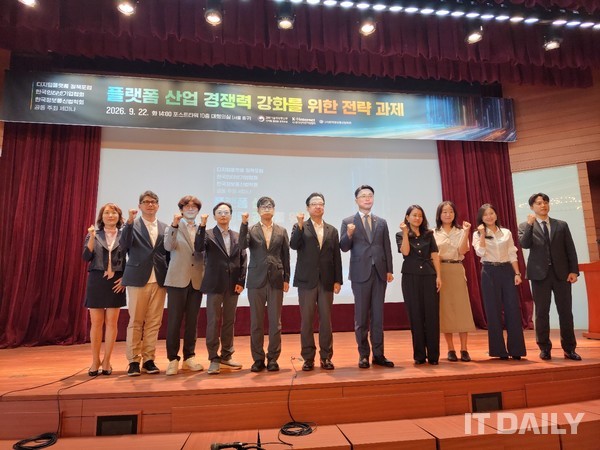
On the 22nd, the "Seminar on Strategic Tasks for Strengthening Platform Industry Competitiveness" was held at Post Tower in Jung-gu, Seoul.
At the seminar, participants discussed the need to redesign the scope and method of platform policy regulation as AI crosses over existing platform functions such as search, shopping, and content.
They argued that regulatory criteria should shift away from company size or the "platform" classification and toward actual effects on competition restrictions, user damage, and control over data and transactions.
On the 22nd, the "Seminar on Strategic Tasks for Strengthening Platform Industry Competitiveness" was held, and participants posed for a commemorative photo. The photo was taken by Kim Byeong-ju. At the seminar, attendees raised the question of how to rethink what should be regulated, and on what basis, as AI crosses over traditional platform functions such as search, shopping, and content.
Speakers at the seminar said the scope and method of platform policy regulation need to be redesigned. They argued that regulatory criteria should shift away from company size or the "platform" classification and toward actual effects on competition restrictions, user damage, and control over data and transactions.
They also diagnosed a shift in the center of AI competition from model development to services and revenue generation, alongside expanding direct user contact for AI companies and the internalization of AI services by existing platforms. In addition, they said that as AI that understands user intent becomes separated from businesses that provide products and services, the existing policy premise that a single platform covers everything from user contact to transactions is weakening.
The Digital Platform Policy Forum, the Korea Internet Corporations Association, and the Korea Information Law Society held a seminar on the theme of "Strategic Tasks for Strengthening Platform Industry Competitiveness" at Post Tower in Jung-gu, Seoul, on the 22nd. The seminar was based on discussions that domestic platform policy goals and regulatory methods need to be reexamined in order to respond to industrial structure changes in the AI era.
At the seminar, participants raised the concern that domestic platform policy direction should be reviewed again in a situation where industrial structures are changing because of AI. On regulatory methods, discussions focused on the need to move away from one-sided top-down approaches and toward governance based on communication among market participants.
Ryu Je-myeong, the second vice minister of Science and ICT, said he agrees with the need to place importance on growth and stronger global competitiveness. He then said the government will pursue both responsible self-regulation and enhanced competitiveness of domestic platforms in parallel.
Lee Kyung-sun, a researcher at the Korea Information Society Development Institute (KISDI), said the axis of competition in the AI industry is shifting from the model itself to application and value creation. This was presented as a diagnosis that the center of AI competition is moving from the model itself to application areas that are closer to users.
Lee explained that AI, which had been research-and-development-centered technology, is changing into an economic service that is continuously produced and consumed. He said that, accordingly, the focus of competition is also shifting from rapidly securing AI capabilities to making them into services and creating industrial value.
Lee analyzed that in this transition, the role of platforms is to connect AI models with actual users. He said that in the digital transition era, platforms and SaaS lowered the barrier to technology use, but in the AI transition era, agentization is being added to platformization and servitization. He also explained that AI agents operate by understanding intent and then selecting and executing the needed services based on a structure that does not require users to search or give commands directly.
In the U.S. commerce market, various forms of experiments are underway in connection with these changes. Among them are cases in which existing platforms internalize steps from search to delivery through AI, and cases in which AI companies handle user contact while existing commerce platforms carry out the transactions.
The structure in which search, shopping, payment, and content consumption were integrated within a single platform is expected to change with the introduction of AI. Kim Seong-ok, a researcher at KISDI, said platforms have been understood as structures in which services are completed in one sweep, but AI may decompose the execution stage and recombine functions and assets. He also noted that this makes it necessary to rethink control points. The questions are who preempts user intent, who decides what gets exposed, and who accumulates transaction data.
On the policy side, it was proposed that the growth of domestic platforms and the securing of global competitiveness should be redefined as the core goals of platform policy. Lee Kyung-sun proposed this direction. There was also the view that policy design should take into account value creation and diffusion across the AI ecosystem. For the regulatory system, a flexible, self-regulation-centered framework was proposed, and as a response principle, it was also noted that competition-restricting behavior that hampers innovation must be addressed with precision.
Regulation of domestic platform transaction practices and user protection follows a structure in which multiple laws apply. In terms of competition order, the Monopoly Regulation and Fair Trade Act regulates abuse of market-dominant positions and unfair trade practices. In terms of consumer protection, the Electronic Commerce Act regulates consumer protection in online transactions.
The revised Electronic Commerce Act, which took effect on July 21, specified the obligations of e-commerce businesses operating online interfaces and businesses engaging in mail-order sales. Obligations under the revised act include displaying the total price on the first screen that provides product pricing information. Here, the scope of the total price refers to the amount that consumers must pay as a prerequisite for purchase or use.
The revised Electronic Commerce Act also includes provisions prohibiting certain acts related to the use of online interfaces. At the same time, regulation of information distribution was also strengthened.
The revised Network Act, which took effect in July, updated provisions on illegal information and false and manipulated information. For businesses that repeatedly distribute illegal information or false and manipulated information that has been recognized by a court and for which related rulings have become final, the Broadcasting and Media Communications Commission may impose sanctions if certain requirements are met. The sanctions can include a fine of less than KRW 1 billion.
Separately from legal regulation, the government operates a platform self-regulation framework. In July, the Ministry of Science and ICT began work on developing "self-regulation principles for platforms in the era of generative AI" as this year's task for the platform self-regulation body.
At the same time, efforts are under way to clarify platforms' legal responsibilities. In the AI sector, new self-regulatory standards are being prepared, and AI is changing the functions of existing platforms as well as relationships among operators.
Amid these changes, policy issues are also emerging. Questions are being raised about what should be treated as the subject of legal regulation and what should be delegated to self-regulation, while how to define the regulating body and the scope of conduct is also emerging as a policy task.
Against this backdrop, Professor Seon Ji-won of Hanyang University School of Law raised concerns about approaches that use platform size itself as a basis for regulation. Seon argued that, under the premise that an existing platform legal framework is already in place, actual market failure should be identified before introducing new ex ante regulation. He also said the limitations of the current system should be identified before introducing new ex ante regulation.
Seon said a regulatory approach based solely on size is inappropriate. He also pointed out that if regulators lack sufficient understanding of platform structures, they may end up designing uniform rules. He argued that regulatory and industrial promotion policies need to be designed in a way that reflects both the social and economic added value of platforms and industrial development.
Hwang Hye-sun, an attorney at Kim & Chang, argued that it is necessary to examine both the effects of competition restriction and the effects of increased efficiency in related markets. She explained that self-preferencing, exclusive contracts, and tying can exclude competitors while also increasing user convenience, improving system efficiency, and reducing transaction costs. She also said that rather than presuming illegality based only on size or vertical integration, concrete market effects such as price increases, innovation suppression, reduced competition, and infringement of consumer choice should be identified.
Hwang proposed that, rather than new ex ante regulation, the sophistication and predictability of ex post regulation based on existing competition law should be improved. She also argued that existing regulation, which examines market characteristics and competition-restricting effects on a case-by-case basis, should be used. She added that stronger enforcement capacity is needed.
At the "Seminar on Strategic Tasks for Strengthening Platform Industry Competitiveness" held on the 22nd, a panel discussion was held. Participants in the discussion included Lee Kyung-sun of KISDI; Professor Seon Ji-won of Hanyang University School of Law; Cho Young-gi, secretary general of the Korea Internet Corporations Association; Kim Yong-hwan, leader of Agenda Relations at Naver; attorney Hwang Hye-sun of Kim & Chang; Lee Seong-yeop, a Korea University professor and president of the Korea Information Law Society; Hwang Yong-seok, a professor in the Department of Media and Communication at Konkuk University and president of the Korea Association for Information Policy; Park Seong-sik, head of external cooperation at Nol Universe; Kim Seong-ok of KISDI; and Gu Hui-seon, head of the Platform and OTT Policy Team at the Ministry of Science and ICT. The photo was taken by Kim Byeong-ju.
During the discussion, participants said that when examining the impact of platform regulation, it is necessary to exclude approaches that limit the scope to platform companies. There was also concern that even the same regulation can affect sellers and consumers differently.
This concern was explained by the fact that platforms have a structure that connects two different groups: sellers and consumers. Accordingly, it was summarized that regulation targeting one group may also affect the costs and benefits of other participants.
Hwang Yong-seok, professor in the Department of Media and Communication at Konkuk University, pointed out that the costs of platform regulation may not remain confined to the legal subject of regulation and may not match the party bearing the economic costs. He explained that those affected by obligations imposed on platforms may be other market participants, and that the transfer channels include usage fees, listing conditions, support services, and opportunities for external businesses to participate.
Hwang emphasized the need for regulatory impact analysis that takes the interdependence of two-sided markets into account. He said that when restricting a specific fee, it is necessary to review not only direct cost reductions but also other fee adjustments, changes in service quality, changes in transaction volume, and changes in incentives to participate in the market. He also explained that because such effects can vary depending on market conditions, premature assumptions about side effects should be avoided, and possible channels should be examined empirically.
Cho Young-gi, secretary general of the Korea Internet Corporations Association, argued that platform-mediated transactions involve multiple stakeholders. He cited sellers, consumers, delivery workers, small and medium-sized merchants, and major brands as those stakeholders, and argued that it is also necessary to review who actually bears the cost of regulation.
There have been persistent concerns about the practice of classifying industries with different characteristics in a blanket manner simply because they share the common label of a platform. Park Seong-sik, head of external cooperation at Nol Universe, said that a platform is not a specific industry but a neutral technological form that accommodates various business models.
Park Seong-sik explained that disparate industries such as lodging, e-commerce, delivery, mobility, content, and fintech are being grouped together under the platform framework. Accordingly, it is argued that the subjects of regulation should be individual industry structures and specific conduct rather than the platform label itself.
This concern is also linked to the AI-driven decomposition of platform functions. That change is connected to the competitiveness of domestic platforms.
Global big tech companies have a linked structure that runs from AI models and cloud services to data, platforms, and services. Amid these changes, the importance of user contact points and data acquisition points is growing for domestic operators.
Kim Yong-hwan, leader of Agenda Relations at Naver, argued that platform policy should avoid ad hoc design aimed at responding to immediate issues. He explained that the current competitiveness of the platform industry is the result of past policies, and that policies formulated now will shape the future of the platform industry. He then said it is necessary to set the goals of industrial policy first and design individual policies afterward.
Kim Seong-ok then proposed expanding the unit of policy analysis. He said analysis should move away from a focus on "platform operators" and toward functions and points of control. He also identified search, recommendation, request linkage, transactions, payment, execution, and data feedback as areas for review, and argued that it is necessary to examine the entities exercising actual control at each functional stage.
Kim Seong-ok also argued for expanding the scope of competition analysis. While saying that elements beyond user numbers and market share should be included in competition analysis, he proposed examining together the entities that secure user intent, the entities that determine standards and interfaces, and the entities that control access conditions for downstream businesses.
Kim analyzed that in the AI era, the point where innovation occurs and the point where final value accumulates may become separated. He noted that even if new AI services are created in Korea, technology, talent, data, and customer relationships may be absorbed into the ecosystem of global model and platform operators, and in that case the place where value ultimately accrues may change over the long term.
On the other hand, he said that if domestic platforms connect AI capabilities with service companies, usage and transaction data, as well as revenue, could be linked to the advancement and reinvestment of domestic services. However, he also warned that if foreign operators dominate user contact points, domestic companies could become locked into the role of providers of service execution functions.
Gu Hui-seon, head of the Platform and OTT Policy Team at the Ministry of Science and ICT, said that in the AI and AX era, platforms will serve as hubs for innovation that connect AI technology with actual services and industries. He also said the government will continue efforts to ensure that responsible self-regulation involving the government, businesses, and users takes root in the market, and added that the government will support efforts to strengthen the competitiveness of the domestic platform industry.
The Ministry of Science and ICT said it began work in July on developing "self-regulation principles for platforms in the era of generative AI." In a generative AI environment, where user contact, transaction execution, and data accumulation functions can be divided among different operators, the remaining tasks were presented as establishing criteria for identifying the party exercising actual control and criteria for identifying points where intervention is needed to ensure competition and user protection.
Source: IT DAILY · Kim Byeong-ju
Original: https://www.itdaily.kr/news/articleView.html?idxno=241829
References
This article was produced with the help of an automated content generation algorithm.
Source: IT DAILY
View originalThis article was summarized and organized by BizCrush based on the original article from IT DAILY. For exact quotations and full details, please refer to the original article.