Social Solidarity Bank: “Inclusive Finance Needs to Reexamine Those Outside Credit Scores”
TECHWORLD ·
✦ AI Summary
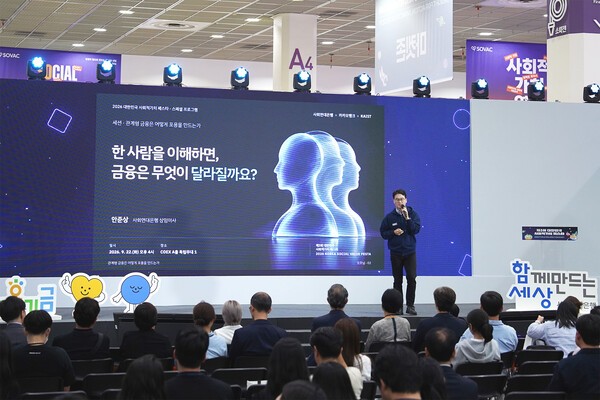
The Beautiful Foundation (Social Solidarity Bank) took part in the 3rd Korea Social Value Festa on the 21st and 22nd, and on the 22nd held “How Relationship-Based Finance Creates Inclusion.”
At the event, the first-year operating record of “Project Again, Spring” and initial findings from a KAIST research team were shared.
The presentations introduced the interview approach of relationship-based finance, records from 1,432 applicants, and an analysis of conversation categorization based on 375 phone interviews.
The Beautiful Foundation (Social Solidarity Bank) took part in the 3rd Korea Social Value Festa on the 21st and 22nd. On the 22nd, the Beautiful Foundation (Social Solidarity Bank) presented a special program titled “How Relationship-Based Finance Creates Inclusion.”
At the event, the first-year operating record of KakaoBank's jointly operated partnership project, “Project Again, Spring,” was shared. Initial findings from joint research with a KAIST research team were also presented.
An Jun-sang, a standing director at Social Solidarity Bank, gave the introduction. He said the barriers to finance had been lowered through expanded supply and lower interest rates. However, he explained that in large-scale screening structures, judgments centered on scores, income, and debt are unavoidable. He added that in such a structure, it is difficult to identify the reasons for debt and the current efforts being made to change.
An introduced “relationship-based finance” as a way to address those limitations. He explained that this approach directly asks applicants about the causes of their crisis, the funds they need, and their future plans. He also said it cross-checks applicants' statements against financial information and preserves the basis for judgment in records.
An said that if the government's inclusive finance is an inclusion centered on lowering barriers, Social Solidarity Bank's approach is inclusion based on relationships. He added that what is gained through relationships is not generosity, but information that cannot be captured by scores.
Kim Se-gwon, head of Social Solidarity Bank's Future Business Division and the first presenter, shared records from 1,432 applicants from April to July this year. According to the records he presented, 93.7% of applicants had income, and the median monthly income of applicants was KRW 2.5 million. The median debt level among applicants was 5 cases and KRW 26.62 million.
In the classification of applicants' narratives, the top primary cause of debt was family support and debt transfer, accounting for 22.6%. That was followed by accumulated living expenses at 21.8% and employment interruptions and unpaid wages at 14.9%. The share of factors tied to applicants' own behavior, such as overspending, investment, and gambling, was 8.2%.
Against that backdrop, Social Solidarity Bank checked in interviews whether statements, financial records, and already begun recovery actions were consistent. It also did not treat a history of carrying out debt adjustment as grounds for exclusion.
Kim said the applicants were young people who were already working and repaying, but whose debt reduction had been minimal. He also said the interviews were not an exclusion process, but a final confirmation to ensure the funds would not become a burden.
The second presentation was delivered by Kim Ga-on, a doctoral student in the Department of Industrial Engineering and the IT Management major at KAIST Business School. The presentation showed an initial analysis of conversation categorization using large language models (LLM), based on recordings from phone interviews of 375 people and speech-to-text (STT) records.
The analysis found that the share of calls mentioning livelihood hardship was high regardless of approval status, at 92.2% for approved applicants and 82.2% for unapproved applicants. By contrast, the share of calls that linked the cause of the crisis, the needed funds, and future plans was 12.6% among approved calls and 4.4% among unapproved calls.
Also, in 43.0% of all calls, circumstances that had not been included in the application were newly identified during the interview. The research team said differences in this style of explanation may be influenced by education, language, and psychological state. It also said the signals should be used not as a standard for evaluating people, but as material for improving the screening process.
Kim explained that the criterion for differences revealed in screening was not the degree of desperation, but whether facts and plans were present together. He also said the role of AI was not to replace the screener's judgment, and that AI was used to structure interview conversations. He added that the purpose of using AI was as an analytical tool to check and improve the screening process.
An later said that when relationships are accumulated as data, relationship-based finance becomes a sustainable system. He said relationship-based finance does not stop at individual experience, and explained that the possibility of taking a second look was not because of our strength. He added that the basis for this point was the idea that a force already exists within that person that is trying to emerge.
Source: TECHWORLD · Lee Gwang-jae
Original: https://www.epnc.co.kr/news/articleView.html?idxno=407316
References
This article was produced with the help of an automated content generation algorithm.
Source: TECHWORLD
View originalThis article was summarized and organized by BizCrush based on the original article from TECHWORLD. For exact quotations and full details, please refer to the original article.