K-Battery Market Share Falls Below 30%: “R&D Must Reflect Policy Shifts”
TECHWORLD ·
✦ AI Summary
Domestic battery companies are struggling because of weak sales in the U.S. market and sluggish sales of ternary (NCM) batteries.
In the ex-China global market, Korean companies' share fell from 53.6% in 2022 to 44.2% in 2024 and 36.7% last year, while the combined market share of the three major domestic battery makers stood at 29.6% in the first quarter of this year.
Whang Kyung-in, head of the Strategic Industry Analysis Division at the Korea Institute for Industrial Economics and Trade, said R&D strategies, local production bases, and demand diversification need to reflect policy changes in the U.S. and EU and shifts in the market landscape.
An analysis has raised concerns about the struggles of domestic battery companies. While the global EV market continues to grow, domestic battery makers are said to be facing difficulties due to weak sales in the U.S. market and sluggish sales of ternary (NCM) batteries. The headline is that K-Battery's market share has collapsed below 30%.
The backdrop to this situation was cited as changes in U.S. and EU industrial policy and shifts in the market landscape. Accordingly, the need for an R&D strategy that reflects not only technology but also policy and demand was raised, along with the need for R&D that reflects policy changes.
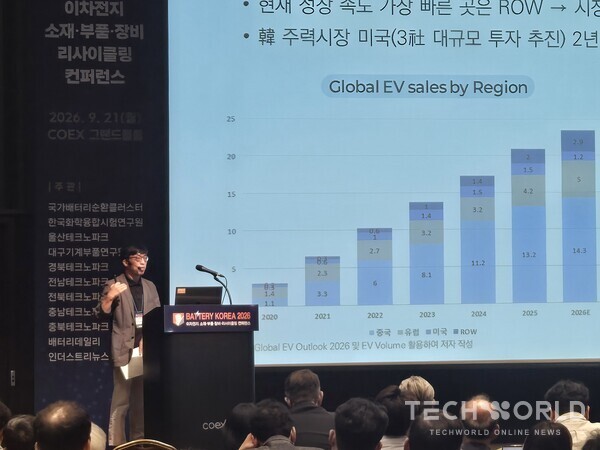
Whang Kyung-in, head of the Strategic Industry Analysis Division at the Korea Institute for Industrial Economics and Trade (KIET), presented these findings on the 21st at 'Battery Korea 2026,' held at COEX in Seoul. The presentation was titled 'A New Landscape for the Battery Industry: Global Policy Shifts and Future Growth Opportunities.'
Whang said it is difficult to view the current battery market as being in a broad chasm. As evidence, he pointed to the continued increase in global EV sales, while noting that growth rates differ by region.
In markets outside the U.S., growth in China and emerging markets recovered. By contrast, the U.S. market showed stagnation or negative growth for two consecutive years. Domestic companies have concentrated their business capabilities on the U.S. and NCM batteries.
It was explained that these demand shifts led to weaker performance. Whang said that the global EV market has continued to grow over the past three years, making the term 'chasm' ring hollow. He added that weak performance in Korea's core markets and core products hurt domestic companies' results.
The decline in market share among domestic battery companies also continued. Based on SNE Research data, the ex-China global market share of Korean companies fell from 53.6% in 2022 to 44.2% in 2024 and 36.7% last year.
In the first quarter of this year, the combined market share of the three major domestic battery makers came to 29.6%. This marked the first time the combined share of the three companies fell below 30%.
Chinese companies held a 52.1% share in the same period. In the ex-China market as well, Korean companies' share declined while Chinese companies' share rose, widening the gap.
Chinese companies are expanding their presence in overseas markets, including Europe, backed by excess domestic production capacity. At the same time, exports of Chinese batteries are increasing, and the continued low-price push from Chinese batteries is contributing to the decline in domestic companies' market share.
At the same time, the center of the battery market is shifting from NCM to lithium iron phosphate (LFP). This shift in market focus is weighing on domestic companies, and adoption of LFP is also increasing in China and emerging markets.
In addition, support for low-cost EVs is expanding in Europe. As a result, LFP demand is likely to continue growing.
However, even if domestic companies expand LFP production, it will be difficult to reduce dependence on Chinese supply chains in the short term. That is because Chinese companies dominate core materials markets such as LFP cathode materials. Whang said that even after the shift to LFP, cathode materials are produced overwhelmingly by Chinese companies, so dependence on Chinese supply chains is likely to remain or even increase.
The U.S. has moved to abolish the tax credit for EV purchases while keeping the advanced manufacturing production tax credit (AMPC) in place and tightening restrictions on Chinese supply chains. In other words, the U.S. is cutting EV support while maintaining production subsidies and strengthening rules related to China.
It was pointed out that if these changes lead to a decline in EV sales, there could be an impact on the battery shipment volumes of domestic companies. A drop in EV sales could also affect the benefits from AMPC tied to local production in the U.S.
By contrast, policies excluding Chinese batteries and materials were cited as an opportunity for domestic companies to expand in the U.S. ESS market. High tariffs on Chinese ESS products and supply chain restrictions could translate into stronger price competitiveness for domestic companies.
The key issue, however, is the supply chain for LFP batteries produced in the U.S. Even assuming that domestic companies can build LFP production lines in the U.S., it is expected to be difficult to both reduce the share of Chinese raw materials and components and meet AMPC requirements. According to his outlook, it will not be easy for domestic companies to satisfy AMPC requirements.
Whang said U.S. tariffs, production subsidies, and restrictions on Chinese supply chains are likely to remain largely in place under the next administration as well. He noted that there are research findings on positive effects for U.S. jobs, corporate profits, and supply chain development, and that those findings could be used as grounds for maintaining the policy.
In the U.S., cuts in EV support and the continued 'Made in America' and de-Chinaization stance were mentioned. At the same time, it was also suggested that ESS policies that further restrict China could become an opportunity for domestic companies.
In the EU, the Industrial Acceleration Act (IAA), which is under way, was cited as a variable that could change the competitive landscape in the battery market. The IAA includes provisions applying local production requirements in the EU to batteries and ESS, as well as screening of foreign investment above a certain scale.
If the current direction of the IAA is finalized, it could favor domestic battery companies that have production bases in Europe. The possibility was also raised that some materials produced in Korea could be recognized as equivalent to EU-origin goods under the Korea-EU FTA.
A shift in European EV subsidies toward low-income households and lower-priced vehicles was described. Accordingly, LFP demand is expected to continue rising.
As necessary tasks in this regard, the use of local production bases was proposed. The need to secure competitiveness in LFP products and supply chains was also mentioned.
An assessment was presented that policy changes in Europe are linked to the possibility of domestic battery companies recovering market share. Whang said that if intra-EU production regulations are linked with subsidies and ESS procurement policies, it could help domestic companies regain market share.
As variables for a mid- to long-term rebound, the rapid securing of new demand in ESS, humanoids, and the defense industry was cited. Given that the current demand structure of Korea's battery industry is centered on EVs, diversifying demand sources was identified as an important task over the mid to long term.
In addition, establishing product and production strategies tailored to the needs of each industry was presented as a necessary task. He explained that to move beyond an EV-centered demand structure, the key is to develop strategies that match the requirements of each industry, including ESS, humanoids, and the defense sector.
On strategy toward China, there was recognition that it is difficult to approach the issue through supply chain separation alone. A countermeasure was also proposed to review limited cooperation options while taking technological competitiveness into account, given the rapid expansion of research on sodium-ion batteries and all-solid-state batteries in China.
These discussions also led to calls for restructuring the domestic government support system. Whang argued that government support for the battery industry is insufficient compared with the scale of private investment, and said expanded direct subsidies, tax incentives, and R&D support are needed.
Whang said that when establishing equipment investment strategies and R&D strategies, one should not consider technological development alone. He added that forecasts of market changes and policy changes are needed, and said in essence that such forecasts must be carried out meticulously and their results reflected in R&D planning and design.
Source: TECHWORLD · Kim Seung-gi
Original: https://www.epnc.co.kr/news/articleView.html?idxno=407238
References
This article was produced with the help of an automated content generation algorithm.
Source: TECHWORLD
View originalThis article was summarized and organized by BizCrush based on the original article from TECHWORLD. For exact quotations and full details, please refer to the original article.