KT Cloud Accelerates Multi-AZ and Multi-Region Infrastructure, From DR to Kubernetes
IT DAILY ·
✦ AI Summary
KT Cloud said it will target the government's public DR mandate with high-availability infrastructure based on Multi-AZ and multi-region architectures, along with public DR build-out projects.
The Ministry of the Interior and Safety enacted the Information System Stability Notice last April, making DR system construction mandatory for public information systems, and KT Cloud presented four DR implementation models by grade.
KT Cloud said it has shifted to KCP-based next-generation fully managed managed Kubernetes, cutting cluster creation and upgrade times to within seconds while strengthening security and automation.
KT Cloud is moving into full-scale deployment of high-availability infrastructure that combines Multi-AZ and multi-region architectures in response to the government's policy mandating DR systems for the public sector. A private-sector public DR build-out project based on cloud will begin in November, and KT Cloud plans to target the public DR build-out business ahead of time.
KT Cloud plans to promote next-generation managed Kubernetes with a significantly revamped architecture and accelerate its push into the cloud-native market. At the same time, it intends to move ahead of demand from companies looking to shift to high-performance container infrastructure.
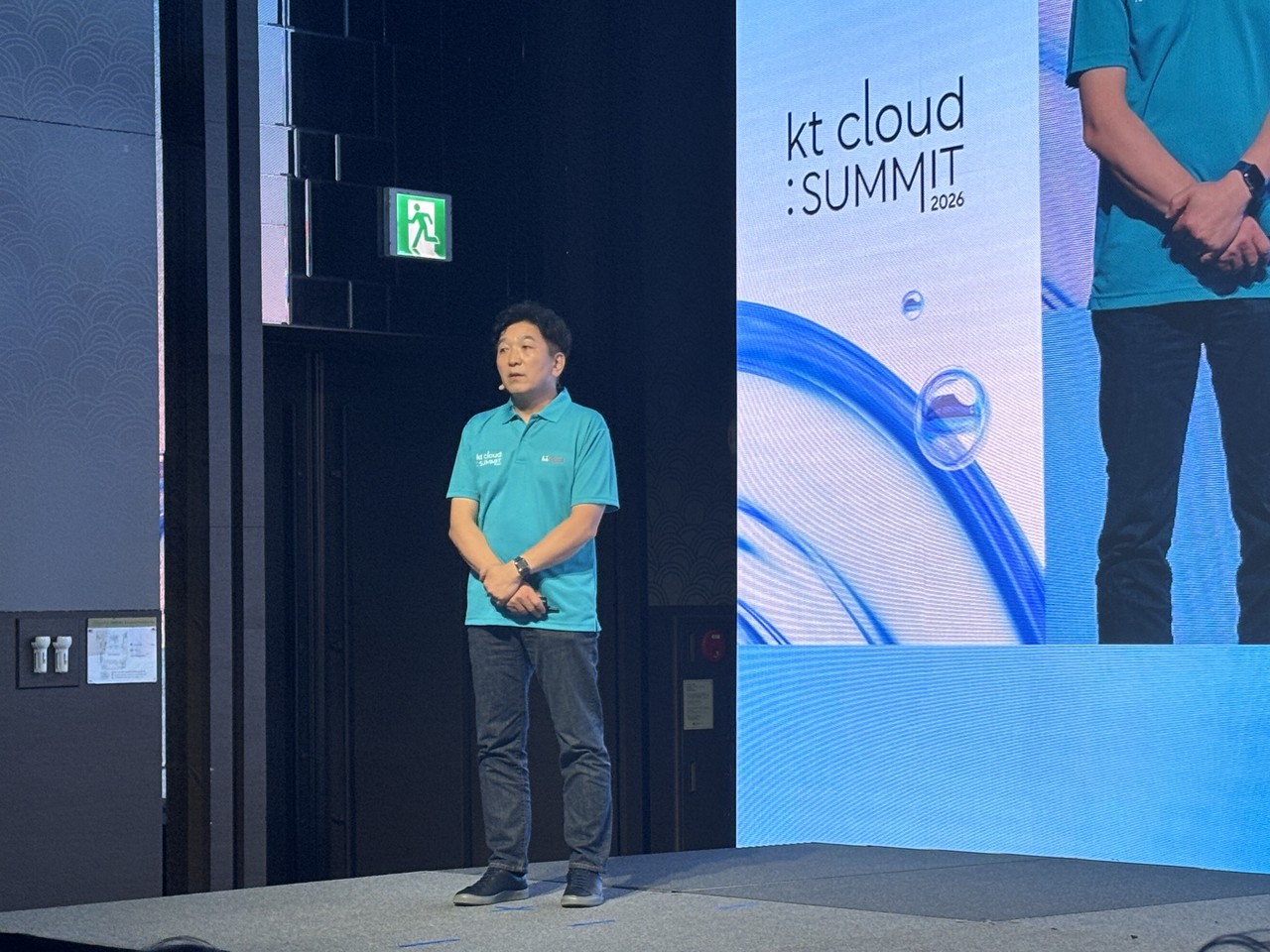
On the 15th, KT Cloud held the afternoon session at "kt cloud summit 2026" and unveiled related roadmaps and market response strategies. Kim Gwang-bae, a team lead at KT Cloud, took the stage in the afternoon session and gave a talk on "Multi-AZ-based high-availability infrastructure and DR implementation strategies," while Park Yong-hoon, also a team lead at KT Cloud, spoke on "Managed Kubernetes Service changes." Kim Gwang-bae and Park Yong-hoon presented KT Cloud's core technology roadmap and its market response strategy.
The government has been pushing ahead with cloud migration projects for public institutions since 2021 and has pursued a goal of moving 90% of public information systems to cloud-native by 2030. Kim Gwang-bae, a team lead at KT Cloud, took the stage at the event, and the photo was taken by reporter Kwon Young-seok. The Seoul Multi-AZ and Gyeongbuk multi-region architecture is in operation.
During this process, a fire broke out at the Pangyo data center in 2022, and a fire broke out at the National Information Resources Service's Daejeon center last September. The two fires were followed by large-scale service outages.
As a result, the need to build service continuity and DR systems across national information systems emerged as a key issue. Last April, the Ministry of the Interior and Safety enacted the "Information System Stability Notice," which made DR system construction mandatory for public information systems.
This notice moves away from a simple user-count basis and assigns grades from 1 to 4 by reflecting "impact on the public" at 70%. A pilot ISP for a DR project using private cloud is currently under way, and full-scale phased construction is scheduled to begin in November.
KT Cloud presented four DR implementation models by grade that meet the government's notice standards, and the format presented was a plain-language architecture specification. KT Cloud organized and disclosed disaster recovery models as concrete architectures in line with the grade criteria in the government's notice.
Grade 1 targets are "core national systems," covering cases where a service outage would cause serious harm to public safety or national security. The Grade 1 standard is RTO within 1 hour and RPO of 0, and the implementation is an "Active-Active" system based on Multi-AZ in Yongsan and Mok-dong within the Seoul region. The Grade 1 center conditions call for two centers within 30 km of each other and physically fully separated data centers, and the network condition is an ultra-low-latency environment with RTT of 1 ms or less. This ensures real-time data synchronization and uninterrupted traffic processing.
Grade 2 targets are "response and essential systems," with standards of RTO within 12 hours and RPO within minutes. The Grade 2 method is an "Active-Standby" system based on GSLB, and the structure calls for real-time replication of data and DBs between the Seoul and Gyeongbuk multi-regions. The distance between the Grade 2 regions is about 200 km, and if a large-area disaster cripples the main center, GSLB supports immediate service recovery in the Gyeongbuk region DR environment.
Grade 3 targets are "administrative critical systems," and the proposed Grade 3 method is "storage DR." The recovery standard for Grade 3 is RTO within 5 days and RPO within minutes, and for a system with relatively lenient recovery tolerances, the operating structure runs only the main center during normal times. In the event of a disaster, the system is rapidly deployed and started at the DR center using asynchronously replicated business data and system configuration information such as remote backup network and security policies. This Grade 3 method helps optimize the cost burden of maintaining computing resources at all times.
Grade 4 targets are "general public administration systems," and the applied method is "remote backup (off-site backup)," based on a high-performance backup recovery solution. Grade 4 data operations consist of off-site storage of backup data from the main center at the remote DR center, and the recovery standard is RTO within 3 weeks and RPO within 7 days. This method is characterized by a simple system build-out and minimal upfront cost burden.
As cloud-native transformation has recently spread, demand for Kubernetes, the container orchestration standard, is surging. Park Yong-hoon, a team lead at KT Cloud, highlighted this trend in his presentation at the event.
However, the existing infrastructure environment was presented as having technical limitations. In a classic environment, network constraints make it difficult to separate the management area from customer tenants, and a VM-node-based provisioning structure means that creating a cluster takes several minutes, according to the explanation.
Another limitation highlighted was that during version upgrades, the burden of worker node work is shifted to customers, perpetuating operational inefficiencies. Accordingly, directions were also presented for improving the separation issue between the management area and customer tenants, cluster creation delays, and the transfer of upgrade burdens.
As improvement directions, provisioning in a matter of seconds and complete separation for security were presented. Team Lead Kim Gwang-bae said he intended to meet the balance of stability, security, and cost efficiency required by public institutions based on the know-how accumulated through participation in DR ISP by the Ministry of the Interior and Safety and the National Information Resources Service innovation ISP project, and the photo was taken by reporter Kwon Young-seok.
KT Cloud has completely shifted its architecture to KCP(kt cloud Platform)-based "next-generation fully managed managed Kubernetes," after going through its early K2P installation and deployment operations and its master-node-centered "classic managed" operations. The new service is the result of KT Cloud's own architecture refinement over the past 7 to 8 months, and it has comprehensively improved performance, security, and automation.
A key technical change is the introduction of Kamaji-based technology. By converting the existing node-based control plane into a Pod-based tenant control plane (TCP), KT Cloud has shortened cluster provisioning time from several minutes or more to within seconds, and cut control plane upgrade time from several minutes or more to within seconds.
KT Cloud has also strengthened its security architecture and network architecture. It structurally separates the Management Plane and customer service area (Tenant VPC) and has established a multi-tenant configuration, while applying eBPF technology instead of the existing iptables control method to significantly reduce container network overhead when large traffic surges occur.
KT Cloud has pushed ahead with the introduction of declarative custom resources and GitOps as a way to strengthen operational stability. Through this, it embedded a structure that continuously synchronizes the expected state and actual state of the infrastructure, and adopted Reconcile as the application pattern. As a result, it has maintained configuration consistency and completed an automated response system that can immediately roll back when issues arise.
KT Cloud is currently providing Kubernetes v1.33 and Kubernetes v1.34. It is also supporting zero-downtime upgrades to higher versions for customers using existing v1.32 clusters. In addition, sequential releases of v1.35 are planned, with the launch timing set for October in the classic environment and December on the KCP platform.
Team Lead Park Yong-hoon said KT Cloud is thoroughly separating the VPC-based management area and customer tenant area, and automating the worker node upgrade process. He explained that this strengthens customer convenience and enterprise security, minimizes the possibility of outages, and implements a platform capable of immediate automatic recovery when issues occur. He added that the company will support a stable transition to cloud-native environments for enterprises.
Source: IT DAILY · Kwon Young-seok
Original: https://www.itdaily.kr/news/articleView.html?idxno=241629
References
This article was produced with the help of an automated content generation algorithm.
Source: IT DAILY
View originalThis article was summarized and organized by BizCrush based on the original article from IT DAILY. For exact quotations and full details, please refer to the original article.