CUBRID Rises to No. 2 in Public DBMS Market, Eyes Replacement Demand That Could Reshape the Market
IT DAILY ·
✦ AI Summary
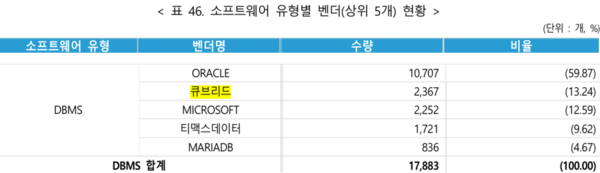
CUBRID's public-sector DBMS market share rose to 13.24%, overtaking MS's 12.59% for the first time.
In the previous survey, CUBRID stood at 10.58%, while MS fell from 14.36% to 12.59%.
The number of DBMS installations operated by public institutions was tallied at 2,367 for CUBRID, and domestic products accounted for 43.8% of the total.
According to CUBRID, and based on reports from IT Daily, CUBRID overtook MS for the first time in the public-sector DBMS market. The comparison is based on the number of installations, and the public DBMS market has long been led by Oracle and MS. With this change in rankings, CUBRID moved up to No. 2 in domestic product market share.
The Ministry of the Interior and Safety and NIA released the "2026 Government-wide EA-based Public Sector Information Resource Status Statistics Report" on the 9th. As of the end of 2025, CUBRID's public-sector DBMS market share stood at 13.24%. In the previous survey, CUBRID's share was 10.58%, an increase of 2.66 percentage points. As a result, CUBRID's ranking moved from No. 3 to No. 2.
However, the gap between CUBRID and MS was only 0.65 percentage points. The share of foreign products in public-sector DBMS also remained high at 74%.
The direction of this ranking shift will depend on securing demand for cloud migration and replacing aging systems. Whether this change will be temporary or become a turning point for the spread of domestic products will hinge on who captures this demand going forward.
Over the same period, MS's share fell 1.77 percentage points from 14.36% to 12.59%. As a result, MS fell to No. 3.
Oracle also saw its share decline. Oracle remained No. 1 with a 59.87% share, but that was down 2.64 percentage points from 62.51% in the previous survey. With this, Oracle's public DBMS market share fell below 60%.
By contrast, CUBRID's share increased. TmaxData's share also rose 0.55 percentage points from 9.07% to 9.62%, and MariaDB's share increased 1.19 percentage points from 3.48% to 4.67%.
As a result, the combined share of the two domestic products among the top five vendors, CUBRID and TmaxData, rose from 19.65% to 22.86%. The overall domestic product rate for public-sector DBMS also increased by about 4 percentage points, from 22.03% last year to 25.97%.
The number of DBMS systems operated by public institutions was tallied at 20,790. Of these, 5,399 were domestic products.
CUBRID installations were tallied at 2,367. The previous year's survey recorded 2,017 installations, up 350 year over year for a growth rate of 17.4%. Compared with 405 installations in 2016, this is about 5.8 times higher over nine years from 2016.
Among domestic DBMS operated by public institutions, CUBRID accounted for 43.8%. This tally was based on the number of products in operation at public institutions.
However, the tally excluded revenue and new contract wins. The business value of each DBMS varies depending on deployment scale, system criticality, and the applicable workload, and for a ranking increase to lead to greater market dominance, expanded adoption in large-scale core systems and cloud environments is presented as a condition.
Barriers to domestic products continue to persist in the public DBMS market. Foreign products accounted for 74.03% of all DBMS. Compared with the 4.62% foreign-product share in the public information resource monitoring sector and the 31.03% foreign-product share in the public information resource information security sector, this shows that DBMS remains an area where localization is relatively slower than in monitoring and information security.
Total public-sector software adoption costs came to KRW 4.8153 trillion, of which DBMS-related costs were tallied at KRW 916.3 billion. As a result, DBMS accounted for the largest share of public-sector software adoption costs and ranked No. 1 by investment size among categories.
From the perspective of domestic DBMS companies, the high market share of foreign products stands out, suggesting a large replaceable market. Since DBMS takes up the largest share of public-sector software investment and foreign products also hold a high share, domestic DBMS companies view it as a market with replacement demand.
The key variables for future competition are cloud migration and replacement of aging DBMS. According to this report, the cloud adoption rate for public information systems stood at 29.11%, leaving more than 70% of information systems not yet migrated to the cloud, and among DBMS operated in the public sector, products that had been in use for 8 years or more accounted for 30.5%. Product EOL and system modernization are cited as factors that could spur replacement projects, and if replacement projects accelerate, competition over whether to keep existing foreign DBMS, switch to domestic products, or move to open-source products is expected to intensify.
In cloud environments, costs are rising because of foreign DBMS licensing policies tied to server processor cores and usage. Those licensing policies are acting as an adoption burden, and open-source-based products that can reduce licensing costs are being raised as an alternative.
However, cost is not the only requirement for migrating core systems. In addition to cost, performance, stability, compatibility with existing systems, and an incident response framework must be proven.
In this situation, CUBRID CEO Jeong Byeong-ju said DBMS and operating systems have long been perceived as the hardest areas to localize. He added that this was the first time a domestic product had surpassed a foreign DBMS in the rankings. He said the result was driven by accumulated product technology, tailored support, and improved perceptions. He also added, however, that 74% of public DBMS are still foreign products. He said the company plans to focus on product innovation and expanding the user ecosystem to address demand for aging system replacement and cloud migration.
Source: IT DAILY · Lee Jae-young
Original: https://www.itdaily.kr/news/articleView.html?idxno=241488
References
This article was produced with the help of an automated content generation algorithm.
Source: IT DAILY
View originalThis article was summarized and organized by BizCrush based on the original article from IT DAILY. For exact quotations and full details, please refer to the original article.