Quantec and ETRI Advance On-Device AI Information Protection Technologies
TECHWORLD ·
✦ AI Summary
Quantec said on the 7th that it is pushing ahead with the development of technologies for protecting on-device AI information together with ETRI. The technologies under development are model obfuscation technology and data flow analysis technology. Quantec is working on Pass-level obfuscation after MLIR conversion, as well as data transfer path tracing technology based on the TFLite API.
Quantec said on the 7th that it is pushing ahead with the development of technologies for protecting on-device AI information together with the Electronics and Telecommunications Research Institute (ETRI). The technologies under development are model obfuscation technology and data flow analysis technology.
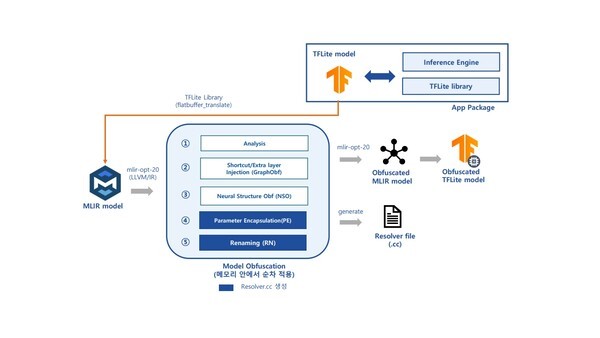
Among them, the technology Quantec is working on is on-device AI model obfuscation. This is a method that applies Pass-level obfuscation functionality after converting an AI model into MLIR (Multi-Level Intermediate Representation).
The detailed technologies presented were anonymization through operator identification information changes (Renaming), parameter encapsulation (Parameter Encapsulation) that separates and hides parameters such as Weight and Bias, neural structure obfuscation (Neural Structure Obfuscation) that transforms tensor shapes, and graph structure obfuscation (Graph Structure Obfuscation) that inserts fake connections and nodes.
The technology is designed to change operator types, parameters, tensor shapes, and graph connection relationships by transforming elements exposed in the model file, making it difficult for external analysts to understand the actual model structure. It is configured so that original operations can still be performed in the obfuscated model by using separate execution information, with the goal of hiding the model structure and maintaining normal inference functionality.
Quantec has implemented MLIR Pass-level obfuscation functionality and made it possible to combine it selectively depending on model characteristics and protection requirements. It also aimed to minimize runtime modifications while applying a method that connects obfuscated operations and actual operations using separate execution information. Quantec said this could improve compatibility and scalability.
In connection with the data flow analysis technology for AI application programs based on taint analysis, Quantec focused on the need for an accurate identification process for parts related to actual AI inference. To this end, it converts C/C++-based AI application programs into LLVM IR and then traces data transfer paths based on the TFLite API, with the tracing targets including variables, pointers, and function calls. The implementation is about tracing how data is transferred, and Quantec said it can automatically identify code involved in AI inference based on actual data dependencies rather than simple patterns such as function names.
Quantec is researching technologies to prevent external analysis from exposing core implementation information in AI models and inference programs in on-device environments. The protection scope has been set to selective protection of core code and information directly linked to AI inference, rather than the entire program.
This research is the second-year study of the project titled 'Development of AI implementation information concealment technology to prevent on-device AI information leaks.' The research is being carried out with support from the Ministry of Science and ICT and the Institute for Information & Communications Technology Planning & Evaluation (IITP), with ETRI as the lead organization and multiple research institutions participating jointly.
Based on the research results, Quantec is planning to link the protection targets identified through taint analysis with the obfuscation technology. It is also pushing ahead with plans to further advance the technology for resource-constrained on-device environments.
Quantec is also seeking intellectual property protection related to the model obfuscation technology secured during the research process. Accordingly, it has completed patent applications for 'Method and computing device for concealing implementation information of an artificial intelligence model' and 'Method and system for automatically identifying protection targets of taint-analysis-based artificial intelligence inference code.'
Bang Hyeok-jun, CEO of Quantec, said that as on-device AI spreads across a wider range of industries and products, the need for protection is expanding beyond AI models to include the core logic of AI-powered applications. Accordingly, he said the company is advancing AI model obfuscation technology and data flow-based protection target identification technology, with the goal of securing on-device AI information protection technology that can be used in real product environments.
Source: TECHWORLD · Kim Hye-jin
Original: https://www.epnc.co.kr/news/articleView.html?idxno=406607
References
This article was produced with the help of an automated content generation algorithm.
Source: TECHWORLD
View originalThis article was summarized and organized by BizCrush based on the original article from TECHWORLD. For exact quotations and full details, please refer to the original article.