'LLMs Alone Aren’t Enough to Protect It': PRIBIT AI Bets on AI Security Platform
IT DAILY ·
✦ AI Summary
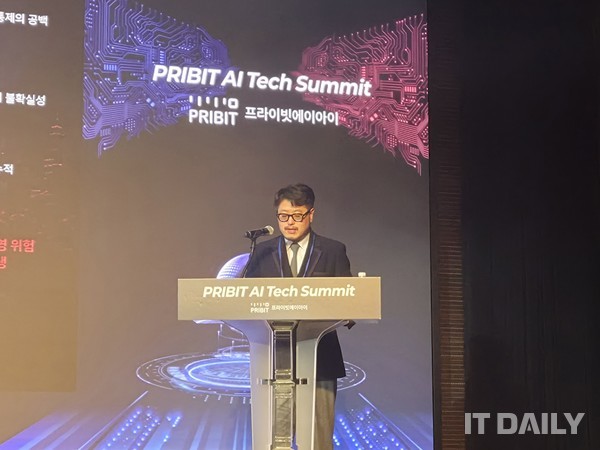
Kim Young-rang, CEO of PRIBIT AI, said at the PRIBIT AI Tech Summit held on the 4th at Banyan Tree Seoul in Jung-gu, Seoul, that there are limits to security responses from a standalone LLM perspective.
He explained the security issues of AI agents and said that the user of the AI, the connected data and systems, and whether misjudgments or distortions occur during the response process must all be considered together.
PRIBIT AI proposed PRIBIT AI Platform, an integrated platform for managing the entire structure from users to AI, and said it is scheduled for an official launch early next year.
According to IT Daily, Kim Young-rang, CEO of PRIBIT AI, said at the PRIBIT AI Tech Summit held on the 4th at Banyan Tree Seoul in Jung-gu, Seoul, that there are limits to security responses from a standalone LLM perspective, and presented PRIBIT AI’s AI security platform strategy. The theme of Kim Young-rang’s presentation was the Risks to prepare for in an era where humans and AI coexist.
Kim Young-rang explained the security issues and solutions arising from AI agents, saying that using AI is easy, but controlling it is not. He then said it is necessary to identify who is using it, what data and systems AI is connected to, and whether misjudgments or distortions occur during the response process. He also said looking at just one model is not enough to solve the problem.
Kim Young-rang presented the core of AI security response as management of the entire environment connected to AI, rather than of individual models. Accordingly, he explained that integrated management of the entire system, including data, networks, and AI, is necessary, and said that managing data, networks, and AI on a single platform was proposed as the solution. The photo was provided by reporter Kim Ho-jun.
PRIBIT AI said it redefined its identity with its name change in July. It has accordingly shifted its identity from a cybersecurity company to an AI governance and risk control company. The move reflects the company’s view that, as AI use spreads across enterprises, an integrated management system for risks in data access, permissions, and execution processes has become important.
The company said it paid particular attention to the background layer of AI agent activity. What users can see is limited to input prompts and generated outputs, but in the background layer, AI carries out request-based planning, calls external tools, and repeats search and execution.
The CEO said that this area is a security blind spot. He said cybersecurity has not kept pace with the advancement of AI technology, and that existing security solutions and AI control are operated separately. He added that the objects observed in security are people and networks, while the objects observed in AI control are prompts and models, making it difficult to verify problems and take action because the two systems are not viewed as one flow.
PRIBIT AI proposed an integrated platform, 'PRIBIT AI Platform,' designed to protect the entire structure from users to AI as a single unified system. Its protection scope covers the full range from users and devices to networks and AI, and its protection method is end-to-end. The platform consists of 'PacketGo OS,' based on a zero-trust architecture, 'RISK Intelligence,' a solution specialized in threat management, and 'PRIBIT Workspace,' a dedicated AI work environment, with the three solutions provided in an integrated package.
PRIBIT AI Platform centrally controls data movement inside and outside the company, classifies data by risk level, and then connects AI differentially based on that classification information. Confidential data uses retrieval-augmented generation (RAG) based on internal documents and closed models, while sensitive information is allowed to use external AI after approval if its risk level is lower than that of confidential data. Data that can be opened is handled using public large language models (LLMs).
Establishing AI governance based on an integrated structure is a way to improve the safety and cost efficiency of organizational AI use by tying together access control by user and device safety level, application of different AI services by data importance, immediate blocking at the hub stage of risky execution and erroneous data transmission, and reduced excess usage costs through token consumption checks.
PRIBIT AI said it is in discussions with some companies and institutions regarding the introduction of 'PRIBIT AI Platform,' which incorporates this structure, and that the solution is scheduled for an official launch early next year.
In the same context, Kim Young-rang, CEO of PRIBIT AI, said the company aims to coexist with humans and AI, and that it intends to position itself as a company that helps enterprises safely entrust more work to AI while maintaining control.
PRIBIT AI held the 'PRIBIT AI Tech Summit' on the 4th at Banyan Tree Seoul, and key guests attending the event posed for a commemorative photo. From the left in the front row are Choi Kang-hyuk, subcommittee member of the Security Special Committee of the National AI Strategy Committee; Jeong Ui-won, advisor at Kim & Chang; Yoon O-jun, standing advisor at Yulchon LLC; Kim Young-rang, CEO of PRIBIT AI; Yeom Heung-yeol, professor at Soonchunhyang University; Seo Seok-jin, auditor at PRIBIT AI; and Ryu Jae-cheol, professor at Chungnam National University, and the photo was provided by PRIBIT AI.
The 'PRIBIT AI Tech Summit' was held. The event was organized to share PRIBIT AI’s new business direction and discuss key security challenges in the AI transformation process. First, Song Ki-woong, professor at Seoul National University of Science and Technology and president of the Korea Cyber Security Society, gave a presentation on the theme of 'Cybersecurity in the Era of AI Agents' and reviewed technology trends based on global conferences and research.
The afternoon session was held, and specific discussions by industry were carried out in this session. Kang Hyung-woo, professor at Korea University and president of the Financial Security Research Association, gave a presentation on the theme of 'Zero-Trust Adoption Strategies in the Financial Sector for AI/SaaS Use' and explained the trust framework needed in a highly regulated financial environment. Kim Chang-hoon, professor at Daegu University and chair of the N2SF Research Association, gave a presentation on the theme of 'Design Direction and Core Technologies of the National AI Cybersecurity Framework (CSF)' and introduced measures to respond to the spread of AI adoption.
Source: IT DAILY · Kim Ho-jun
Original: https://www.itdaily.kr/news/articleView.html?idxno=241417
References
This article was produced with the help of an automated content generation algorithm.
Source: IT DAILY
View originalThis article was summarized and organized by BizCrush based on the original article from IT DAILY. For exact quotations and full details, please refer to the original article.