Beyond a Seoul-Centric One-Pole Structure: Building Regional Growth Engines Through Mega Projects and Mega Special Zones
TECHWORLD ·
✦ AI Summary
The government is pushing to shift the capital-area-centric one-pole structure into a multi-pole system based on the "5 poles, 3 special zones" framework, linking strategic industry investment such as semiconductors, physical AI and AI data centers (AIDC) to regional growth.
The Office for Government Policy Coordination and related institutions held a forum on the 2nd to share directions for balanced growth under the "5 poles, 3 special zones" framework and for connecting the 3 mega projects with regional industrial ecosystems.
Presenters argued for super-regional growth hubs, mega special zones, functional division and the spread of results within each region.
The government aims to shift the country’s capital-area-centric land structure to a multi-pole system based on the so-called "5 poles, 3 special zones" framework. To this end, it is advancing a plan to link large-scale strategic industry investments, such as semiconductors, physical AI and AI data centers (AIDC), with regional growth, creating a structure in which multiple regions become growth axes.
This vision moves beyond the existing balanced-development approach, which has dispersed projects and funding across individual local governments, and instead focuses on creating super-regional growth hubs to attract companies and talent. It also includes a plan to integrate existing special economic zones by function into "mega special zones," along with a strategy to spread the investment effects of the "3 mega projects for a great leap forward in the Republic of Korea" across entire regions.
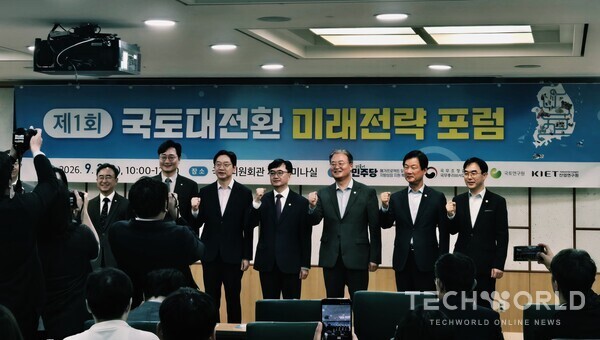
The Office for Government Policy Coordination, the Democratic Party of Korea's Special Committee on Mega Projects and Local Growth Support, the Korea Research Institute for Human Settlements and the Korea Industrial Research Institute held the "1st Forum on Future Strategies for a Great Transformation of the Land" on the 2nd. At the forum, policy directions were shared for balanced growth under the "5 poles, 3 special zones" framework and for linking the 3 mega projects with regional industrial ecosystems.
In his opening remarks, Office for Government Policy Coordination Minister Kim Young-gun emphasized the need to turn the land transformation agenda into action. Kim said the urgency of the current situation is increasing, and stressed that the great transformation of the land should not end with a plan announcement but must be realized on the ground in the implementation phase.
Kim called for joint cooperation among the central government, local governments, the National Assembly, the private sector and research institutions to achieve that goal.
Kim Kyeong-soo, standing vice chair of the Democratic Party of Korea's Special Committee on Mega Projects and Local Growth Support, said the AI era could mark a new turning point for regional growth. He noted that the environment, the era and the playing field are changing, and that opportunities are expanding for non-capital regions that have power for AI infrastructure and available land. He added that the key is in the details, and stressed that obstacles in the policy implementation process must be identified and resolved in concrete terms as a condition for delivering results from the 3 mega projects, the "5 poles, 3 special zones" framework and regional growth engines.
A view was presented that the focus of regional growth strategy should shift from simple dispersal support to the creation of industrial ecosystems at the metropolitan regional level. Lim Jae-man, president of the Korea Research Institute for Human Settlements, said a shift in resource allocation is necessary, proposed broader living and economic zones as the central axis, and identified fostering leading industries by region as the goal.
Lim said fostering key industries by province through metropolitan-area design is important. He also said building an industrial ecosystem with self-sustaining capacity and competitiveness is a key strategy.
Kwon Nam-hoon, president of the Korea Industrial Research Institute, stressed that strategic industry investment should not be limited to specific hubs. He pointed to semiconductors, AI and future mobility as representative strategic industries, and said large-scale investment in strategic industries needs to spread across the entire regional ecosystem. He also said the existing scattered special zones need to be connected and that a new vessel in the form of a single mega special zone is needed.
These discussions led to the direction that policy should move beyond support for individual regions and toward the creation of strong hubs. Park Kyeong-hyeon, head of planning and coordination at the Korea Research Institute for Human Settlements, gave a presentation titled "The Policy Need for and Direction of the '5 poles, 3 special zones' Balanced Growth Framework," diagnosing capital-area concentration as a structural problem that cannot be solved by support for individual regions alone.
The diagnosis was that as good jobs, universities, culture and everyday services continue to concentrate in the capital area, talent flows in from across the country, which in turn leads companies and investment to follow the capital area, reinforcing the concentration structure. Park said balanced growth and balanced development are not short-term phenomena but long-standing land-related issues. He also said balanced growth is a key issue not just of regional policy but of national sustainability and growth potential.
On the other hand, he said non-capital regions are seeing an outflow of young people, and that the weakening of small and mid-sized cities outside the capital area is also undermining everyday foundations such as medical care, education and culture in surrounding rural and fishing communities.
The government has promoted balanced-development policies such as innovation cities, Sejong City and metropolitan economic zones, but those policies have exposed limits in fundamentally easing capital-area concentration. Park analyzed that support only at the level of individual provinces, cities and counties makes it difficult to secure a growth base large enough to attract companies and talent, identifying this limitation as a cause of the lack of progress in easing capital-area concentration.
The speaker said continuing to support individual provinces, cities and counties alone has limits in creating a growth base large enough to draw companies and talent, and called for expanding the policy space into super-regional zones.
Accordingly, the "5 poles, 3 special zones" framework was described as a strategy to create growth hubs outside the capital area that can attract companies and talent, by dividing functions with surrounding cities and integrating them into a single region. The focus of the framework is said to be on fostering industry as well as providing living conditions such as education, medical care, housing and culture, with the goal of simultaneously creating economic zones and living zones.
Park said people do not choose where to move based only on jobs, emphasizing that regions also need education, medical care, housing and culture. He also highlighted the need to link regional industries with universities, establish a structure in which talent can study and work locally, and improve living conditions, citing a local study-and-work structure and better living conditions as conditions for sustained population inflow.
A proposal was made that cooperation between regions needs to change. Rather than individual plans by each region, the need is for joint planning at the super-regional level, as well as joint project operation systems and joint fiscal operation systems. Functional division was identified as necessary to achieve this.
It was also pointed out that the approach of assigning the same functions to all regions and distributing the same fiscal resources to all regions should be avoided. Resources need to be concentrated in hubs where competitiveness can be secured, and Park also said selection and concentration around hubs are necessary. He added, however, that just because a specific major city grows does not mean the entire region will automatically grow.
He compared the approach to gathering firewood in one place to make a bonfire, saying resources should be concentrated in hubs with competitive potential while surrounding cities should take on production, logistics, housing and service functions. He also said hubs and surrounding cities need to be connected, suggesting that this could spread growth effects across the entire region.
He also explained that once growth engines are selected, policies to attract actual investment are needed. Investment in talent development, regulatory easing, innovation support and fiscal packages are required, and the investment regions of companies, the direction of universities and the direction of national finances need to be considered together at the spatial planning stage.
A proposal was made to redefine the role of the metropolitan transportation network. The idea is to move beyond simple infrastructure construction and use it as a means of connecting jobs in growth hubs with medical, education and cultural functions in surrounding areas. It was also proposed that the achievements of the hubs should be spread to small and medium-sized cities and population-declining regions.
Regarding this vision, Park said the "5 poles, 3 special zones" framework is a national spatial strategy to expand the capital-area-only structure of Korea's growth space into multiple regions. He added that the core of the framework lies in creating strong hubs, connecting them and spreading the results.
3 mega projects investment, spread through mega special zones.
Choi Jun-seok, a senior researcher at the Korea Industrial Research Institute, gave a presentation titled "Mega Project and Mega Special Zone Connection Strategy for Realizing the '5 poles, 3 special zones' Framework." He proposed the mega special zone as the practical means of linking industrial investment under the framework.
As a key measure, he proposed investment in the 3 mega projects — semiconductors, physical AI and AIDC — and linkage with existing economic special zones. This was described as a way to prevent investment from remaining confined to specific companies or worksites and to ensure that investment from the 3 mega projects spreads into regional industrial ecosystems.
Choi said large-scale mega project investments occur in specific regions or locations, and that if they remain at the level of a single worksite, the spillover effects are limited. He said a mega special zone linking existing economic special zones is therefore needed, and explained that the role of the mega special zone is to serve as a mechanism for spreading investment into the region and its industrial ecosystem.
He then pointed out that current operation of economic special zones is fragmented. He said the fragmentation is based on purpose and supervising ministry, and explained that the types of economic special zones include free economic zones, free trade zones, specialized complexes for national advanced strategic industries, research and development special zones, regulatory-free special zones and opportunity development special zones.
As a result of analyzing economic special zones, Choi said functional diversity and linkage are more important for regional economic performance than simply increasing the number of zones. He also said that after a certain threshold, the effect weakens as the number of special zones increases, whereas a stronger combination of zones with multiple functions was found to be associated with productivity gains.
Choi therefore said that functional linkage and qualitative structure are more important than quantitative expansion of special zones. He added that economic special zones need to maintain an appropriate scale and pursue functional diversity.
The existing special zone system was said to have problems such as the existence of zones that do not match regional industries, fragmented operation of institutions by ministry, pointed-out limitations, a lack of a linkage system for special zones at the super-regional level and insufficient common evaluation and performance management foundations.
As an alternative, the mega special zone was proposed, and its nature was summarized as a function-integrated platform for solving problems. Under the principle of not creating additional special zones, the concept aims to integrate production, research and development, and demonstration functions of existing zones while strengthening links between investment in the 3 mega projects and regional growth engines.
Choi said there were many questions that misunderstood the mega special zone as the creation of new special zones. He added that what is lacking is not the number of special zones but the linkage among them, and emphasized that the mega special zone must be a function-integrated platform connecting existing special zones at the super-regional level.
As a concrete measure, the linking of production, innovation and demonstration zones was proposed. Production zones would handle large-scale equipment investment by companies, innovation zones would focus on links with universities and research institutions as well as R&D and talent development, and demonstration zones would support testing, certification and commercialization of new technologies, leading to the creation of an industrial ecosystem spanning the full cycle from R&D to demonstration, production and reinvestment.
As for how to promote the mega special zones, it was argued that regulatory and fiscal support should be provided as a package rather than split into separate systems. The proposed package includes common regulatory exceptions, industry-specific regulatory exceptions, regulatory suspensions linked to corporate and local government demand, regulatory sandboxes for new technologies and new services, tax support and R&D support.
It was also suggested that mega special zones by region need to be designed to fit the local industrial base. Choi cited semiconductors, biotech, robots and physical AI, and shipbuilding and autonomous ships as examples, and proposed super-regional links among production facilities, universities, research institutions and demonstration infrastructure. He also said that even under the same mega project, the composition must be differentiated according to each region's growth engines and conditions.
However, the regional industries and specific special-zone compositions are not finalized government policy, but examples that can be considered. It was also explained that the industries and special-zone models presented are cases for review.
For actual implementation, building super-regional governance was presented as a task. Necessary elements were identified as a control tower for coordinating projects by ministry, a joint operating system by region, an integrated database by special zone, common performance indicators and a performance-linked resource allocation system.
Choi said the mega special zone is not about creating new zones but about linking and expanding existing ones. He explained that the mega special zone serves as an implementation platform for the "5 poles, 3 special zones" framework by placing the 3 mega projects into region-specific growth engines. The framework was described as a land strategy for creating new growth spaces outside the capital area, and the role of the 3 mega projects and the mega special zone was presented as a means of concretizing the framework into industrial investment and jobs.
Future tasks were identified as building a structure that connects investment, talent and R&D within each region, beyond simply placing large projects in a region. It was also said that a structure is needed to spread the results of intra-regional connectivity to surrounding small and mid-sized cities. Building such a structure was presented as the next task of the great transformation of the land.
Source: TECHWORLD · Kim Seung-gi
Original: https://www.epnc.co.kr/news/articleView.html?idxno=406425
References
This article was produced with the help of an automated content generation algorithm.
Source: TECHWORLD
View originalThis article was summarized and organized by BizCrush based on the original article from TECHWORLD. For exact quotations and full details, please refer to the original article.