[Virtualization 2] From Cost Cuts to 'Infrastructure Sovereignty' and AI Modernization
IT DAILY ·
✦ AI Summary
As Broadcom's VMware license overhaul enters its third year, the approach of contract renewal is fueling growing demand among existing VMware users to reconfigure virtualization in order to reduce cost burdens.
Red Hat is presenting OpenShift Virtualization as an alternative, emphasizing a way to integrate and manage VMs and containers on a single platform and migration support through MTV.
Domestic vendors are also stepping up their campaign to win back public and enterprise customers under the banner of K-virtualization, and competition in the market is expanding into the issue of infrastructure sovereignty in the AI era.
As Broadcom's VMware license overhaul enters its third year, the approach of contract renewal is fueling growing demand among existing VMware users to reconfigure virtualization in order to reduce cost burdens. These companies are shifting toward 'hybrid multi-virtualization,' splitting core systems from non-core workloads.
In this process, the domestic 'K-virtualization' camp, including Red Hat, is intensifying its win-back push. Competition in the virtualization market is expanding beyond simple cost reduction to the issue of infrastructure sovereignty in the AI era.
Red Hat is presenting 'OpenShift Virtualization' as an alternative. Its proposal goes beyond merely replacing a hypervisor, and 'OpenShift Virtualization' is a way to absorb virtual machines (VMs) and containers into a single platform.
Red Hat's strategy focuses on moving away from simply replicating existing legacy infrastructure and toward a Kubernetes-based integrated management environment. Through this, it aims to flexibly support future cloud-native and AI workloads.
The OpenShift Virtualization architecture consists of three pillars. Component 1 is KVM (Kernel-based Virtual Machine), a hypervisor built into RHEL CoreOS; component 2 is KubeVirt, an open source project that supports VM orchestration in a Kubernetes environment; and component 3 is the OpenShift control plane that manages the two together. KVM uses the Linux kernel itself as the hypervisor and schedules all VMs like standard Linux processes. KVM also ensures strict security boundaries between VMs (MAC) through the combination of SELinux and sVirt.
With this structure, there is no need to operate separate hypervisor infrastructure. As a result, a single physical server can run container Pods and legacy VMs at the same time, and the container Pods and legacy VMs can share the same network, storage, and logging resources.
Kubernetes's built-in automation features are also applied to VM operations. As a result, there is no need to manually specify where to deploy VMs, and Kubernetes detects spare CPU and memory resources on nodes in the cluster and automatically schedules VMs to the optimal host. In addition, if a specific physical node fails, the VMs running on that node are quickly restarted on healthy nodes, and Self-healing and high-availability mechanisms are supported as well.
The adoption model is designed to reduce purchasing burdens by cost, so customers do not need to buy the full stack of features all at once. For enterprises that need only pure virtualization features (VMs), the most economical entry subscription option is offered, allowing customers to first build a VM-centric infrastructure and then gradually expand licenses toward containers and extended functions according to their service modernization plans.
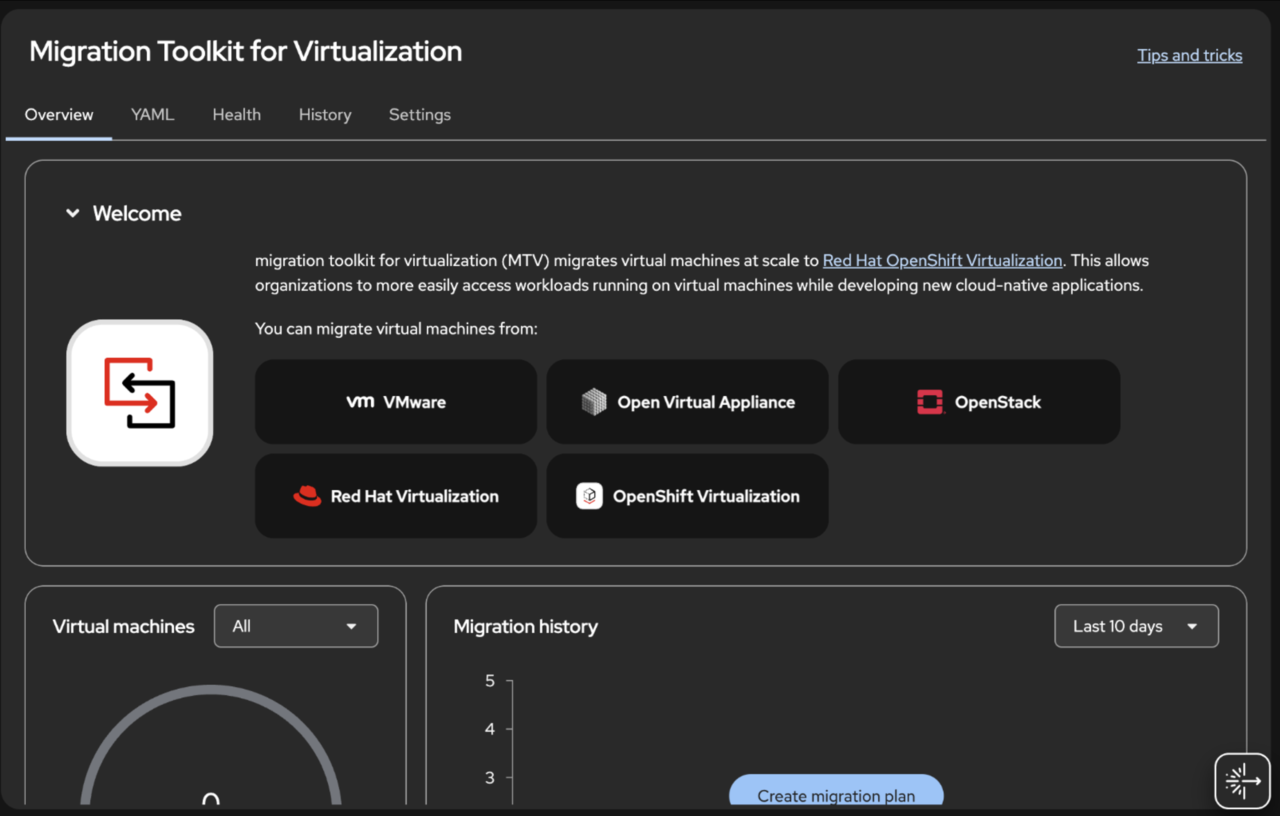
Red Hat says that downtime and operational burden, often cited as problems during migration, can be reduced with Red Hat's own migration tool, 'MTV (Migration Tool for Virtualization).' The migration process involves entering existing vSphere account information and then selecting and moving the target with a few clicks in a web UI. Red Hat said that during this process, background data replication continues while the service is running, and that completion follows after a brief switchover, minimizing service downtime.
Red Hat also emphasized that, contrary to the common view that moving to another platform is difficult, VMware-to-OpenShift migration is more convenient and simpler than moving between other KVM solutions in terms of MTV tool support. This is explained as a practical confidence based on evidence.
As the background for these claims, Red Hat pointed to the strength of a global ecosystem built on KVM for nearly 20 years. In addition, in terms of supporting AI workloads, it highlighted its close partnership with NVIDIA and the ability to directly use GPU resources inside VMs without loss. As an example, it cited NVIDIA's large-scale cloud service infrastructure and said performance verification has been completed.
Its broad compatibility with existing infrastructure is closely tied to the ability to respond to transition risks without being locked into a specific vendor or hardware platform.
The target of long-standing cooperation is major global server and storage vendors.
Its range of acceptance at the Linux kernel level extends to x86 and ARM architectures, NAS, shared file systems, and various legacy storage systems.
This makes it possible to avoid dependence on a specific vendor and proprietary hardware, while also providing a safety net for post-migration incident response and a stable foundation for troubleshooting after the transition.
Regarding customer migration demand and sentiment after Broadcom's price overhaul, Kim Jong-gyu, executive director at Red Hat Korea, said that companies operating infrastructure mainly around basic virtualization functions saw maintenance burdens rise as the perceived price at renewal time surged.
Kim also said that in industries ranging from large manufacturers to public institutions and finance, cases of moving from large-scale PoCs to full business rollouts continue to emerge.
He also said that while there is demand for gradual migration on the scale of 10 to 20 units, there is also substantial enterprise demand for all-at-once migration on the scale of hundreds of physical servers.
The key differentiator of Red Hat's solution lies in integrated operation of virtual machines and containers under a single control plane. Previously, legacy VM environments and Kubernetes environments had to be managed separately in a dual system, but Red Hat said it unified them into one framework by combining KVM hypervisor and KubeVirt technology.
The solution provides an operating model in which VMs and containers are created, deployed, and managed in the same way from a single web console. Through this, infrastructure operations can be centralized, and the application of Kubernetes's automatic resource scheduling and high-availability features to VMs is also supported, it said. The speaker explained that the differentiator of the Red Hat solution lies in integrated VM-container operations and unified operations.
From an operator's perspective, a fully equipped intuitive UI was presented as a strength. It was explained that, regardless of the OS environment, VMs can be started, stopped, and expanded with a mouse click alone, lowering the barrier to initial operations.
For concerns about transition burden and migration stability, the MTV tool approach was presented. By integrating with the existing vSphere environment and performing live data replication, service downtime can be minimized, and the speaker said that UI simplicity and MTV-based live replication can ease concerns about technical transition burden and migration stability.
In advice for companies considering a virtualization infrastructure overhaul, it was said that converting every system immediately to containers and the cloud carries too much risk. Instead, it was suggested that a more realistic approach is to first move existing legacy VM environments to a Kubernetes-based environment.
It then recommended advancing containerization and AI-native environment transitions step by step according to business conditions. The idea is that if fear of technological change is reduced, infrastructure reform can become an opportunity to secure long-term IT flexibility.
Along with this, a screen from Innogrid's Openstackit was mentioned, and the source was Innogrid. The overall theme is a 'K-virtualization' counterattack in the name of technological independence.
Behind this lies an oligopolistic market structure centered on foreign vendors, along with continued spikes in license costs. In response, domestic software companies say they have their own technologies.
Based on this, domestic software companies are pushing advanced migration strategies. They are also accelerating win-back efforts in the public and enterprise markets.
Domestic vendors are seeking to secure leadership in the virtualization alternative market by combining more flexible technical support and customization capabilities than global vendors with the rationale of securing national software sovereignty. Large companies are maintaining their VCF setup for mission-critical workloads while considering parallel use of alternative platforms for new and non-core workloads. Accordingly, domestic vendors are aggressively targeting the new and non-core workload segments.
Innogrid has its own core technology based on OpenStack and is moving in earnest to target the public, finance, and enterprise sectors. Innogrid merged with NHN Injin INC. in 2026, through which it secured a cloud full-stack lineup including IaaS, PaaS, CMP (cloud management platform), DevOps, and migration. Innogrid's flagship products are the OpenStack-based integrated virtualization platform 'Openstackit' and the dedicated migration tool 'Migrationit.'
Innogrid is also operating the 'VMware Modernization Program.' The program aims to ease the downtime customers worry about when moving to another virtualization platform and to resolve instability caused by architectural differences. Innogrid is targeting related demand with this technology base, product lineup, and transition support program.
The migration approach begins with a precise preliminary assessment of each workload's dependencies and criticality, then establishes a roadmap that prioritizes non-core tasks and proceeds step by step. It then uses Migrationit to pre-replicate large volumes of data, and at the time of cutover only the changed data is finally synchronized. Delta synchronization techniques are applied in this process to minimize service interruption time.
During the pre-consulting stage, Innogrid calculates detailed post-migration cost items versus the existing environment, and directly produces a 5-year cumulative TCO comparison analysis and ROI modeling. It also operates a cost verification system, with the goal of building trust. In addition, taking into account SMB customers who lack dedicated operations staff and some SMB customers that are still on perpetual licenses, it supplies its own CMP 'TabCloudit' for SMB customers. TabCloudit aims to fill staffing gaps by providing automated resource approval and an integrated operations dashboard.
NamuAX, formerly known as Namu Technology, has accumulated technology in the virtualization infrastructure field for more than 20 years. This technology accumulation includes virtual desktops (VDI). Based on this, NamuAX recently launched 'namuVIRT,' a server virtualization platform that can control large-scale VM infrastructure from a single console.
NamuAX emphasized an approach that reduces the problems that arise the moment a hypervisor is changed through pre-processing and correction before the change, rather than post-response. It said the goal is to maximize a hypervisor-neutral state by заранее adjusting guest OS drivers and boot settings for VMs. Through this, it presented the effect of fundamentally reducing driver conflicts and boot errors that can occur during hypervisor transitions.
It explained that VMs that have completed this advance preparation can be transitioned sequentially using 'Rolling Update' and 'Blue/Green' deployment methods to achieve data and infrastructure migration without service interruption. On cost, it presented the possibility of cutting TCO by more than 30% to 50% over 3 to 5 years compared with VMware, and said its license policy lowered the minimum delivery quantity and price floor, unlike the VCF package for large enterprises. It also said it plans to support free technical verification (PoC) and SMB-focused subscription promotions, aiming to ease migration barriers for small and midsize sites.
A screen from NamuAX's namuVIRT was shown. The source is NamuAX.
The changes in the virtualization market triggered by Broadcom's pricing policy overhaul have continued for 3 years, and the scope of change has gone beyond a simple software price comparison. The issue has expanded into a question of what foundation companies should place their core infrastructure and data on in the AX era, and it has taken on the character of an infrastructure sovereignty issue.
Virtualization industry experts warned against viewing the current 'de-VMware' trend simply as a search for alternative solutions or interpreting it as a hypervisor win-back campaign. They said dependence on a specific foreign vendor means losing control over core infrastructure, and that as companies begin expanding large-scale GPU resources and investing heavily in hyperscale AI infrastructure, it could lead to soaring costs and loss of control over infrastructure.
The experts argued that the current virtualization overhaul is not simply a replacement for VMware. They said it is for the flexible integration of future high-end GPU resources, PaaS, and MLOps solutions, and that because the current overhaul is an essential preliminary step for cloud infrastructure modernization, preparation based on this perspective is necessary.
Domestic virtualization transition strategies differ by industry. The public sector, influenced by the national policy direction of cloud transition across the country, is actively considering the adoption and transition to domestic platforms on the grounds of independence in national information assets and the removal of foreign software monopolies.
Financial institutions and large private enterprises, by contrast, value business continuity and prefer a risk-diversified approach. In these areas, they are building alternative virtualization environments by conducting phased verification starting with non-core systems and new development and verification environments, then gradually expanding the scope after establishing a successful model, while adopting a 'hybrid multi-virtualization' approach.
People in the virtualization industry expect that the factor determining the market landscape going forward will shift from simple hypervisor replacement to AI workload readiness and organic scalability with PaaS, MLOps, and similar solutions. At the same time, a 'two-track' strategy is emerging as a core task for enterprise infrastructure innovation: maintaining stability-verified legacy systems while introducing open standards and cloud-native architecture to break free from infrastructure dependence.
Source: IT DAILY · Kwon Young-seok
Original: https://www.itdaily.kr/news/articleView.html?idxno=241276
References
This article was produced with the help of an automated content generation algorithm.
Source: IT DAILY
View originalThis article was summarized and organized by BizCrush based on the original article from IT DAILY. For exact quotations and full details, please refer to the original article.