[Interview] “AI Workloads: The Cloud Is Not Always the Answer”
IT DAILY ·
✦ AI Summary
Cloudera launched a new platform, Cloudera Anywhere Cloud, in response to market changes that are prompting companies to reconsider where AI workloads should be placed.
The platform supports operations for data distributed across public clouds, sovereign infrastructure, and data centers without data movement or replication, and provides a single management console plus AI and data service deployment features.
CEO Charles Sandsbury and CBO Abbas Riki discussed cost burdens, data sovereignty, and rising on-premises inference demand, explaining the trend of companies dividing workloads across their own infrastructure, the public cloud, and the edge.
As AI moves beyond the experimental stage and into real-world operations, companies are reexamining where to place workloads. Rising unexpected costs and tighter rules on storing data within national borders have weakened the assumption that a fully public cloud is the default, and the headline’s premise is that the cloud is not always the answer for AI workloads.
In response to these market shifts, Cloudera launched a new platform called Cloudera Anywhere Cloud. The platform supports operations for data distributed across public clouds, sovereign infrastructure, and data centers without moving or replicating the data, while providing a single management console and supporting the deployment of AI and data services.
IT Daily conducted an on-site interview in Singapore on the 20th local time at EVOLVE26. The interviewees were Cloudera CEO Charles Sandsbury and Cloudera CBO and head of Applied AI Abbas Riki, who explained market changes and the company’s response strategy.
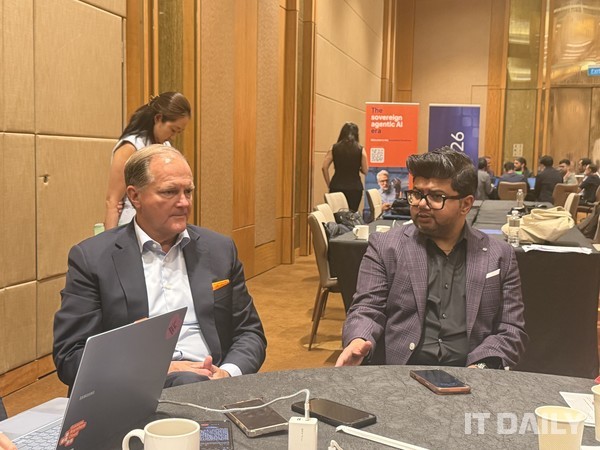
Cloudera CEO Charles Sandsbury and CBO and head of Applied AI Abbas Riki took questions from reporters at EVOLVE26. The photo was taken by reporter Yang Seung-gap.
The topic of the Q&A was cloud cost burdens and distribution across on-premises infrastructure, the cloud, and the edge. It was noted that enterprises’ approach to designing AI projects has changed over the past year.
Sandsbury said that in the past, many companies did not sufficiently consider where AI workloads would actually run when designing projects, and also failed to think enough about the cost structure at the production stage. He explained that the situation has changed as more companies have experienced unexpected costs after large-scale deployment, and as those cost experiences have spread.
As a result, companies have begun dividing operating environments by workload type. He said workloads that run continuously and have predictable computing demand are being placed on their own infrastructure, short-term and experimental workloads and those with large demand fluctuations are being placed in the public cloud, and latency-sensitive workloads are being placed at the edge.
Sandsbury cited banks’ abnormal transaction detection as a representative example, saying that if a cost-heavy workload is run in the public cloud, costs can rise to 4 to 5 times those of in-house hardware. He explained that this is why there is a move to reassess the economics of the public cloud.
Sandsbury said the cloud remains important for many initiatives. At the same time, he added that in cost terms, many companies see the cloud not as a simple commodity but as a relatively expensive resource.
Cost is not the only factor in deciding where enterprise workloads should run. As regulations increasingly require data to be stored within specific countries or regions, data sovereignty is emerging as a key criterion for workload placement.
In line with this trend, the number of cloud providers targeting in-country data storage demand is rising in each region. Cloudera is working with some of these providers.
Sandsbury said interest in sovereign AI has increased significantly. He explained that this demand is particularly pronounced in Asia-Pacific and the Middle East and Europe.
With on-premises environments drawing renewed attention, expectations are growing for increased inference demand and greater data control in on-premises settings. Riki said that, according to several industry forecasts, the scale of inference running on-premises could more than double.
Riki said the ability to run inference under secure control of proprietary data will become even more important. He also outlined a direction for responding to these demands.
Sandsbury said Cloudera launched Anywhere Cloud to address this. Anywhere Cloud is designed to run data and AI services in a cloud-like way regardless of where they are deployed, including on-premises and sovereign infrastructure, while managing governance in a unified manner.
Sandsbury explained that Anywhere Cloud does not mean it is limited to the public cloud. He said the core idea is to provide a cloud-like user experience in any computing environment.
Cloudera invested about USD 1 billion over the past 3 years in the launch of this product, with more than USD 800 million allocated to research and development. Sandsbury said this was a large-scale launch that required substantial time, manpower, capital, and process investment.
Anywhere Cloud is not a replacement for Cloudera’s flagship product, Cloudera Data Platform (CDP), and Sandsbury said the company will continue investing in CDP. Additional CDP 7 versions are planned for release in the future, and CDP 8 products are also planned. Sandsbury described Anywhere Cloud as a data platform tailored for hybrid environments. Accordingly, Cloudera plans to develop Anywhere Cloud and CDP in parallel, and views the platform as a foundation for layering on functions rather than as a standalone product.
Cloudera is pursuing a marketplace strategy to attract partners. Riki said the publicly disclosed content is still at an early feature level, and explained that as use expands among practical users and developer communities, feedback is expected to play an important role in determining the direction of future roadmaps.
Riki said it will take time for enterprise AI to settle into actual production operations. Still, he said the scale of results for companies that move beyond the transition to production is large.
In some use cases, Riki said, AI can deliver exponential improvement rather than just gradual productivity gains. He added that in certain industries, AI could create winner-take-all markets.
Sandsbury then identified the Asia-Pacific region, including Korea, as an area for increased investment. He said Cloudera has relatively strong market coverage in Australia and Singapore, and has identified additional opportunities in Korea, Thailand, and Malaysia. He also said the company is selectively increasing investment in Korea, Thailand, and Malaysia as needed.
Sandsbury said those markets include many large banks, insurers, and telecom companies. He added that these companies have data governance and AI-related challenges that the platform aims to address. He said Asia-Pacific remains an important growth region.
The photo shows Abbas Riki, Cloudera’s CBO and head of Applied AI. It was taken by reporter Yang Seung-gap.
In a one-on-one Q&A with Cloudera CEO Charles Sandsbury and CBO Abbas Riki, a question was raised about whether the shift to hybrid and private AI involves cost issues.
In response, Sandsbury said data security is becoming more important and data sovereignty is also growing in importance. He also said that private AI in North America and sovereign AI in other regions are based on similar core concepts.
Sandsbury said companies strongly want to retain control over their own data and do not prefer moving all of it to the public cloud for AI model training and inference.
Asked about the criteria for distributing workloads between the cloud and on-premises environments, he said each workload has different economic and operational characteristics. He said workloads with steady and predictable demand, such as banks’ fraud detection and prevention, may be more economical to run on their own infrastructure.
He also explained that short-term operational workloads, experimental projects, and workloads with high demand volatility may be suitable for the public cloud, while latency-sensitive workloads are better suited to edge operations. He said the goal is to provide flexibility so customers can place each workload in the optimal computing environment.
Asked about the fastest-growing area within on-premises infrastructure amid the spread of enterprise AI, Riki said inference is likely to be one of the fastest-growing areas. He cited sovereign AI and private enterprise AI as drivers and important factors behind inference growth.
Riki predicted that more mature end-to-end solutions targeting these needs will enter the market over the next few months. He said the key principle is choice, explaining that customers should not be tied to a single infrastructure model and need to be able to decide autonomously where each workload runs.
Asked whether Anywhere Cloud changes the competitive landscape with Databricks, Snowflake, and hyperscalers, Sandsbury said there has not been any major change in the competitors themselves. He added that many companies are still trying to solve enterprise data management problems.
Sandsbury said, however, that the market environment is changing. He stated that AI’s growth base is the cloud, but that does not mean the final resting place for all AI workloads is the cloud. He stressed that customers do not need to choose between data control and a cloud-level user experience, and that they need cloud-platform-level capabilities and experiences while maintaining governance where the data resides.
The question at hand was whether companies are overestimating AI’s potential and underestimating the difficulty of moving it into operations. Sandsbury said companies are underestimating the complexity of turning AI into production more than they are overestimating AI itself. He said interest in and expectations for AI are higher than for any previous technology, but the key issue is not a lack of interest but implementation.
As evidence, Sandsbury pointed to the fact that enterprise data is spread across multiple systems and that those structures are also deeply intertwined. He said substantial preparatory work on the data side is needed before successful model training and the deployment of real AI applications. He said there has been too little discussion of this complexity.
Riki said that, separate from these difficulties, the potential revenue scale of AI could be very large. He added that some banks, payment providers, and telecom companies are already using AI, and some companies are developing applications that could fundamentally change customer-facing products and services.
Regarding local SI and partner reactions to the new platform, Riki said the response has been very positive overall. He explained that the new platform is being viewed by local SI and partners as a business opportunity to develop their own Cloudera-based applications and solutions.
Riki referred to a recent conversation with a partner in Australia. He said the environment in which the partner operates is highly regulated, including in the defense industry, and that due to specific customer requirements, major cloud-native data platforms and hyperscalers cannot be used.
Accordingly, the partner is considering not only using Cloudera technology but also developing higher-level solutions, and is also considering future OEM cooperation, Riki explained. He said the point is that data sovereignty and regulatory requirements are being translated into real business demand.
Asked about future new growth opportunities, Sandsbury identified large banks, government agencies, and the public sector as Cloudera’s traditional core customer groups, while noting that AI is creating new opportunities. He said interest is expanding into industries that did not previously see themselves as data- and AI-centric companies, citing natural resources, shipping, and other asset-intensive industries as examples. He explained that because these industries generate enormous amounts of data, using that data can greatly improve their operations with AI.
Riki said there are substantial growth opportunities within existing customers. He said a single large bank may contain 6 or 7 different purchasing decision-making organizations, and telecom companies also have multiple such organizations. He added that as AI makes it possible to create new use cases for each business unit and functional organization, the opportunity to enter a new division within an existing customer is effectively similar to a new business.
In line with this trend, Riki said the company will continue strengthening its core platform capabilities. He said the areas being strengthened are governance and the integrated data fabric, and that AI is a major investment area. He also cited frontier models, agentic AI, and agent observability as areas under review.
The company said acquisition is not its only strategy. It also said it plans to deepen technical integration with foundation model providers and expand strategic partnerships with companies across the AI ecosystem.
Sandsbury said the internal development roadmap for the next 12 months is already full, and that the company is taking a cautious stance toward additional large-scale acquisitions. He explained that another major acquisition could burden the organization and dilute focus. He added that the company will continue to review smaller opportunities to fill specific capability gaps, and emphasized the importance of both in-house development and partnerships.
Source: IT DAILY · Yang Seung-gap
Original: https://www.itdaily.kr/news/articleView.html?idxno=241144
References
This article was produced with the help of an automated content generation algorithm.
Source: IT DAILY
View originalThis article was summarized and organized by BizCrush based on the original article from IT DAILY. For exact quotations and full details, please refer to the original article.