Sizl Develops 'SIZL Agentic Brain' to Support Diagnosis and Improvement of Manufacturing Site Issues
TECHWORLD ·
✦ Resumen de IA
Sizl said it is developing a manufacturing-specific AI platform called 'SIZL Agentic Brain.'
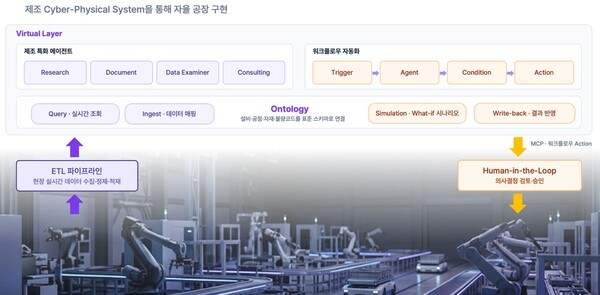
The platform uses ETL and ontology to collect and refine dispersed data from MES, ERP, PLC, and other systems, and structures the relationships among equipment, processes, products, and quality.
It also applies Supervisor, specialized Agents, Reviewer, Human-in-the-Loop, and a no-code workflow to support problem diagnosis and improvement measure generation, and started a PoC with Rebellion in June 2026.
BizCrushWant to follow Korean talks and live streams in real time?Try BizCrush Live
On manufacturing sites, production, equipment, and quality data are being collected using MES, ERP, and PLC systems. However, because manufacturing data are dispersed across multiple systems, integrated analysis and utilization are difficult. As a result, when problems arise, on-site personnel need to extract and analyze data directly, and in many cases, root-cause diagnosis and improvement measures also depend on the experience and judgment of the person in charge.
Sizl, a smart factory and manufacturing AI solutions company, said it is developing a manufacturing-specific AI platform called 'SIZL Agentic Brain' to address these existing limitations. The platform is being developed to integrate the various types of data generated on manufacturing sites.
Through 'SIZL Agentic Brain,' Sizl plans to support the connection of manufacturing site data and to assist with AI-based problem diagnosis and improvement tasks. 'SIZL Agentic Brain' also includes AI-based problem diagnosis functions and improvement recommendation functions.
The platform operates by using ETL and ontology as its core technologies to collect and refine dispersed data from individual systems such as MES, ERP, and PLC, then structure the relationships among equipment, processes, products, and quality. Through this, it enables AI to understand manufacturing site data, work flows, and situational context.
On this basis, the SIZL Agentic Brain architecture operates through the division of roles and collaboration among multiple specialized AI Agents. When a quality problem occurs, a quality analysis Agent analyzes the relevant data, identifies the main causes of defects, and presents improvement directions based on manufacturing innovation methodologies such as DMAIC.
The platform can derive improvement measures not only for quality problems but also for bottlenecks in production processes, and it can also derive improvement measures for equipment operation issues. In these cases, manufacturing methodologies such as Lean, TPM/OEE, and TOC are applied to the improvement measures.
The platform is composed of a Supervisor, specialized Agents by field, and a Reviewer, with the Supervisor overseeing operations and the Reviewer examining the analysis results. Its operating structure is not one in which a single AI model performs everything at once; instead, it includes role sharing among Agents and result review. Through this structure, it can analyze complex manufacturing-site problems step by step and support result validation and evidence tracing.
The platform incorporates a Human-in-the-Loop framework. This is intended to preserve the operator's control authority in site operations, and it excludes any approach that automatically executes AI-generated results without review. Instead, it requires review and approval procedures by the person in charge according to the nature of the task and their authority, thereby securing operational reliability and controllability.
It also provides a no-code workflow, allowing site personnel to configure work flows without coding. The system uses a drag-and-drop approach to place 18 types of nodes, including trigger, agent, conditional branching, and action, and connects multiple agents and tools into a single automated process. In this process, users can take advantage of automatic pre-execution verification, AI-based error correction, and execution history tracking, with the goal of reducing repetitive work.
Sizl said that AI transformation in manufacturing is incomplete if it stops at data collection and visualization, and that achieving it requires understanding site data as well as diagnosing the causes of problems and linking those diagnoses to actual improvements.
In line with this, Sizl said it began a proof of concept with Rebellion in June 2026 and is verifying the operating stability and technical completeness of SIZL Agentic Brain. Sizl plans to secure system stability based on the verification results and aims to pursue commercialization as soon as possible. It also plans to pursue market expansion as a manufacturing-specific Agentic AI platform, and the platform supports the use of manufacturing site data, problem solving, and work improvement.
Source: TECHWORLD · Kim Gyeong-ju
Original: https://www.epnc.co.kr/news/articleView.html?idxno=409403
References
This article was produced with the help of an automated content generation algorithm.
Source: TECHWORLD
Ver originalThis article was summarized and organized by BizCrush based on the original article from TECHWORLD. For exact quotations and full details, please refer to the original article.
Keep reading
BizCrush