EDB Acquires Altinity, Accelerates Push Into AI Data Market
TECHWORLD ·
✦ Resumen de IA
EDB said on the 6th that it had announced the acquisition of Altinity and was pushing ahead with strengthening its competitiveness in the AI data platform market.
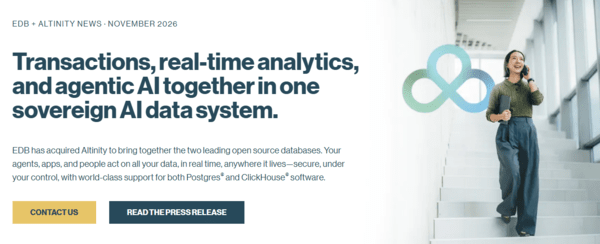
Altinity is a solution provider based on ClickHouse software, and EDB aims to combine the strengths of Postgres and ClickHouse.
EDB said the acquisition will enable integrated support for transaction processing, real-time analytics, and AI agent workloads, and that it plans to launch enterprise ClickHouse integration features in the fourth quarter.
BizCrushWant to follow Korean talks and live streams in real time?Try BizCrush Live
EDB announced on the 6th that it had acquired Altinity and said it would push ahead with strengthening its competitiveness in the AI data platform market. Through the acquisition, EDB said it was aiming to strengthen its response to the AI data market.
At the center of the acquisition is a plan to combine existing database technology with large-scale real-time analytics capabilities. EDB said it aims to reduce enterprises' data management burdens and also support AI agent operations.
Altinity is a company that provides solutions based on ClickHouse software and has specialized in ClickHouse since it was founded in 2017. Altinity has provided enterprise software, managed services, and technical support based on ClickHouse software.
EDB said the acquisition would strengthen the capabilities of EDB Postgres AI (EDB Postgres AI, PG AI). EDB Postgres AI (PG AI) is the industry's first open sovereign AI data system, and EDB seeks to combine the transaction-processing strengths of the open-source database engine Postgres and the real-time analytics strengths of ClickHouse.
With the acquisition, the company aims to reduce data management costs across enterprises and bring together transaction processing and analytics, which had been separated in enterprise data operations, into a single system. Through this, it will provide integrated support for transaction processing, real-time analytics, and Agentic AI workloads.
In traditional enterprise data environments, many companies have run separate systems for transaction processing and analytics in parallel. In such environments, data movement costs have arisen, along with costs and management burdens tied to system integration.
EDB said the acquisition would allow it to address latency issues stemming from distributed data architectures, and that it could also solve cost issues and Vendor Lock-in problems. It also plans to reduce existing constraints and advance an integrated sovereign data system for autonomous AI agents.
Kevin Dallas, CEO of EDB, said AI agents require real-time persistent reasoning based on two open-source engines, not legacy systems or distributed architectures. He also said combining the two engines into a single Multi-model Data Layer could significantly reduce customer costs.
Devin Pratt, research director at IDC, said EDB's acquisition of Altinity integrates transaction processing and real-time analytics capabilities into the portfolio of a single company, reflecting the market's convergence trend. He said the competitiveness of a multi-model platform depends on whether it can preserve the strengths of specialized engines while linking them efficiently and reducing customers' integration burdens and costs.
EDB said that after the acquisition, Altinity engineers are scheduled to join the existing Postgres development organization. It also said it plans to expand technology development and operational support capabilities, continue contributing to the Postgres and ClickHouse communities, and pursue an integrated product roadmap.
As part of the integrated roadmap, the two companies plan to introduce a shared Apache Iceberg catalog and roll out consistent access control across Postgres and ClickHouse software. They also said they will pursue links between transaction workloads, real-time analytics, and an open lakehouse architecture, while minimizing data movement and integration work so that customers can make use of operational data and Data Lake.
EDB plans to release enterprise ClickHouse integration features in the fourth quarter, with the delivery model divided into four configuration modes. Mode 1 is BYOC (Bring-Your-Own-Cloud), in which the system operates in a cloud environment owned and managed by the customer. Mode 2 is Developer Cloud, which provides a cloud environment for development and testing. Mode 3 is a customer-managed Kubernetes- or OpenShift-based self-hosted/on-premises model. Mode 4 is a physical Far Edge model that runs on local hardware in an air-gapped environment completely isolated from external networks.
EDB is pursuing support for maintaining enterprise data and operational control. To that end, it will directly control from the data layer the data access and task-execution permissions of AI agents, and it will also secure an Audit Trail of all activities. It also plans to support customers so they can shut down the system themselves if needed.
Source: TECHWORLD · Kim Hye-jin
Original: https://www.epnc.co.kr/news/articleView.html?idxno=409408
References
This article was produced with the help of an automated content generation algorithm.
Source: TECHWORLD
Ver originalThis article was summarized and organized by BizCrush based on the original article from TECHWORLD. For exact quotations and full details, please refer to the original article.
Keep reading
BizCrush