Government-Funded Research Institutes Unite Around Open Source...Driving R&D Innovation in the AI Era
TECHWORLD ·
✦ Resumen de IA
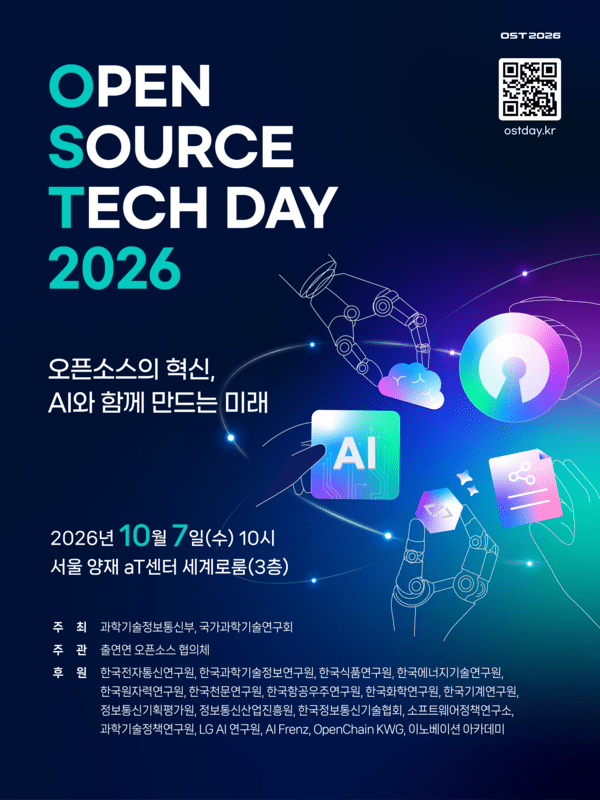
The Ministry of Science and ICT and NST will co-host the "OST 2026 Open Source Tech Day" on the 7th.
The event theme is "Open Source Innovation, Building the Future with AI," and it will share R&D innovation and changes in the technology ecosystem driven by the combination of AI and open source.
Nine government-funded research institutes, along with government and related organizations, industry, and communities, will participate and exchange experience in AI and open source-related technology, policy, law, and industry practice.
The Ministry of Science and ICT and NST will co-host the government-funded research institute open source event, the "OST 2026 Open Source Tech Day," on the 7th. The event will bring together government-funded research institutes, with participation from industry, academia, public institutions, and developer communities.
The event theme is "Open Source Innovation, Building the Future with AI." It will explore directions for open source technology and R&D innovation in the AI era and share changes in R&D innovation and the technology ecosystem driven by the combination of AI and open source.
ETRI said the event will serve as a venue where stakeholders from multiple fields, centered on government-funded research institutes, gather to discuss the changes that the combination of AI and open source will bring to R&D and the technology ecosystem. It also said the event was organized to expand cooperation among government-funded research institutes, industry, academia, public institutions, and developer communities based on the sharing of such changes.
Nine government-funded research institutes will participate. They are ETRI, the Korea Institute of Science and Technology Information (KISTI), the Korea Institute of Energy Research (KIER), the Korea Atomic Energy Research Institute (KAERI), the Korea Astronomy and Space Science Institute (KASI), the Korea Aerospace Research Institute (KARI), the Korea Research Institute of Chemical Technology (KRICT), the Korea Institute of Machinery and Materials (KIMM), and the Korea Food Research Institute (KFRI).
The event will also include government and related organizations such as the Institute for Information & Communications Technology Planning & Evaluation (IITP), the National IT Industry Promotion Agency (NIPA), the Telecommunications Technology Association (TTA), and the Software Policy & Research Institute (SPRi), along with industry and community participants such as LG AI Research and AI Frenz (Frenz). Through this, it will provide a forum for exchange connecting R&D sites, industry, policy, and the developer ecosystem.
ETRI emphasized that, against the backdrop of rapid advances in AI technology, this year's event will highlight the role of open source. It said the focus is on treating the role of open source not merely as a matter of releasing and sharing software, but as a core foundation that determines AI technological innovation, industrial competitiveness, and technological sovereignty.
Against this backdrop, the keynote address will be delivered by Mazine Gilbert, director at the Agentic AI Foundation. The Agentic AI Foundation is promoting the establishment of open standards and an ecosystem in the field of agentic AI, and Gilbert will present the transition from AI to agentic AI and the significance of open standards in that process under the theme "From AI to Agentic AI: The Role of Open Standards."
LG AI Research Executive Director Lee Hwa-young is scheduled to give a presentation on the hidden legal risks of AI training data. The presentation will cover copyright issues and legal questions involved in the use of AI training data, as well as points that companies and research institutions need to consider.
The afternoon session will proceed in three tracks, with a total of 18 specialized presentations. Major topics include open source-based domain-specific AI research, AI safety and reliability, sovereign agentic AI stacks, China's AI industry and open source ecosystem, open source and intellectual property in the AI era, copyright and lifecycle management of open data, embedded AIoT operating systems spanning RISC-V and ARM, AX transitions at research institutes, open infrastructure and digital sovereignty, and the evolution and future of the Model Context Protocol (MCP).
ETRI Senior Researcher Park Chan-sung is also scheduled to present. His presentation topic is accelerating domain-specific AI research through open source.
Head of the Network AI Computing Lab Ahn Sin-young will also present. Ahn will introduce OpenVela, a next-generation embedded AIoT OS spanning RISC-V to ARM.
The event brought together domestic and international companies, research institutes, universities, and private-sector experts, including Vincent Caldeira, CTO of Red Hat APAC; Igalia, a global company based in Spain; LG AI Research; the NST National Science AI Research Center; KISTI; KASI; KIMM; the Korea Financial Security Institute; universities; and private companies. They shared experience and know-how in AI and open source-related technology, policy, law, and industry practice.
Kim Ik-kyun, head of the government-funded research institute open source council at ETRI and director of the Information Strategy Department, explained that the role of open source is expanding beyond the disclosure of research results to become a core foundation for connecting knowledge and technology among research institutes and improving the speed and usability of AI R&D. He added that he hopes the sharing of each institute's experience and achievements will expand cooperation to industry and developer communities, serving as a catalyst for strengthening the domestic open source R&D ecosystem.
Park Se-wung, president of ETRI, said that in the AI era, technological innovation cannot be achieved by a single institution or company alone. He presented openness, sharing, and cooperation as the alternative conditions, and said that under this recognition, open source is no longer merely a choice for individual researchers or institutions, but a shared research culture among government-funded research institutes and an important foundation for R&D innovation. He also said he expects this event to help the government-funded research institute open source council connect Korea's research community, industry, and developer communities, and establish itself as a hub leading the country's open source ecosystem.
Source: TECHWORLD · Lee Gwang-jae
Original: https://www.epnc.co.kr/news/articleView.html?idxno=407791
References
This article was produced with the help of an automated content generation algorithm.
Source: TECHWORLD
Ver originalThis article was summarized and organized by BizCrush based on the original article from TECHWORLD. For exact quotations and full details, please refer to the original article.