Microchip and Navitas Develop 800V Power Solution for AI Data Centers
TECHWORLD ·
✦ Resumen de IA
Microchip Technology and Navitas Semiconductor announced that they have jointly developed an 800V DC-to-6V DC reference design for AI data center rack power applications.
The platform consists of Microchip's dsPIC33AK digital signal controller, TA100 CryptoAuthentication security IC, and Navitas's GaNFast FET.
The two companies are providing reference hardware, software, and design documents to reduce development risk and shorten the time required to develop 800V DC-based power systems.
As power demand from AI data centers rises and power density increases, the shift to 800V DC-based rack power architectures is gaining momentum. In line with this trend, Microchip Technology and Navitas Semiconductor have jointly developed a reference design to support the development of high-voltage rack power systems and have begun targeting the next-generation AI data center power infrastructure market.
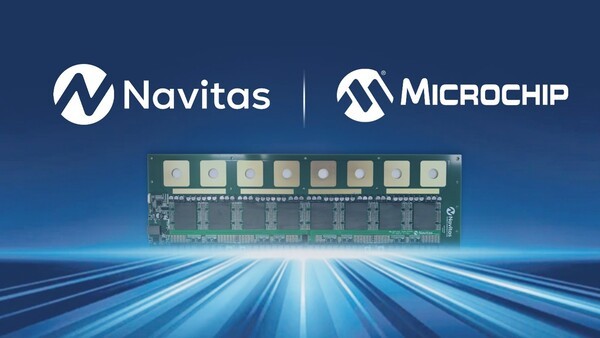
On the 6th, Microchip Technology announced that it had jointly developed an 800V DC-to-6V DC reference design for AI data center rack power applications with Navitas Semiconductor. The platform combines Microchip's digital power control and hardware security technologies with Navitas's GaNFast gallium nitride (GaN) power devices. The two companies are providing reference hardware, software, and design documents to reduce development risk and shorten the time required to develop 800V DC-based power systems.
The solution is based on the OCP(Open Compute Project) 800V DC rack power architecture. It is intended to support the implementation of high-efficiency power conversion systems.
The reference platform features a control, security, and power conversion device combination built around Microchip's dsPIC33AK digital signal controller(DSC), TA100 CryptoAuthentication security IC, and Navitas GaNFast FET.
The dsPIC33AK handles digital power control for high-frequency, high-efficiency DC/DC conversion and also supports cryptographic functions. The dsPIC33AK256MPS306 family includes a 200MHz 32-bit core, a floating-point unit(FPU) with double-precision support, 78ps high-resolution PWM, and multiple 12-bit ADCs operating at up to 40MSPS.
The dsPIC33AK also supports the CNSA(Commercial National Security Algorithm) Suite 2.0 recommended post-quantum cryptography algorithm library and hardware-accelerated encryption. This gives the platform a configuration in which the dsPIC33AK is responsible for DC/DC conversion control and cryptographic functions.
Navitas's GaNFast FET is responsible for enabling high-efficiency, high-power-density power conversion. Sixteen 650V·17mΩ NV6034 GaNFast FETs are deployed on the PDB primary side, and the NV6034 is configured in a stacked half-bridge topology.
The platform uses a DFN8×8 dual-sided cooling package to lower thermal resistance and is designed to support efficient operation under high continuous output conditions. For performance targets, the PDB aims for a 1MHz switching frequency and up to 96% peak efficiency at full load, while the PDB design target is a power density of 2,100W/in³.
In particular, the platform adopts a direct 800V DC-to-6V DC conversion structure. Unlike the existing two-stage conversion path of 800V DC-to-50V DC followed by 50V DC-to-6V DC, it integrates the two stages into a single converter to reduce power conversion losses and improve overall system efficiency.
At the same time, to match the growing connectivity of AI data center power systems, security functions have also been integrated into the platform. It is equipped with Microchip's TA100 CryptoAuthentication IC, which provides a hardware-based root of trust for system authentication and protection. As a result, developers can apply system authentication and firmware protection without implementing security functions from scratch.
The TA100 supports code authentication, including secure boot, MAC(Message Authentication Code) generation, trusted firmware updates, and multi-key management protocols including TLS(Transport Layer Security).
Joe Thomsen, vice president of Microchip's Digital Signal Controller business unit, said that a major power architecture shift is under way in the data center industry as AI infrastructure is optimized. He explained that, as the ecosystem moves to high-voltage rack power systems, developers need proven control and security technologies to reduce implementation risk.
Joe Thomsen added that Microchip is collaborating with Navitas. He said the goal is to combine digital control, hardware-based security, and advanced GaN power conversion to help customers accelerate the launch of 800V rack power systems.
Vipin Bothra, vice president of global solution marketing at Navitas Semiconductor, said Navitas's GaNFast technology plays a role in increasing power density and efficiency to support the expansion of AI infrastructure and high-performance computing platforms. He also said the technology is a key factor in improving system performance.
Vice President Bothra said the collaboration was pursued by combining Navitas's power semiconductor leadership with Microchip's digital control expertise, and that this could accelerate the launch of advanced power solutions for next-generation AI data centers that fit changing requirements.
In response, Microchip and Navitas unveiled a reference design with an ultra-thin structure designed for close integration with GPU boards, saying it improves transient response performance and power distribution efficiency. The two companies are also providing reference boards, software, and related design documents to support developers in evaluating 800V DC-based AI data center power conversion systems and linking that evaluation to real-world system buildout.
Source: TECHWORLD · Park Gyu-chan
Original: https://www.epnc.co.kr/news/articleView.html?idxno=407793
References
This article was produced with the help of an automated content generation algorithm.
Source: TECHWORLD
Ver originalThis article was summarized and organized by BizCrush based on the original article from TECHWORLD. For exact quotations and full details, please refer to the original article.