SKT Develops
TECHWORLD ·
✦ Resumen de IA
SK Telecom announced on the 6th that it has developed a “UX Writing Guide” to make digital communication with customers easier ahead of Hangul Day.
The guide includes principles for using easy Korean, considering customer emotions, and using emojis, and it is set to be applied in the field.
SKT plans to support copy review with its self-developed AI agent “Soongongi” and apply it across all customer touchpoints.
SK Telecom announced on the 6th that it has developed a “UX Writing Guide” to make digital communication with customers easier ahead of Hangul Day. The guide was created to reflect the spirit of Hangul’s creation in digital language for customer communication. The company said it reflected its view that the spirit of Hangul’s creation lies in enabling anyone to learn it easily and use it comfortably.
The guide focuses on helping customers easily understand the phrases they encounter while using mobile services. It also aims to help their next action unfold naturally. The guide incorporates easy Korean expressions for customers and also takes into account the emotions they may feel during the service use process. SK Telecom plans to apply the guide in its business operations.
The guide was developed by SKT’s Customer Language Research Team. During development, customer and employee surveys were conducted, and advice from language experts was also reflected. The process brought together the experiences of customers using the service, the orientation of the employees building the service, and the perspectives of language experts. SKT said the guide reflects the viewpoints of customers, employees, and experts alike.
This guide focuses on carefully considering even the emotions customers feel while using services. To that end, it introduced a “customer emotion map” based on expert advice.
The “customer emotion map” is designed to provide a single-glance view of the service journey and emotional flow. The guide identifies emotions such as expectation, anxiety, confusion, suspicion, and satisfaction as factors to consider, and it recommends using phrases suited to those emotions.
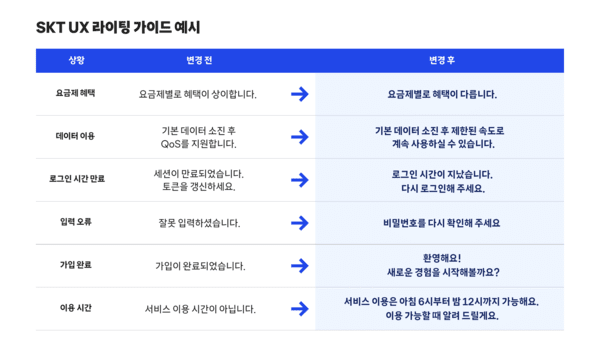
SKT presented 4 principles for closer communication with customers. The 4 items are “easy,” “helpful,” “trustworthy,” and “empathetic.”
In particular, for easy and smooth communication, it recommended using everyday expressions rather than difficult Chinese characters or foreign words. Accordingly, it included examples such as changing “Benefits vary by plan” to “Benefits differ by plan” and “The session has expired” to “Your login time has passed.”
The guide takes into account changes in Korean usage over time and also includes expression standards that fit current social sensitivity. Accordingly, it identified expressions that could generalize or exclude specific groups as items for revision, offering examples such as changing “a son who repays parents’ kindness” to “popular product” and “parental consent” to “guardian consent.”
SKT prepared an emoji guide aimed at conveying emotions and friendliness that are difficult to express in words alone. It also noted that emojis should not replace text, in order to ensure all customers can understand the information.
It also provided cautions on emoji use, including avoiding emojis that specify skin color or gender. The company set out usage principles that supplement emotion and friendliness without undermining accessibility and comprehension.
In addition, SKT introduced its in-house AI agent, “Soongongi.” To reduce the burden on employees of searching through the extensive guide one item at a time, it said “Soongongi” would help review phrases in real time.
“Soongongi” has functions that support revision and supplementation. Its training data includes 23 internal communication guides, including the UX Writing Guide, and more than 50,000 pieces of language review data.
All SKT employees can use “Soongongi.” Its purpose is to review customer-facing copy and suggest better expressions, and its scope covers all touchpoints where customers encounter SKT, including banners, product and event pages, and notices.
Lee Hye-yeon, head of SKT’s Customer Value Innovation Office, said that a single line used in a service is effectively the message SK Telecom sends to customers. She added that the company unveiled the guide on the occasion of Hangul Day and would use “Soongongi” to drive changes in customer experience with empathetic language that first considers customers’ feelings.
Source: TECHWORLD · Lee Gwang-jae
Original: https://www.epnc.co.kr/news/articleView.html?idxno=407783
References
This article was produced with the help of an automated content generation algorithm.
Source: TECHWORLD
Ver originalThis article was summarized and organized by BizCrush based on the original article from TECHWORLD. For exact quotations and full details, please refer to the original article.